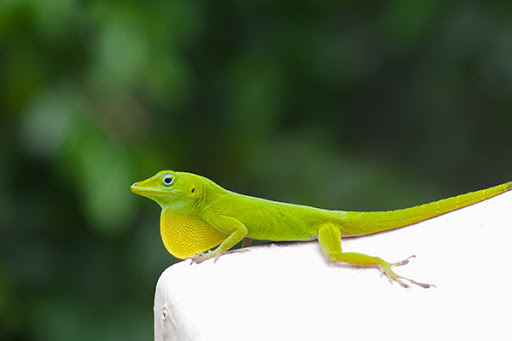
Behavioural flexibility and problem solving in a tropical lizard- Leal & Powell
- Abstract: When behavioural flexibility is observed in studies, most of them observe mammals and birds, because theory states that this characteristic is prominent in clades that exploit a diverse food source of a large range of habitats, and/or have intricate social connections. A series of cognitive experiments were used to test flexibility, which included learning a new motor task via multiple strategies, reversal learning as well as rapid associative. The lizards were capable of these tasks, thus provided evidence of being relatively similar to mammals and birds in terms of cognitive function.
- Materials and Methods: species- Anolis evermanni, arboreal lizards. n=6; 3 female and 3 male. The experiment was conducted in home enclosure (good idea to eliminate the need of habituation to an arena, and minimizes stress on the subject thus providing cleaner results) and they were habituated to the testing apparatus which was two wells with coloured lids. During habituation of the apparatus they left the lid half covering or beside the well but never covered it, and then during testing they secured the lid on and thus it becomes a novel motor task with an instilled response. 2. the second experiment was discrimination, they placed two lids on to see if they could discriminate visually and placed larva scent followed by actual larvae to see if the choice was still present. 3. Reversal learning was done by reversing the previous response by rewarding the other well type.
- Results: 4/6 lizards completed the novel problem using 2 different methods. All four of those lizards also discriminated between the rings and 3/4 of them did it with no mistakes. 2/4 of the lizards exhibited reversal learning.
- Discussion: the results show that these lizards are quite similar to mammals and birds even though they do not reside in complex social structures or exploit a wide range of food sources that requires multiple strategies to attain. Thus other life history traits may be the result of higher cognitive function. The lizards used strategies to remove the disc that would not be used in their natural environments, showing the ability to adapt and improvise new solutions to problems. Furthermore the fact they were able to discriminate with minimal mistakes shows that they can rapidly associate a reward to a non-ecologically relevant stimulus. The lizards also learned these associations far quicker than birds would, with 3 times less presentations for the same response. Since 2/6 of the lizards were capable of reversal learning it shows they are capable of high levels of discrimination, but it also points out that not all cognitive modules would be effective to address all the individuals of a study even if they are of the same species.
- Conclusion: in summary these lizards are comparable to mammals and birds in cognition. It is possible that because these lizards are found in a wide range of niche habitats with complex behavioural repertoires, this could have been the factor to allow for this level of behavioural flexibility. However, on the other hand it is possible that the behavioural flexibility allowed the radiation into multiple intricate niches, the whole chicken and the egg sitch.
 Al3xandria