A basal ganglia circuit for evaluating action outcomes – Stephenson Jones et al. 2016
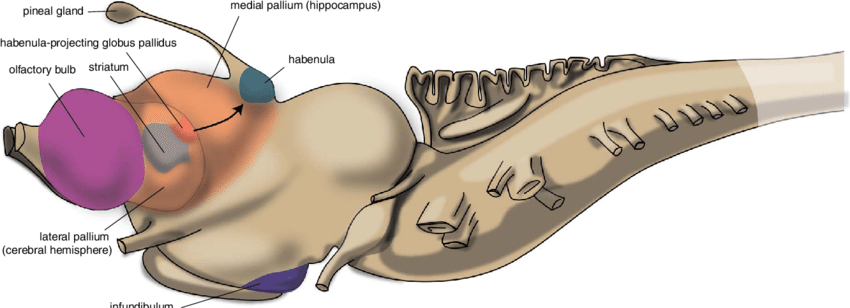
- basal ganglia, made up of subcortical nuceli, crucial in decision making and evaluating outcomes. How nuclei contribute to outcome evaluation is unclear. This paper showes evidence that the habenula-projecting globus pallius (GPh) is essential for understanding repercussions of actions and are regulated by inputs from the basal ganglia. ~The GPh has a natural tendency to lean towards caution, thus think of it as working more when caution is needed and less when positive events have occurred, gonna save you a headache later. ~Found that GPh neurons encode for both whether an action will produce a better or worse outcome and is manipulatable by optogenic (optogenic means using light to control genetically modified neurons that are sensitive to light and in turn activate gated ion channels) inhibition or excitation. Using rabies virus assisted monosynaptic tracing they found that GPh neurons are found in a certain circuit within the basal ganglia where it receives inhibitory input from striosomal and the striatum while excitatory input comes from the limbic regions of the subthalamic nucelus.
- this is cool because they are starting to map out the chemical pathway of decision making, basically which parts of the brain are responsible for providing a certain feeling about an outcome that is based on personal experience. For example a mouse that happens upon a cheese in a rat trap may get a mix of input from both sources if there was no prior experience with the contraption. However, if the mouse decided to risk it by taking the cheese and was punished by said action then an increase in GPh activity would be seen which would excite the Limbic regions of the subthalamic nucleus into inhibiting dopamine neurons and thus discouraging future actions that resemble this event. However, if the rat took the cheese from the rat trap and the trap didnt go off, then the rat would have a positive interaction thus lowering caution towards similar scenarios. this means that the GPh activity would decrease which would decrease the excitatory drive to inhibit dopamaine in turn releasing more dopamine to reinforce said actions. honestly how cool is that
- I wonder if the GPh area of the basal ganglia ultimately decides how much an organism would err to caution. I mean its common knowledge that environmental enrichment encourages the use of natural behaviours and encourages bravery in a sense by the normalization of novel stimuli, does this mean that the GPh activity in enriched individuals is considerably less because of less inhibition of dopamine and less bad experiences with stimuli.
- The study also showed that the GPh system is affected by habituation, when certain expected outcomes were omitted or skipped, then the neurons would still behave in the expected fashion but just at a lower rate, almost as if recalculating for this new information. For example when punishment was skipped for a known punishment action then GPh neurons fired less thus decreasing the inhibition of dopamine, while when reward was skipped in a reward known scenario then GPh neurons fired relatively more thus exciting the inhibition of dopamine.
 Al3xandria