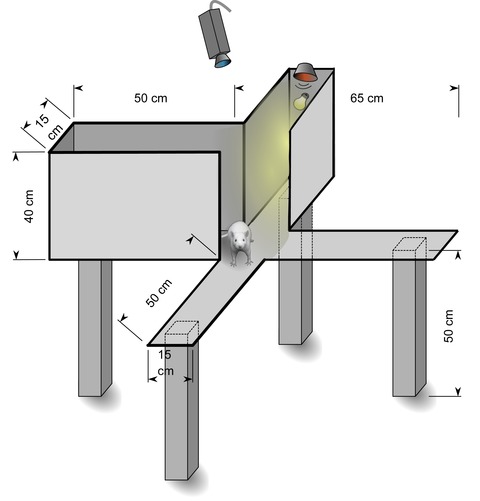
Free versus forced exposure to an elevated plus-maze: evidence for new behavioral interpretations during test and retest– Roy et al. 2009
- Abstract: elevated plus mazes are built upon approach/avoidance behaviour when exposed to “safe” closed arms and “aversive” open arms, using this you can assess anxiety. Objectives: they wanted to compare standard forced exposure of the maze on the rats compared to the behaviour of rats allowed free exploration, they also then dosed the rats with chlordiazepoxide. Results: Found that open arm avoidance was a natural tendency, and that some open arm entries could be viewed as attempts to avoid the whole situation by finding an exit rather than low level of anxiety. One trial tolerance effect was partially reduced in free-exploration situations.
- Introduction: Elevated plus maze is a standard anxiety test pharmacologically validated for rats and mice. Anxiety Parameters: number of open arm entries, open arm time, associated ratios. Locomotion parameters: closed arm entries and total arm entries. Main Problem: trying to parse the difference between a learned response for aversion or an unconditioned response for it.
- Methodology:
- Experiment 1: Forced exposure rats were put in the centre of the maze facing an open arm, free-exploration rats were allowed to enter the maze through a closed arm from their habituation cages through a small door. Duration was 5min within the maze for both treatments. Both treatments were re-exposed to the maze after 24hrs with the same treatment.
- Experiment 2: The forced rats were now placed at the end of a closed arm for better comparison, and the free exploration rats were given CDZ which is a known anti-anxiety compound to see if there is a change in behaviour during the second trial.
- Experiment 3: Trial 2 follow up after 24hrs of experiment 2 with the addition of CDZ for rats that had saline solution and exposed to either exploration or force-exposure.
- Results:
- Experiment 1: Open arm entries (freely exploring rats entered less open arms than forced rats in trial 1, in trial 2 this effect was abolished since open arm entries were severely reduced in the forced rats. No effect on locomotion, however all rats moved less on the second trial than the first. A significant effect of treatment was observed for closed arm exploration, freely exposed rats did this more often and did it more often in trial 1 compared to trial 2.
- Experiment 2: Forcibly exposed animals spent more time in open arms, and CDZ doses increased open arm time in the free exploration rats, similar results were found for the number of open arm entries. Freely exploring rats spent more time in closed arms but after the addition of CDZ there was a significant reduction in this time in the highest dose group of 5.0mg/kg.
- Experiment 3: The difference in time spent in open arm between trial 2 to 1 was significantly higher for free exploring rats and those dosed with high conc of CDZ. Rats free exploring dosed with CDZ had more open arm entries than those with saline solution or force exposure in combination with CDZ.
- Discussion: Shown evidence that open arm avoidance is an unconditioned tendency rather than learned since even the freely exploring rats tended to avoid the open arms. Also showed evidence of forced rats exploring open arms more frequently than free exploration rats which shows that the method of forcing rats may cause this behaviour. Forcing rats into exploration rather than freedom for exploration causes a disparity in behavioural choices, forcing them may provide the need for escape to trump motivation stemming from curiosity, thus entering open arms isn’t because of less anxiety but rather more anxiety driving the need to explore and find an escape as quick as possible. This is further supported by ethological behaviours such as stretched positions and head scans.
- Discussion: One trial tolerance was found to occur for forced rats, CDZ showed effects in trial one for the forced rats but a second trial of rats that had not been dosed but were given the dose prior to the second trial showed no effect of the drug. However the free exploration rats did not show this when given the high dose of 5.0mg, but they do mention this could be a result of observing trait anxiety vs. state anxiety. Trait anxiety is observing anxiety of the individual while state anxiety reflects anxiety stemming from a specific situation with aversive stimuli.
- Discussion: Another hypothesis is that the one trial tolerance effect is because in trial 1 after exploration the rats understand the layout and the layout loses its novelty. Thus, the apparatus is separated into aversive and welcoming areas since novelty has now been reduced. This unbalances the approach/avoidance conflict in trial 2 thus reducing the anxiolytic drugs (anti anxiety drugs) to inefficiency since the second exposure to the apparatus has already eliminated the fear stemming from novelty.
 Al3xandria