The Language of Dendrites- Branco, 2011
- In 1943 McCulloch and Pitts found that neurons can be considered like an on/on switch with only a binary function to either fire action potentials or not. They fire these action potentials when a certain input sum is surpassed, therefore -this was cleverly written- if neurons had a language and synapses were letters, then only the number of letters would matter while the meaning of the word did not. For example, lets say it takes 6 synaptic inputs to fire an action potential, then based on the old ideology any 6 synaptic inputs would fire the action potential, basically any 6 letter word whether it was garden or danger should trigger the neuron to fire the action potential regardless of the message. But most neurons seem to be capable of more than this.
- Contrary to the old theory synapses are found on dendrites (protrusions from the cell body separating the input and action potential zone, basically like a bridge), and dendrites are capable of regulating and processing information themselves, which may aid neurons in being able to accomplish more than just binary actions.
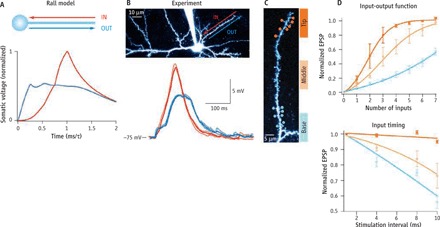
- Question 1. Can neurons tell the difference between garden and danger? Neurons are able to receive input temporally (in timed sequence), but testing this required a two-photon laser glutamate uncaging which allowed the precise synaptic activation required for the study. He selected an 8 to 10 synaptic region along a dendrite and then activated the sequentially in opposite directions and measured the voltage response at the soma (cell body) with a whole-cell patch clamp. The old theory had been correct in the sense that going in one direction provided more of a response than in the opposite direction, however this was eliminated when NMDA receptors were blocked.
- He ran other experiments where he found that distal parts of dendrites were able to amplify and pass on information forward, but proximal parts of the dendrite, -im assuming close to the soma?– impeded the input with small gains thus needed more input for summation or for the firing of an action potential. Since the neurons are being fed information that is modulated heavily by the dendrites prior to receiving the summation this might allow them to differentiate between garden and danger based off the temporal differences and impeded differences.
- Since it seems that dendrites are the ones modulating the information that the neurons are processing, and they can complicate the language even for a single neuron by probably administering input in a variety of manners, are synapses and dendrites the reason enriched individuals are faster at habituating to stimuli? does environmental enrichment boost the dendrite’s ability to regulate information? or maybe environmental enrichment increases the impedance when exposed to repeated innocuous stimuli thus increasing habituation since the neurons are not firing action potentials for that stimuli.
 Al3xandria