Brain size predicts problem-solving ability in mammalian carnivores (Comparative Cognition in zoo) – Benson-Amram et al. 2016
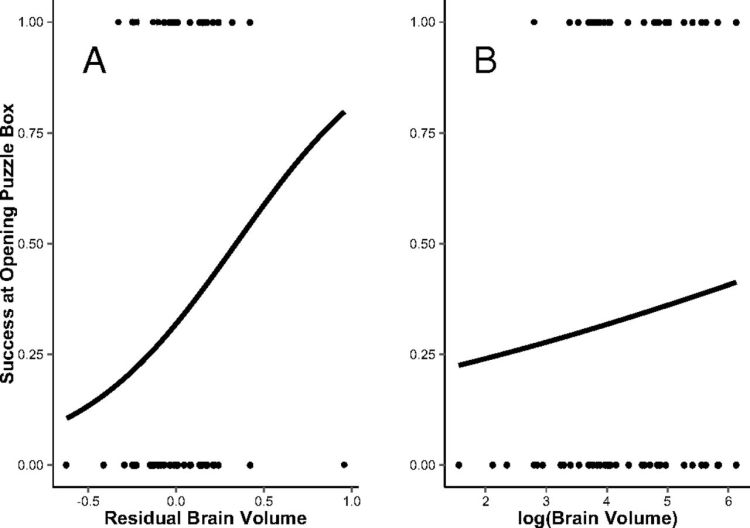
- Abstract: There is speculation over whether a larger brain size does indicate better cognitive abilities, tested this by giving puzzle boxes baited with food and scaled the stimuli according to the different carnivores. Found that animals with larger brain to body size ratio were better at the task, whats cool is that they found that the social brain hypothesis wasn’t a good enough predictor for cognitive ability, meaning animals that don’t engage in social interactions should not necessarily be ignored.
- Introduction: Brain tissue is energetically costly, but at larger sizes they are beneficial with enhanced cognition, and the size of the brain is indicative of certain things in certain species, for example larger brained bird species have been found to be better at building food caches and large brained guppies are better at numeracy. However no real experimental data on problem-solving, thus gave steel mesh puzzle boxes to different species and observed whether they could retrieve the reward.
- Methods: Used puzzle boxes of two sizes so that the animals had a reasonably sized apparatus. Observed a total of 39 species, and tested 1-9 individuals based on the species giving 140 subjects. They ran heavy statistics as well as brain modelling to tease apart the results. Built 12 different brain models based on the animals in question.
- Results: 49/140 individuals were able to open the box from 23 species. Ursidae (bears) were 69% successful, Procyonidae (Racoons and stuff) were 53% succcessful, Mustelidae (weasels and badgers) were 47% successful while mongoose were not at all. The subjects that were sucessful also learned over time and decreased the time spent on the puzzle with increasing number of trials. Also found that animals that came from large groups were no more successful at opening the puzzle box than individual species. Individuals with smaller body sizes were better at opening puzzle boxes than those with larger body sizes.
- Discussion: Found that animals with larger brain sizes were better at solving puzzles, and found that animals with social groups were no better at solving that solitary animals. now this is key because this causes a lot of stigma towards solitary animals that dont engage in social interactions that often, for example like reptiles. I really like this study because they didn’t bite off more than they could chew, and were able to clearly outline their results in a direct and easy to read manner. Obvi if youre looking at more species over more animal groups the methodology wouldnt exactly work.
 Al3xandria