Confronting the neglected problem of snake bite envenoming: The need for a global partnership – Gutierrez et al. 2006
- Most regions affected by snake bites are Africa, Asia, Oceania and Latin America.
- Global Burden of Snake Bite Envenoming: identifying the total number of snake bite cases is difficult especially in developing countries where reporting cases isn’t always the top priority. In Asia the highest mortality rate was 162 snakebite deaths/100,000 people per year and in a certain part of Africa it was 497/100,000. Most deaths and disabilities are because of lack of antivenom and poor healthcare.
- Species that cause high morbidity and mortality: Most severe cases are caused by elapidae (cobras, etc.) and viperidae (rattle snakes, etc.). The highest snakebite species in each area – 1. Northern Africa (saw-scaled viper) 2. Central and South America (lance headed pit vipers) 3. Asia (cobras and kraits)
- Clinical Features of Snakebite Envenoming: 1. Viperids = cause prominent local tissue damage, swelling, blistering, hemorrhaging and necrosis of skeletal muscle. 2. Elapids = which includes spitting cobras can cause the previously mentioned as well as local necrosis, neurotoxins that target neuromuscular junctions and cause paralysis which can also stop respiratory systems, rhabdomyolysis (causes death to muscle fibers and releases it into the blood stream which can cause renal failure), spontaneous haemorrhage (like a cerebral hemorrhage, disseminated intravascular coagulation.
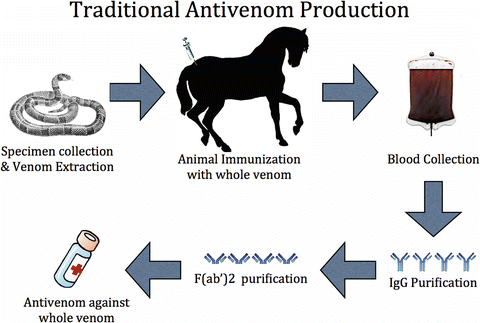
- Antivenoms and Ancillary Treatments in Envenoming: most antivenoms are created from horse and sheep, they are also mainly manufactured in 3 forms= consists of the whole IgG molecules, majority use F(ab’)2 fragments obtained by pepsin digestion of IgG, and some produce Fab fragments after papain digestion of IgG. The efficacy of antivenoms is also usually restricted to geographic region and biological spectrum because of the large diversity in snake venoms. A big problem is that snakebites are fast acting and usually it is too late for the antivenom to reverse certain amounts of damage like necrosis. Antivenom therapy also includes assisted ventilation, and different medication is given to combat the clinical features of envenoming.
- New treatments to reduce Local Tissue Damage: as stated previously the tissue damage is a big issue since the antivenom doesnt really reverse necrosis. They propose using inhibitors made my pharmaceutical labs that have already been created for mammalian enzymes, for example peptidomimetric hydroxamate metalloproteinase inhibitor known as batimastat is highly effective in preventing local tissue damage from the venom of a B.asper . Also most necrosis effects are a result of certain enzymes that are usually conserved in most snake venoms, so could maybe use the same drug to prevent local tissue damage in multiple bites.
- More Effective Antivenoms: Should try to explore other animal species to derive venom from for example like camels that a specific type of IgG chains. Also possibility of combining complete antibodies with nanobodies so that they can reach the tissue compartments quicker since nanobodies have a low molecular mass.

 Al3xandria