Behavioural Methods to Study Learning and Memory in Rats – Quillfeldt, 2006
- Phenomenological observations are observations that are based on phenomenon the subject displays and are then used to make conclusions about intrinsic mechanisms. Also called an indirect form of observation.
- Taxonomy of Memory Types: can be classified into many types:
- Function: working vs reference
- Content: Declarative/explicit vs Procedural/implicit
- Duration: short term vs long term
- Nature: Associative vs Non associative
- Motivation: reward vs aversive
1st Level: Declarative (explicit) vs. Procedural (implicit): declarative concerns with facts (semantics) or events (episodic) while procedural refers to motor or sensory abilities. Examples with people are remembering dates for declarative and riding a bicycle for procedural. Procedural information tends to last a long time, less vulnerable to emotional modulation and is difficult to erase. While declarative information can be either short or long term and requires a complex consolidation process from different enzymes. Also short term and long term memory are individual processes that occur simultaneously, short term is not the initial phase for long term memory.
2nd Level: Associative vs Non associative: behavioural tasks that promote associations between stimuli and responses are seen as associative, this leads to anticipatory behaviour drawn from previous experiences. The 2 main categories of declarative memory is classical pavlovian conditioning and Operant conditioning. Pavlovian conditioning is manipulated by the experimenter and the subject in question has no real choice in associating the stimuli, in Operant conditioning the environment is situated in order to permit a certain response that produces a result for example avoiding a pain stimulus, basically Pavlov vs Skinner. Skinner operant conditioning is a voluntary response while pavlovs was involuntary, getting a mouse to sit on a level to get food would be Skinner while ringing a bell to make dogs salivate after giving them food with the sound would be Pavlov since the dogs can’t control the salivating, its involuntary. Pavlov: Provide a CS a controlled stimulus to an UR uncontrolled response which is provoked by an unconditioned stimulus, over time you can create a conditioned response by only initiating the controlled stimulus without the unconditioned stimulus. - Memory Phases: Memory is formed through Acquisition where new information is gathered and also known as the learning phase, followed by Consolidation which is when the information gets physically stored, and finally recall where you get to see if the memory has been made. Long term for rats may be minimum 6hrs spanning to months, short term is a few hours after training and working memory would be just minutes after. Interfering via a pharmalogical treatment at certain points of memory making causes for varied consequences depending on when it is administered.
1. Pretraining: any drug administration done during this time may affect both acquisition and consolidation, or individually. If the training sessions are too short, it may not be enough to facilitate a recall.
2. Post training: Since acquisition has taken place, the drug can only affect consolidation.
3. Pre-Test: drug administration here only affects recall since both previous steps have been formed. - Control Groups: When testing drugs you need a control group that will be dosed with the same quantity of the drug vehicle (could be saline) with the same protocol.
- Separating memory from the rest: Depending on the treatment and the type of behavioural task used, an observed behavioural response has to be gauged correctly. For example in an avoidance task a good memory is seen as increasing latency to step down onto an electrified floor, and it can be seen as amnesiac if latency was decreased and as facilitator if latency increased. Given the flexibility in responses and the complexity with of comprehending cues, it is critical to use a battery of cognitive experiments to observe neurological states. Different experiments include:
1. Motor Performance: Open field test, rotarod test, pole climbing test
2. Anxiety: elevated plus maze, light-dark transition task, observing thigomataxis
3. Pain Sensitivity: Tail flick test
4. Sensory perception: Object discrimination test
5. Attention and Arousal: Discrimination/reaction tests - State Dependency: When the responses observed from a subject are a result of being in a certain neurochemical state of mind produced by hormones or a drug. When this occurs because of internal reasons it is called endogenous state dependency. For example training without a drug and then testing while on the drug should alter the responses observed, however if both are the same it could be because of state dependency.
- Observations of Memory:
1. Amnesia: memory reduction
2. Facilitation: memory improvement
3. No measureable effect - Responses:
1. Retrograde: acts upon recently formed memories
2. Anterograde: acts upon new memories still to be formed after the treatment
3. Ambigrade: when it acts in both directions - Types of Tests:
1. Open Field: This test is used to gauge motor control as well as general explorative tendencies. Test durations can range from 3min to 10min, prior to 3min its not enough time to acclimate properly to the arena and by 10min they could be stationary and bored. Mammal behaviours: rearing, grid squares crossed, defecation, grooming habits, time spent in quadrants, latency to leave initial marker.
2. Inhibitory avoidance: learns to inhibit a certain response to avoid receiving an aversive stimulus. Training usually means eliciting a single shock and then test sessions observe how long it takes for the subject to move down to the shock platform from the high rise. memory is seen as better when the latency to drop down increases between training and test trials. Amnesiac means to forget, faciliatory means they remember. - Contextual fear conditioning: The subject learns that a certain environmental stimulus is aversive, with no means to escape a defense behaviour is triggered making this an example of classical pavlovian conditioning. This can be tested by placing subjects into 2 boxes, the first has an electrified floor that shocks after an acclimation period, and the second differs from the second in all properties which includes size, flooring and colouring of walls. These subjects are then tested again 24hr after the shock session, by randomly assigning them to one of the 2 boxes and measuring frequency of “freezing” in both environments.
- Two-way active avoidance: the subject learns that a random stimulus, say a sound or a cue card is a predictor for an aversive stimuli and can encourage the subject to escape the stimuli by moving to the other side of the box. Since there is possibility for escape this is an example of operant conditioning because the animal has to learn a response to evade the predicted aversive event while in pavlovian responses the subject has no real choice in learning. This test is run by making a box with a floor split in 2, both halves can emit a shock and the subjects are trained with a tone to move to the other side through exposure. It is deemed as two-way active because the direction should not matter, as long as the subject knows to move into the other half. It starts off with free exploration and then the tones and shocks occur consecutively at random to ensure the connection made is between the tone and the evasive maneuver.
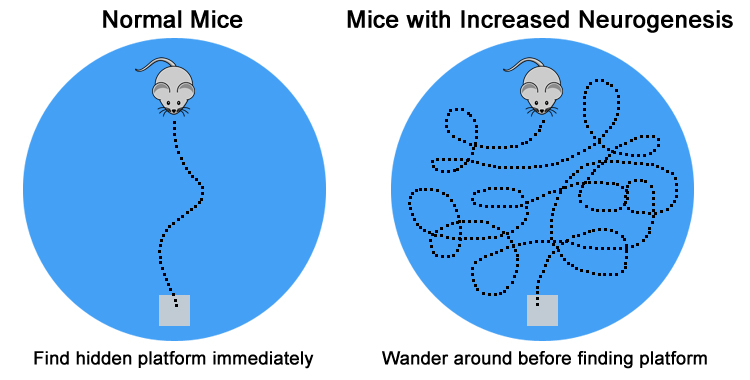
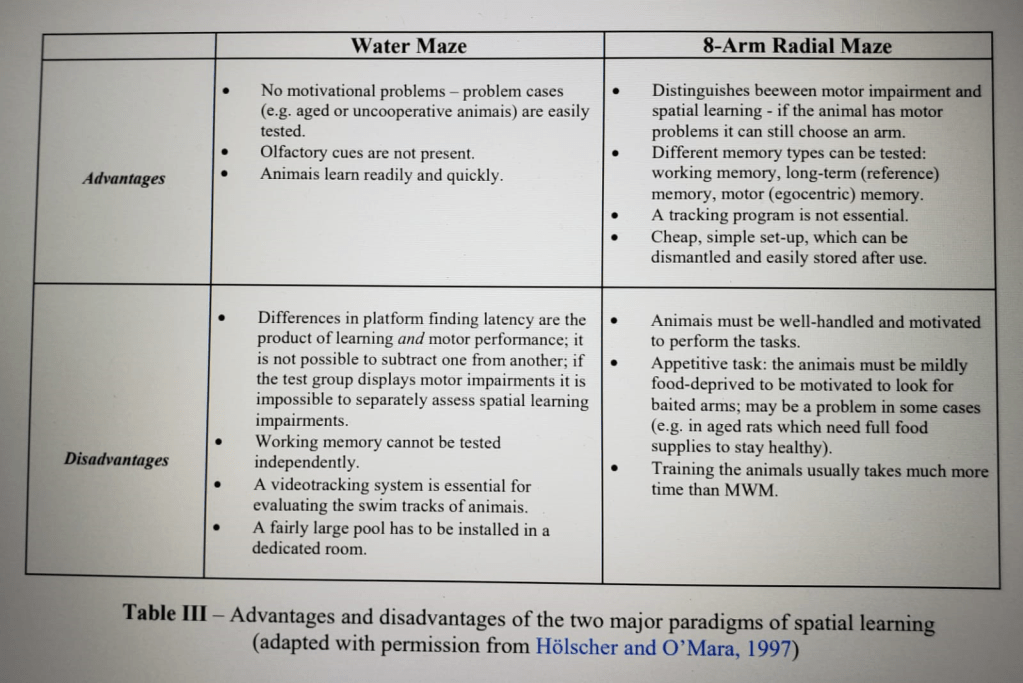
- Morris Water Maze: A box is filled with water and a platform is submerged just below the surface in the middle of a quadrant, the location is kept constant during training. Subjects are then placed in the apparatus and left to find the platform, in test sessions the platform is removed and subjects are given a single 60 second trial. Bonuses are that this is a self motivated goal and water has no locational cues, room for reversal learning, as well as observing visual discrimination by marking the walls or raising the platform.
- 8 Arms Radial Maze: 8 arms, or could be a variant, could also be made up of a combination of open and closed arms, this makes this test very versatile if the parts were detachable. Guillotine doors are also used to create certain context by closing doors and the ends of the arms are have food cups for rewards.
7. Object Recognition Test: seems there are a couple different ways to do this. the one in the paper says to use 2 different objects for the first trial and let the subject explore them. Then remove the subject and replace the objects with a familiar one from the last trial and a new one, followed by placing the subject after a certain inter-trial interval, could be 15min or longer. The researcher then observes exploratory behaviour for both trials and sees whether there is a difference in the amount of exploration between objects based on familiarity. The way I did this was by using one object and exposing the subject to this object for 2 trials where I placed the object in one of 2 quadrants to ensure locational cues weren’t being used. The test phase was conducted 30min or an 1hr later, I cant remember where the familiar and a novel object were placed, and the same test was conducted again 24hrs later as well with locations counterbalanced. This could be modified by placing 2 identical objects during the training phase. I think using identical objects is the best way to ensure your subject really explores the object, however using 1 object kinda forces your subject to pinpoint the stimuli which may alter motivation to explore? I mean if given 2 identical objects are you more inclined to explore compared to when given only 1? 2 objects increases the chance of happening on the stimuli quicker, thus more efficient use of trial duration since object recognition is being tested. however when using 1 you may be able to make an argument for curiousity as well as discrimination since you are now only providing 1 passive stimuli that requires the subject to engage first?
 Al3xandria