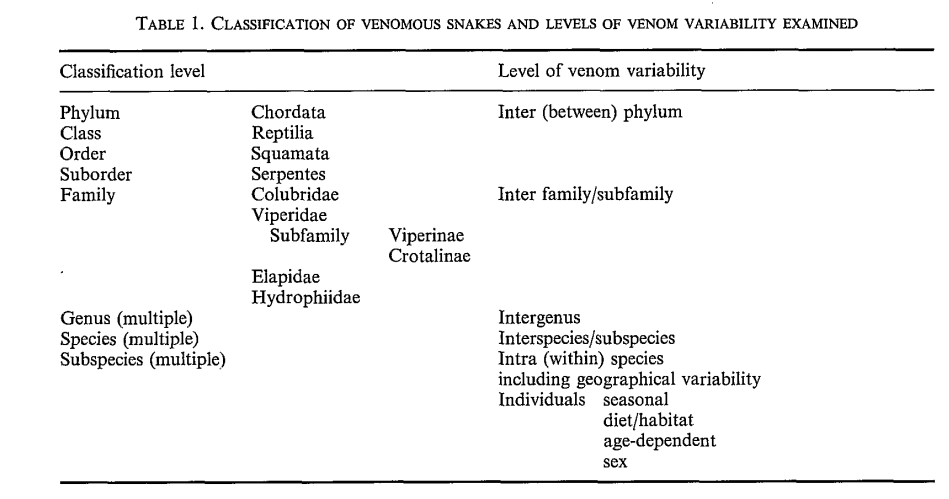
Snake Venom Variability: Methods of study, results and interpretation- Chippaux et al. 1991
- Immunological Analysis: Cross-reactivity is commonly used when talking about antivenom and it basically means “how reactive is something against something else” for example some studies used polyvalent antivenoms to determine the cross-reactivity in thrombin-like enzymes of various venoms determined by blocking their activity or neutralizing them. The immunodiffusion technique by Ouchterlony (1949) allowed scientists to examine venom components and compare antigenic components of different species. Medlineplus.gov Definition: An antigen is any substance that causes your immune system to produce antibodies against it. This means your immune system does not recognize the substance, and is trying to fight it off. An antigen may be a substance from the environment, such as chemicals, bacteria, viruses, or pollen). This method can also be used to determine phylogenetic relationships.
- Venom Variation: Russo et al. (1988) looked at venom variability by comparing toxin composition of venoms of different animals. They found that monoclonal antibodies that were raised against sea nettle and Portuguese man of war were reactive with the venom of a rattlesnake suggesting some antigenic recognition between the different species.
- Interfamily Variability: Previously we talked about some antigenic recognition between venoms of different species, but Lamb (1902, 1904) tested for something similar using a precipitin test in which you search for the presence of a specific antigen and found that numerous venomous snakes were not neutralized by cobra (N.naja) antivenom. This concluded that precipitin reactions could not be used to assess phylogenetic relationships of these snakes. However when using immunological parameters a large number of common antigens were found between phylogenetically separated snakes. So it seems that snake venom is actually built of multiple antigen populations which means antivenom needs to be able to combat all the specific antigens to be successful in neutralizing the venom. For example it seems like you can have an antivenom that may stop the coagulant activity but not the defibrinating ability of the venom or the necrosis components. I wonder if enrichment or cognitive welfare can be used to manipulate antigen populations in venomous snakes???? These trends in similarities and differences between venoms were also found between genus. Found that guinea pigs dosed with one snake venom repeatedly was sometimes immune to the venom of certain other species.
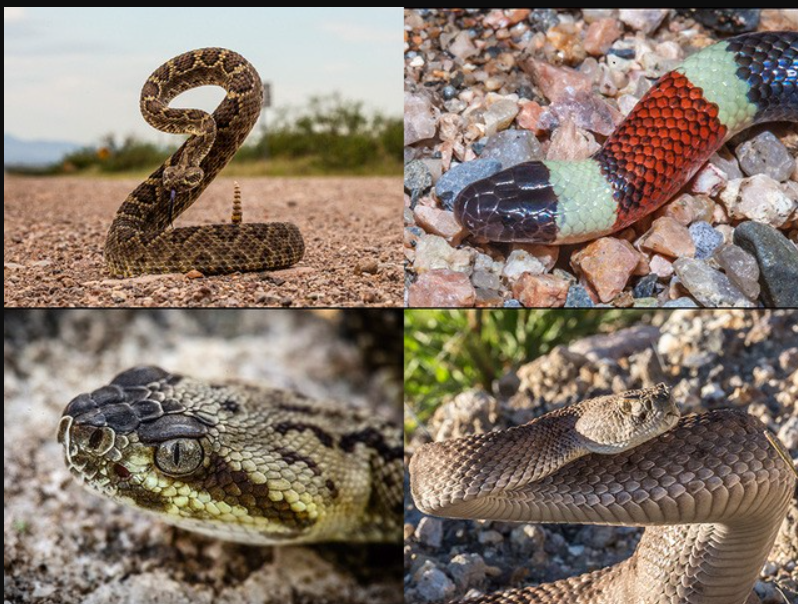
- Geographic Variation: the variation in venom of snakes of the same species is also affected by location. Barrio and Brazil (1951) found that the neuromuscular action of a rattlesnake produced 2 distinct responses based on the region they were sampled. For example venoms from Argentina, Paraguya and Bolivia were heightened for seizures, hypotonia and paralysis, while venoms from brazil were more characterized by initial hypotonia and muscle flaccidity. Geographic varation can occur through sympatric populations or isolated populations (allopatric).
- Individual Variation: Multiple studies that show opposing results, some show that nothing changes with milking intervals for individual venom samples but others show that new bands appeared and old ones disappeared when comparing electrophoretic patterns. Age seems to also a play role in variation, with toxicity decreasing with age but leveling off after maturity. Venom is mainly used as a way to procure prey which means that it is most effective when newborn and young. At this stage the subjects are still unable to effectively catch prey because of size and inexperience thus potent venom is prized more at this stage. Maybe using young snakes would be the best way to get the most potent venom from the individual and maybe the venom is also most reactive to change at this stage? Would enrichment possibly delay the decrease in toxicity that we see with aging? Kind of like how cognitive diseases are delayed with enrichment?
 Al3xandria