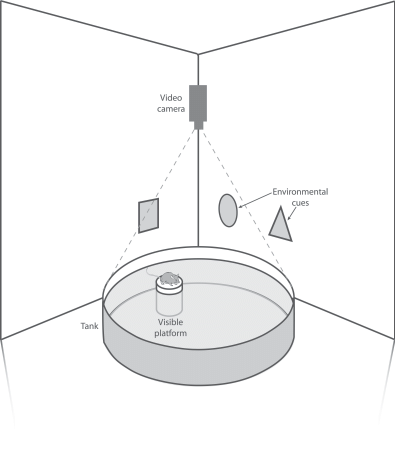
Developments of a water-maze procedure for studying spatial learning in the rat- Morris, 1984
- Abstract:
Outlines procedures for 1. automatically tracking the spatial location of a rat without using attached light-emitting diodes, 2. studying different aspects of spatial memory (ex. working memory), 3. studying non-spatial discrimination learning. - Introduction:
The essential feature of the Morris water maze is to observe associative learning via escape routes. The subjects are placed within a circular pool of opaque water with a platform submerged below the surface from view, therefore the platform doesn’t provide any local cues to guide the escape behavior. Normal rats tend to learn where the platform is through trial and error over consecutive trials and can do so from any starting point relying on distal cues to guide them. This method allows you to examine the neurobiology of spatial learning by comparing dosed subjects to normal, or any modification to the brain (cerebral toxins, brain lesions). This study will look at 1. technique for tracking the paths taken by the rats to reach the platform, 2. variations in the training schedule to see their effects on spatial memory, 3. procedures for examining non-spatial discrimination learning. - Methods:
2 different apparatuses were constructed (1st: 1.32 m in diameter x 0.60 m high (as used in Morris, 1981), 2nd, currently in use, is 2.14 m in diameter x 0.40 m height). Made from hardboard, attached to a baseboard, coated with fibreglass and resin. Initial design was painted white which kept flaking, the second was made with permanent white gelcoat, pools filled with water to depths of 0.40m and 0.25m respectively. Water was made opaque by adding a small amount of milk (powdered or pure). The circumference of the pool is marked with and designated as N, S, W, E, hence giving 4 quadrants. Platforms were circular and rigid with a diameter of 9cm, they were made from perspex tubing filled with stones, and heights of the tubes were fitted to be 1cm above the water and 1cm below the water. Thus one platform is visible and one is not, a third platform (super short) is basically used as a base attachment (I think) for the other 2 taller ones. Platforms are coloured (white, grey, black and white stripes), and are used for the hidden platform procedure, cueing procedure, and two platform task.
A) Tracking Techniques:
Used a tracking system made up of an image analyzer (HVS Ltd, VP110) coupled to a small BBC (<-LOL i am not making this up) Model B Microcomputer. This works by using high amounts of contrast to the point that the subject’s head (for example), is the only part that is tracked within the white murky water and it outputs an x and y coordinate. Check for specifics.
B) Computing Programs:
This is more about smooth algorithms to reduce the number of false x,y coordinates. Check for specifics. I wonder if you could use ImageJ or Boris for something like this, but it would require man hours compared to a software. - Behavioural Procedures:
A) Acquisition and reversal: 2 groups of rats were trained to find the hidden platform, one group had the platform be in a consistent spot while the other group had the platforms change from trial to trial, named Group Place and Group Random respectively. Group place decreased in latency to reach the platform through 2 factors: 1. they learned to swim away from the wall which acts as their safety net towards open water to increase chance of hitting a hidden platform, 2. they learn the spatial location of the platform. Group Random only showed a decline for the first portion. On the 21st trial Group Place increased in latency since the platform was put in a new quadrant, should be noted that this is not reversal learning because not all the cues required for reaching the platform were reversed (I think this is called transposition procedures when it is reversal).
B) Path-directionality:
In a literal sense, as normal rats learn the location of the platform, their angle towards the goal site gets smaller and smaller with increasing accuracy. These are normally plotted on polar diagrams, and subjects with brain lesions or drug impairments usually display a higher average angle.
C) Use of Cueing Procedure:
Okay this is pretty smart -> So basically you can’t conclusively say that the brain lesions are causing a disruption with spatial learning since the brain lesions could be affecting a motivation to escape or just their ability for motor control. To control for this a study did 28 trials of the hidden platform training, then followed it by 20 trials of the cueing procedure (cueing procedure is raising the platform slight above the water so that it is visible, this means visual then followed it by 4 more trials of the hidden platform. The brain lesioned rats were able to find the platform with no latency when it was visible but the latency reappeared during the hidden phase at the end. With this they were able to say that the subjects had genuine spatial deficit since they couldn’t make the connection without a landmark, but were normal in the presence of it.
D) Transfer tests:
This is also pretty cool -> For this test you remove the platform entirely and you place the subject within the arena for a certain amount of time (60 seconds used in the study) and then observe the amount of time spent in specific quadrants as well as number of quadrant transects crossed.
E) Effects of repeated transfer tests (RTTs):
They just going back to back *Cue Drake* -> When running repeated transfer tests it is mainly affected by two things: 1. total number of training trials; 2. the spacing of trials or inter-trial interval. But when these are kept constant you still come across two problems with running RTTs: 1. true forgetting; 2. extinction effects (the platform no longer being present contributes to them unlearning the training cause it no longer serves a purpose). 3 groups of rats were given consistent training schedules and then three different RTT sessions: G1. 4h, 48hr, 336hr; G2. 48hr, 336hr; G3. 336hr. Group 1 had the most repeated testing but still did just as good as the other groups which shows that the function connecting spatial bias to retention interval is basically insensitive to extinction effects.
F) Spatial “matching to sample” procedure:
This one focuses on running a two trial procedure-> 2 trials per day per rat, basically place the rat in the arena and let it swim to the platform which can be placed anywhere, then let it sit on the platform for 30-60s. On trial 2 the platform is hidden in the same location and escape latency should be quicker on the second trial if information was gained correctly during trial 1. But before they can conclusively say this is evidence of spatial “matching to sample” they had to remove alternate possibilities such as the fact that the subject is wet during trial 2 but not during the 1st, thus the improvement may be a motivational difference. Another group of rats was tested with a similar methodology but the 2nd trial had the platform in a random location. 25% of the trials just randomly had the platform in the same spot as trial 1, latency was the same for the changed platform positions but faster when the platform was in the same spot which shows they adopt a win-stay strategy.
G) Spatial and non-spatial discrimination learning:
To test this you need 2 platforms, one of which is a floating platform that sinks when the subject tries to climb on. This soon creates a positive connection between the rigid secured platform while discouraging the approach of the floating platform. This can then be used to test either spatial awareness or visual discrimination. For spatial they used two platforms that looked identical but differed in location while for visual discrim they used platforms that differed in appearance coupled with raised black curtains around the platform to focus more attention towards the stimuli. - Discussion:
3 main problems with this testing protocol are: 1. you can’t vary the motivational level too much in an experiment like this (unless you use temperature?); 2. experiments must be run by hand which is tedious; 3. continuous exposure to water may cause endocrinological or other stress effects may compromise the clarity of observing the drug or lesion’s effects.
 Al3xandria