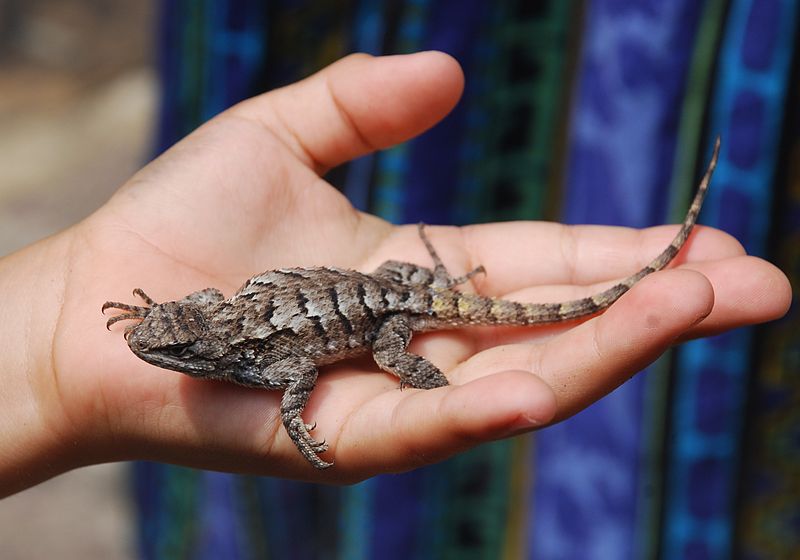
Does environmental enrichment really matter? A case study using the eastern fence lizard, Sceloporus undulatus- Rosier & Langkilde, 2011
- Abstract: Little is known about reptilian environmental enrichment, thus was investigated by using Eastern Fence Lizards that spend most of their time in trees or high ledges. They implemented solely climbing enrichment and found there to be no significant difference in any of the variables such as basking behaviour or plasma corticosterone (stress marker). However should be noted that the climbing enrichment was fractional compared to the heights that they frequent in the wild (I think the enrichment was 15cm but they normally are found at heights of 10ft.)
- Introduction: Environmental enrichment are specifcally designed to : (1) enhance an individuals quality of life while in captivity, (2) ensures the quality of scientific data by eliminating confounding effects from stress. Enrichment can take many forms like olfactory, auditory, structural enrichment, etc. However enrichment can have confounding effects if the enrichment implemented is anthropomorphic rather than beneficial to the subject. Physiological measures are important, includes corticosterone, high levels are indicative of stress and can take away from growth and reproduction. They state that their natural habitat heights are 10-300cm but I read a paper by Kennedy (1950?) that says its much higher.
- Methods: Split clutch design (controls vs. enriched, not within subject); enriched n= 53 lizards; control n= 54 lizards; even split sexes. Enriched enclosure ( furnished with 13.5cm height basking platform, this platform also has a square base that rests on the floor and acts as a second hiding spot), control enclosure (only had the square base resting on the substrate, doesn’t allow for climbing). Enclosure sizes are 30cm x 20cm x 25cm. Experiment ended at 34 weeks.
Observational Variables:
1. Baseline Corticosterone: blood samples were taken when the lizards were 28 weeks of age, to avoid diel fluctuations they took them during their active hours, and only bled one subject per enclosure per hour b/c catching a subject from an enclosure may stress the other residents.
2. Behaviour Assessment: 3 main behaviours were observed -> Active (Lizards were running, jumping from platforms, or climbing platform legs; Basking (Unmoving and visible to the observer); Hiding (not visible to the observer, burrowed or under the shelter). Used repeated point sampling of behaviour, behaviours were taken every hour for subjects on observation days. Aggressive behaviour was not displayed during observation sessions.
3. Morphological measurements: growth rates and body condition can be affected by physiological stress, initial measurements were taken as hatchlings and then final measurements were taken at 34 weeks. - Results: None of the parameters were affected by the treatment.
- Discussion: Restated that nothing was altered by the implementation of climbing enrichment (13.5cm). Other forms of enrichment may be better, or a combination of enrichment types, for example live food, thermal gradient, variable basking sites, or olfactory stimulation. A possible explanation for the lack of results could be that the subjects were captively bred thus do not use climbing as an escape response as wild-caught individuals would, maybe they would exhibit a change in Corticosterone levels when provided with this type of enrichment.
- This is a good paper b/c it solidifies that enrichment is very subject-specific, sure this paper implemented climbing enrichment but it was 13.5cm which is less than half a ruler size, a fraction of natural heights that they have access to. Thus does not actually allow them to engage in natural behaviours. Another paper by Londono et al. (2018) shows how something super simple like the addition of olfactory stimulation via filter paper with conspecific scents had been observably beneficial to a different lizard species.
 Al3xandria