Environmental Enrichment of Laboratory Rodents: The Answer Depends on the Question – Toth et al. 2011
- Abstract: Environmental enrichment may increase welfare of subjects but it does move away from standardization since enrichment can be perceived as numerous things. Does not help that the same type of environmental enrichment (EE) can have different effects on the same species if applied at different life stages or genders, EE is very complicated. This study is a literature review.
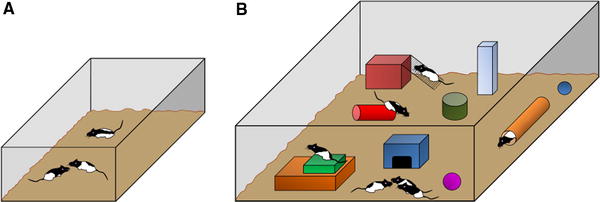
- Introduction: EE has multiple definitions, for example some define it as housing conditions that enhance sensory, motor and cognitive stimulation while others state that EE counts as biologically relevant features allowing engagement in natural behaviours. Implementing these would provide different conditions in their enclosures which could affect the main aim’s results. Social housing, larger enclosures and environmental complexity (manipulatable objects, climbing or exercising stimuli, foraging opportunities, hiding or nesting; basically engaging in naturalistic behaviours) -> all count as EE. But EE is very relative b/c the enclosures that are standard today with diggable substrate would be considered more enriching than the wire cages that were used in the past. Also the implementation and removal of EE has its own effects, with long term motivational differences found in mice that were exposed to EE and then removed compared to control of no EE, LOL ignorance may be bliss?)
- General Approaches to the study of EE: Multiple studies have shown that EE has an effect on body and organ weights. One study compared different strains of mice under EE and found that the strain specific traits were accentuated in exploration, hot plate latency, forced swim tests. But some studies also report no significant findings like Rosier and Langkilde 2010? (check out my previous post for an example “subject-specific enrichment…” yes im pluggin.), and a study that showed mice do not need nesting material since there were no significant differences in behaviour or physiology when provided. However another study showed that nesting material affects their core temperature and locomotor activity but metabolic rate wasnt which means it may be required for toxicological or phamracological studies where body temp may affect the drug function. In another study with individually housed hamsters, enrichment and a larger cage size was associated with lower rectal temperatures and a greater febrile (fever like) response to an injected solution. This shows that environmental enrichment, or at least mimicking an environment of the targeted audience in is crucial. This is evident with the enriched hamsters that showed changes in thermoregulatory homeostasis. Other studies have shown that rodents do better in water mazes and under stress conditions when provided with enriched enclosures. But there are also studies that have shown that EE doesn’t affect a mouse’s response to an infection.

- Defining the Adequate Environment: Captive environments limit engagement of natural behaviours, and animals adjusting to this get stressed and long term stress can alter normal physiology leading to the development of abnormal behaviours and abnormalities in general. But animals are resistant, even in conditions that partially inhibit natural behaviours their welfare is decent; especially if they are only being maintained for a short part of their lifespan. Thats true, some studies are done on juveniles, but enrichment at these stages has been shown to be really critical because this is when neurogenesis is peaking so maybe it is important? Also lab animals have been bred for lab conditions so like domestication maybe they have adapted behaviourally to life contained within an enclosure. Enriched mice show more abnormal behaviours when going into standard and show high motivation to get back -> the ignorance is bliss thing b/c these were significant compared to mice that were reared in standard conditions.
Stereotypical abnormal behaviours are normally accompanied with changes in extinction learning, home cage activity, response latency and behavioural switching. Check paper for more examples of EE providing contradicting results like reducing and increasing aggression in some species by providing shelter, also the dangers of untested EE like when they gave cotton balls to mice which happened to cause liver damage because of the bleaching process used on cotton balls. Cool study was that rats housed in enriched during pregnancy were leaner, produced fewer but heavier offspring and maintained a constant postpartum weight, sounds like the tradeoffs for healthier individuals but fewer number. Thus EE may be important to consider in some studies but not in others. - Enriched and Standardized Environments- Considerations of Experimental Design: When you change the environment of multiple subjects it increases the inter-individual variability which means you’ll need a greater n to achieve a reasonable statistical power. (check paper for examples). However there is also evidence of the contrary which shows that you can run experiments and enrich the subjects without affecting the results. For example one study assessed consistency of behavioural changes in relation to housing conditions across different labs and found the absolute values of their measurements to be significantly different in some cases, BUT the relative effects of the treatments of enriched vs. standard were pretty much consistent. In terms of strain diversity effects which occurs a lot with mice since there are multiple breeds, it may be better to adopt a higher benchmark for significance to reduce the chance of having inconsistent findings across labs.
- The value of EE in Scientific Discovery: EE has provided us with insights into disease mechanisms and recovery, as well as physiological mechanisms. EE has been known to affect neurogenesis, brain chemistry and function with benefits to people suffering from a number of conditions such as depression and epilepsy. EE also has the capability to mimic antidepressants without leaving the same putative (general) markers on the associated brain regions, if anything there is evidence to say that it increases or elongates neurogenesis. But EE like everything else is optimal when provided at the correct time, in alzheimer mice this was proven with access to a running wheel.

- Conclusion: The same enrichment design can cause positive, negative, different or even no effect depending on the strain of subject used and variables considered. Okay this is kinda cool -> Also we shouldn’t choose enrichment based purely off animal preference, animals like people do choose to engage in detrimental behaviour for temporary gratification, for example like some rat strains that choose to drink an ethanol solution over water for the psychoactive effects (monkeys and jaguars do this too).
 Al3xandria