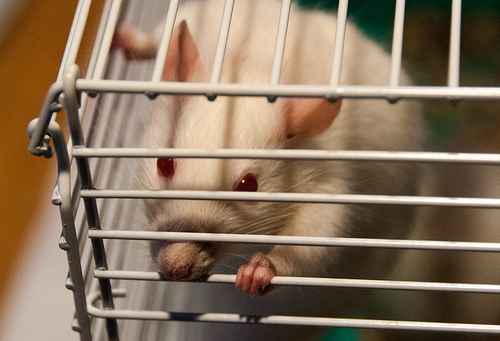
Sources of stress in captivity- Morgan & Tromborg, 2007
Abnormal Social Groups
- Most animals that are housed in lab settings are normally kept in individual enclosures even if the animals require social contact to engage in normal behaviour. Social isolation has been known to cause stress to subjects and is a well-known stress inducer for many research studies. For example lab dogs housed individually show more abnormal behaviours compared to group housing, isolated calves show greater fear responses and social isolation can have physiological effects as well. Separating female sheep from herds has shown to increase respiration rate, serum cortisol, vocalizations and locomotion which could all be reduced just by the addition of a single conspecific. The social isolation is stressful to the point that some animal species will work to gain a companion over food, even when starved. For example tufted capuchins have shown to choose companions as a reward after a task is completed over a food reward even after several hours of food deprivation. Both calves and rats show similar traits by working for a social companion.
- Other end of this spectrum is improperly grouping animals for the sake of space which may be stressful since it does not emulate a natural environment. Over-housing or crowding animals can cause an increase of injuries from in fighting and aggression as seen with red deer and rhesus macaques. Crowding or social instability from shifting subjects of enclosures can also cause death, as seen with captive dolphins that showed an increased mortality rate. Another example is with an adolescent gorilla that showed multiple escapes from its enclosure b/c of bullying from a dominant silverback in the group. In normal circumstances the adolescent male would emigrate to a new group b/c of the pressure but this is impossible when constrained to a captive enclosure.
- The problem with these is the fact that the subjects do not have full control over their interactions, they cannot completely escape a dominant individual nor can they engage in social behaviours when housed individually.
Discussion: Predictability, Control and Boredom
- This is where they state what I stated before about lack of control causing stress. Animals that are allowed more control over their environment have shown less symptoms of stress, for example hens that could control extra food or extra lighting showed less self-directed behaviour, rhesus macques that could control the occurrence of a loud unpleasant noise showed lower cortisol levels compared to those who could not control it. Another symptom of chronic stress with no control is learned helplessness in which the subjects give up b/c escape is not possible and they seem to be in a depressed state. This can be accompanied by anorexia, lack of exploration, and aberrant immune responses.
- The problems with predictability could go both ways, having predictability for aspects such as food and shelter are beneficial but having predictability in stressors like routine husbandry and environmental stimuli can be detrimental. Half of this is b/c of the boredom that comes with predictability while the other half is the anticipation of a predictable stressor.
- Another problem with animal behaviour in terms of stressors (fyi behaviour is the quickest response to a stimuli in these situations) comes from the diametrically opposite suites of behaviours when exposed to stressors. For example subjects can response to unpleasant loud noises as more locomotion or paralysis, can exhibit increased exploration or crypsis, become extremely vocal or completely silent. Basically just purely examining stress symptoms won’t be good enough to identify the source, but we should focus on understanding the subjects natural history and try to evaluate all of the animals needs even from multiple aspects.
 Al3xandria