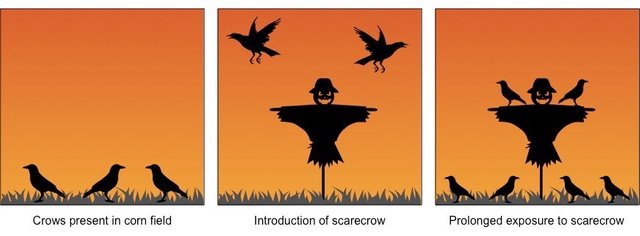
Habituation Revisited: An Updated and Revised Description of the Behavioural Characteristics of Habituation- Rankin et al., 2009
Introduction:
- Thompson & Spencer (1966) and Groves & Thompson (1970) first wrote an in-depth analysis on the definition of habituation. These two papers became classics and were revisited with some changes made to the content but mostly just for clarity. Habituation is seen as the simplest form of learning since it allows the filtering of irrelevant stimuli to allow focus on important stimuli, thus is a prerequisite for other forms of learning.
Definition of Habituation:
- This is defined as a decrement in a behavioural response to a specific stimulus that is repeatedly exposed to a subject, keynote is that this is not a result of sensory fatigue or motor fatigue. This basically means that you need to ensure the habituation you observe is not b/c the subject is tired from using said sense/motor function to perceive the stimuli. Habituation is ensured by dishabituation, and by stimulus specificity (this means that the habituation response is only observed for that specific stimulus, thus when presented with another stimulus it produces a different behaviour as a result of the novelty). Habituation can be observed on multiple scales, from cells (like neurons) to population activity.
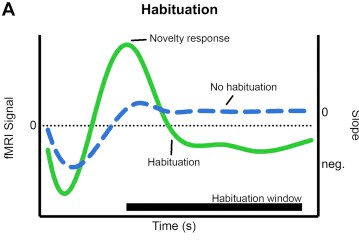
There are 9 characteristics
Characteristics 1: Repeatedly applying a stimulus to a subject causes the progressive decrease in response till it reaches an asymptotic level. The decrease could be exponential but it could also be linear, in some cases there is also sensitization prior to habituation (this means that there is a general interest in the stimulus for the first few exposures and then a decline as they lose interest, -> Thompson and Graves describe this as dual process theory of response habituation)
Characteristic 2: When the exposure of a stimulus is stopped, the response to said stimulus will recover either partially or completely, and regardless both cases are considered spontaneous recovery.
Characteristic 3: When a stimulus is repeatedly exposed to a subject and undergoes multiple spontaneous recoveries, then the response decrement becomes more rapid and this is called potentiation of habituation.
Characteristic 4: When everything else is constant, giving more frequent stimulations means quicker response decrement and quicker spontaneous recovery if the decrement has reached asymptotic levels.
Characteristic 5: When exposing a subject to a stimulus, if it is less intense then the response decrement is more rapid, probably b/c the less intense stimulus is easier to get used to and code as irrelevant since it poses no real benefit or threat other than minor annoyance. Thus can be ignored and tolerated. On the other hand very intense may cause no observable change in response.
Characteristic 6: The effects of having a stimulus repeatedly may surpass the asymptotic level and actually accumulate to affect subsequent behaviour, for example delaying the onset of spontaneous recovery.
Characteristic 7: When exposing the stimulus in a specific fashion, the response decrement shows some stimulus specificity (this means that the quicker decrease in response behaviour is in response to a specific stimulus and exposure to another would elicit a greater response behaviour). This is tested by showing a second novel stimulus of a similar type to see if there is stimulus generalization.
Characteristic 8: Okay this covers the dishabituation test, dishabituation needs you to present another stimulus that increases the response to the original stimulus.
Characteristic 9: When you repeatedly expose the subject to the dishabituating stimulus then the amount of dishabituation seen also decreases.
Characteristic 10: Some stimulus repetition protocols may result in properties of the response decrement that last hours, days or weeks. For example like more rapid rehabituation than baseline, smaller initial responses than baseline, etc. This is termed long-term habituation.
 Al3xandria