
Latent Inhibition – Lubow, 1973
Introduction:
Latent inhibition is defined as the decrement in learning performance which stems from the nonreinforced pre-exposure of a stimulus prior to conditioning with said stimulus, which slows the learning curve.
Scope of Latent Inhibition Phenomenon:
- Distribution across species: this has been demonstrated in goldfish, goats, sheep, rabbits, dogs and rats. This has also been shown in humans but some tests have also shown that we are not capable of this in some aspects (look at the paper for specific examples).
- Distribution across testing situations:
1. Classical Conditioning – Pavlovian: this has been successfully observed in goats and sheep through leg flexion and tail movement in rats but was not seen using nictitating membrane response in rabbits. There is one successful eye lid study with adult humans, while 6/7 studies did not. However with infrahumans (primates) it was found in 12/13 studies to be successful of latent inhibition.
2. Classical Conditioning- conditioned fear as a suppressor: this has been demonstrated in behaviour that can be suppressed for example like licking rate, bar press rate, and running speed. Out of 19 independent experiments across 13 articles, only one of them had failed to demonstrate a latent inhibition effect.
3. Avoidance escape conditioning: 5 studies have preformed this task and only 1 had failed to be successful
4. Discrimination of go/no go stimuli: this connects latent inhibition to an operant situation where the unconditioned stimulus is diet related and appetitive, and most have used a classical conditioning system with noxious unconditioned stimuli. For some of these studies the unconditioned stimulus and the conditioning occur in pre exposure but are not correlated.
5. Gustatory aversion conditioning: in these studies food was another motivator. For these the subjects had a familiar food they were comfortable with and then were given novel food and the familiar food which was now slightly poisonous thus illness inducing which would give the same kind of scenario for latent inhibition. They found that the animals still preferred the familiar food to the toxic and took longer to switch to novel safe food.
6. Ivanov Smolensky conditioning: This is an adaptation of classical conditioning for humans.in this technique the unconditioned stimulus is a verbal command paired with a conditioned stimulus. This was done using humans, in adolescents it had a significant impact and in college level students it had low levels but still showed latent inhibition.
7. Conditioning of autonomic responses in humans: Did this experiment looking at galvanic skin responses which are autonomous sweat gland changes, they found that when combined with a verbal command and the command was pre-exposed then the galvanic responses were less than the group with no prior exposure. For example students with 20 pre exposures needed 7 paired conditions and 40 needed 6 paired conditions while no prior exposure needed only 4.
8. Response Speed: Motor experiments with children show evidence of latent inhibition, such as lever pulling.
Parameters of Latent Inhibition:
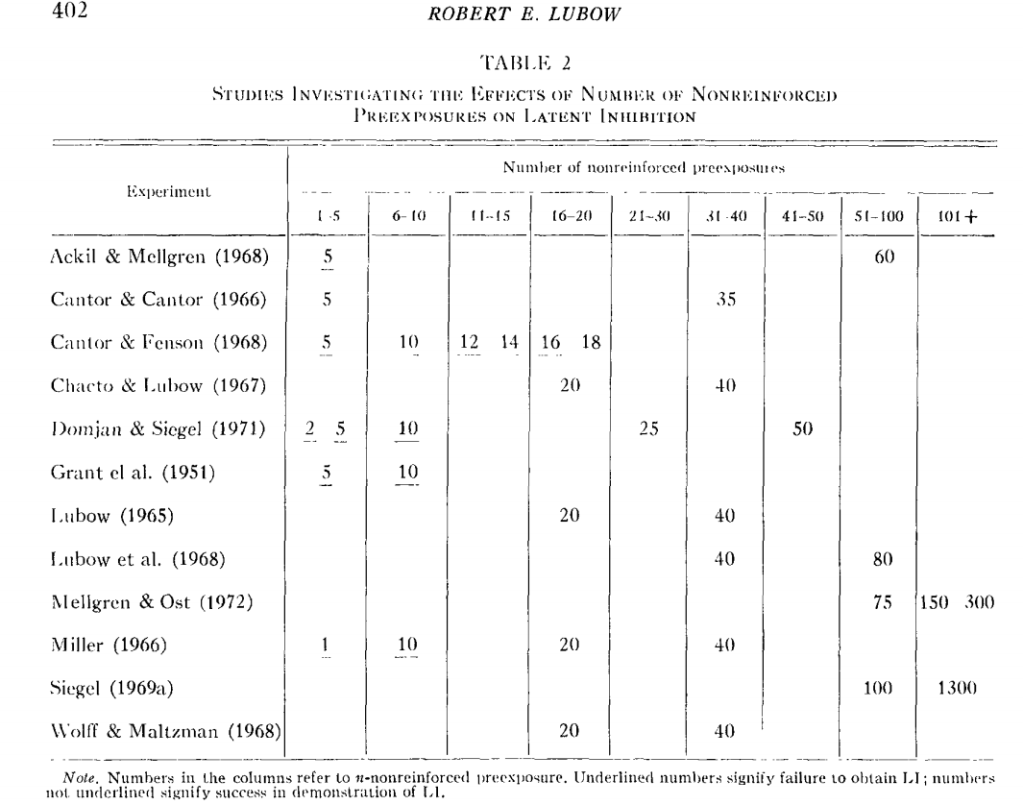
- Number of Pre-exposures: On average most studies use 5-80 non reinforced pre exposures, with the most typical being 20-40. Studies focused on the number of pre exposures have found there to be a significant inhibitory effect when giving stimuli for a narrow range of 16-20 with 5 studies showing significant effects across multiple species.
- Stability of Latent Inhibition Effect, Temporal Duration: This means the amount of time between the last nonreinforced pre-exposure and the beginning of acquisition, one study did not show latent inhibition had used a delay of 24hrs, which might have been enough time to forget the pre exposure because of insignificance. However other studies have used the 24hr delay and found it to be still effective in rabbit eyelid and pinna tests, with no significant difference b/t 0 and 24hrs (this is quite interesting cause I thought they would have seen some effect of so much time passing). Another study checked 0, 30min and 60min and gound that to also have no significant differences b/t treatments. Some studies have also used 48hrs and have shown some evidence of latent inhibition.
- Stimulus specificity of Latent Inhibition: important factor for latent inhibition is whether the inhibition is stimulus specific or generalized to a variety of stimuli, and most show that it is stimulus specific. Another cool thing is location, latent inhibition is stronger when the location of preexposure is the same as testing, but it can still be achieved when locations are different. They explain a scenario where subjects exposed to the test apparatus were better at learning the action for it compared to non-exposed. But pre-exposing them to the conditioned stimulus of the apparatus still produced similar avoidance learning as the non-exposed group, and normally all subjects are exposed to the apparatus prior to experiments. Thus maybe the reduced learning effects of pre exposure to a conditioned stimulus is more pronounced and is being masked by facilitative effects of apparatus exposure? -> still mad confusing so maybe look into the paper.
Explanations of Latent Inhibition:
- Habituation of the Orienting Response: Orienting response (dishabituation occurs when attention is redirected to a stimulus but the nature of the stimulus has changed, for example sensitization occurs when you first hear the laundry and orient yourself to it but then you habituate and are not aware of it.). Studies were done to test the orienting response as a method of contradicting the effects of latent inhibition, but not proven.
- Competing and Complementing Responses: Another explanation was maybe that the learned response to the pre exposed stimulus was not compatible with the later response when paired with another stimuli, but this was also not proven.
- Conditioned Inhibition: the definition of this is a stimulus which only comes through learning to specifically interfere with excitation. They way to identify this is with 2 steps: summation of a known excitor and retardation of the development of a conditioned reflex. -> Experiments have found that latent inhibition is not the same as conditioned inhibition which would make sense. In my head its that conditioned inhibition takes another stimulus to cause the conditioning and pre-exposing a stimuli with no reinforcement is not a strong enough force to be inhibitory but rather gets ignored because it didn’t serve a purpose or have significance to be remembered. This can still be paired with another stimulus and learned just at a slower rate b/c of the pre-exposure as the subject tries to learn that this innocuous cue is actually a precursor to another dangerous cue.
Conclusion:
- There is no strong support for a single claim to latent inhibition, some studies with the drug scopalomine have found that they reduce the amount of habituation that can occur from repeated stimulation as a result of an anticholinergic effect.
- Another study used lesions in certain parts of the brain like hippocampal lesions, neocortical lesions and no lesions, they found that the neocortical and non lesion showed evidence of latent inhibition but hippocampectomized there was no difference b/t pre exposed groups and no pre exposure groups.
- Both the drugs and the lesions point to effects in a centrally mediated decrease in attention to the pre exposed stimulus which causes the slow learning later on known as latent inhibition in a normal subject with no lesions or drugs.
- Latent inhibition can be narrowed down to 2 reasons: the learning mechanism refers to a general inhibition of both the specific stimulus and other similar stimuli. While the attention mechanism focuses more on saliency of the stimuli and says there is a reduced saliency b/c of the non-reinforced pre-exposure of said stimuli. Problems with the latter theory even though it fits better is the lack of reasoning for a decreased saliency, lack of generalization for other stimuli and the stability of this over time. Therefore both learning and attention theories should be combined.
 Al3xandria