
Physiological demands and signaling associated with snake venom production and storage illustrated by transcriptional analyses of venom glands – Perry et al 2020
Abstract:
The physiology and regulation of the venom gland still needs clarification thus a time series gene expression analysis was conducted on rattlesnake venom glands in comparison to other non-venom tissues. Found that mitigating cellular stress is critical for venom production and that the venom gland has a high degree of cellular and secretory activity. Also evidence of vacuolar ATPases as the mechanism for acidification of the venom gland lumen during venom production and storage.
Introduction:
There has been recent development in snake venom gland organoids research (check to see if this means they’ve been able to artificially produce it). This study focused on understanding the physiological, cellular and molecular functionality of snake venom glands in comparison to non-secretory tissues. After a snake depletes its venom glands because of a bite or manual extraction, the gland exhibits a high magnitude of upregulation of venom gene transcription, venom protein production, and secretion of venom components into the lumen. This high magnitude of activity causes a lot of stress to the relevant venom gland epithelial cells which in turn activates cellular stress response mechanisms so as to safely produce venom at that rate without damaging the relevant tissues and cells. Also not much research has been done on the storage of toxic venom components in the venom gland during steady states of no use. Currently theories are that acidification by groups of mitochondrial cells keep the venom inhibited and stable so as not to damage the glands and tissues. These aspects were studied on the Prairie Rattlesnake.
Methods:
Tissue samples from unextracted, 1 and 3 days post extraction of the venom gland were acquired and also the skin, pancreas and stomach for those days as well. They generated new poly-A selected mRNA libraries for this study and then sequenced them. Differentially expressed genes that were not known previously as venom genes were given orthologous human gene identifier. Read methods for better insight.
Results:
Timing and Variation in Snake Venom Gene Expression: After a bite, 1 day post bite the venom genes expression is significantly upregulated and is also upregulated at the 3 day mark. However there is a decrease in upregulation between days 1 and 3.
Differential Expression of All Non-venom Genes Across TimePoints: When comparing the unextracted venom gland compared with 1 day post bite, they identified 2598 differentially expressed non-venom genes and half of them were upregulated after the bite. This may mean these genes may actually be relevant to venom genes and may need to be included in the group of venom genes. Also 54 genes were differentially expressed in terms of upregulation between post bite day 1 and post bite day 3 which shows that the venom production process fluctuates even within 72hrs. Maybe this means if you were to nourish or enrich an animal for venom production or give them some solution to help them produce venom, this would be the most optimal time to do it since there is a significant amount of upregulation. Also maybe there is a way to prolong the amount of upregulation found on the first day?
Regulatory mechanisms associated with venom gland physiology during venom production: Okay this is pretty cool, so when comparing unextracted with 1 day post bite, there is a significant increase in activity by stress response pathways. Now this includes an increase in the endoplasmic reticulum stress response and unfolded protein response pathways which are response for lowering cellular stress by caused by misfolded proteins and demands for high protein production. There is also an increase in two DNA damage checkpoint regulations to prevent replication of damaged cells (would this be useful in cancer research????). There is also an increase in activity by other pathways responsible for degrading proteins that are incorrectly formed. Increase in pathways related to cellular growth, cell cycle regulation and tumour suppression (useful for cancer research????). Increase in processes related to transcription, translation, protein transport, modification and metabolism.
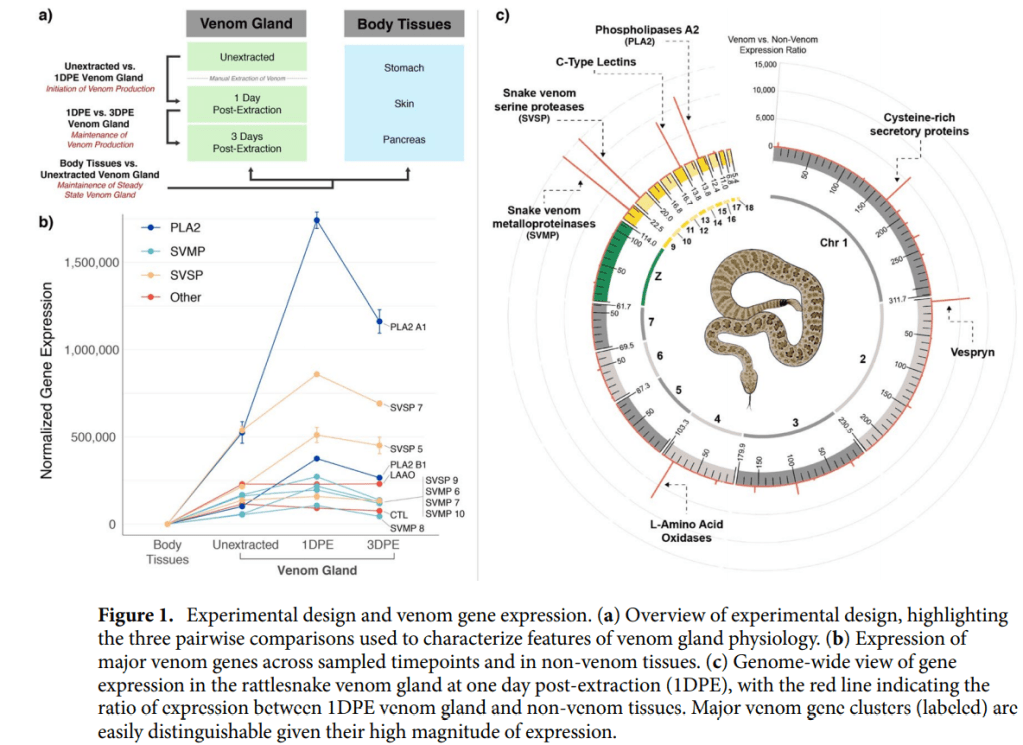
Steady-state Regulatory Mechanisms that Differentiate the Venom Gland from Other Tissues: Even when in a steady state prior to a bite, this gland is expressing multiple genes with a high activity rate compared to other non-venomous organs like the pancreas. For example the cellular stress response mechanisms reported previously are higher than non-venomous organs which shows that the venom glands specifically have evolved to take on high pressured demands like replenishing proteins needed for venom after a bite. Furthermore these high activity gene expressions get further upregulated right after a bite. There are also higher levels of tumour suppression, cell cycle regulation, regulated cell growth in the steady state. However there is a lack of regulation for transcription and translation occurring in venom gland in steady state compared to other secretory organs.
Candidate gene analysis of venom gland acidification: They pooled 57 candidate genes that could have a role in pH reduction and found that 26 of them were upregulated in steady state venom gland compared non venom organs and 6 more are upregulated one day post bite.
Discussion:
The venom gland shows signs of upregulated cellular activity that is responsible for preventing DNA damage, apoptosis and cellular dysfunction.
This paper basically outlines that venomous snakes have glands that can replenish venom at an unprecedented rate, even though this is actually extremely minute in quantity. They are making venom from other components and replenishing at that rate puts on tremendous stress on the cells and organ itself. At that rate mistakes are made quite frequently but the organ itself has evolved to express genes at a higher rate to mitigate for this. I should look into whether stress from the environment affects similar pathways mentioned here in other experimental models, because maybe if the snakes were enriched then the replenishing system could be made more efficient.
 Al3xandria