
The occurrence and behaviours of North American fireflies on milkweed – Faust & Faust, 2014
Introduction:
Fireflies are chemically protected by steroidal pyrenes called lucibufagins which have cardio-toxic properties are similar to components found in milkweed and other plants. It is still unknown exactly where the fireflies accumulate this chemical. Some fireflies known as the femme fatale fireflies harvest it by eating other fireflies. However adult fireflies have been observed with mouthparts but have rarely been observed eating thus the aptly described adult fasting rule, which is an exception for the previously stated firefly species. In recent research there has been more evidence of specific species feeding on maple sap and nectar however in general it seems most fireflies do not need to eat, focusing more on survival and feeding. But there are also theories that the fireflies acquire these toxins through milkweed when they are in their larval stage and some adults have been seen attracted to milkweed nectar. This study specifically looks at the feeding behaviour of fireflies including times of foraging and general seasonality.
Methods:
Surveys were conducted of fireflies in the natural habitats, ranging from pastureland to higher elevations in national forests. Milkweed was observed for 19 days with an average of 2hrs per survey at different times throughout the day. This was continued from bloom till the end of the blooming season. Neighboring plants were also observed to see if there was a variety in dietary preference. A small experiment with 12 captive firefly larvae was also conducted where diet preference was tested with milkweed and other foods.
Results:
From July 7th to August 17th, 56 fireflies were spotted from 4 different species. They appeared to be collecting nectar actively from milkweed plants and mouthing on leaves and stems. However actual chewing of the plant was not seen, mouthing is described as mouth in contact with the plant.
Main Behaviours displayed:
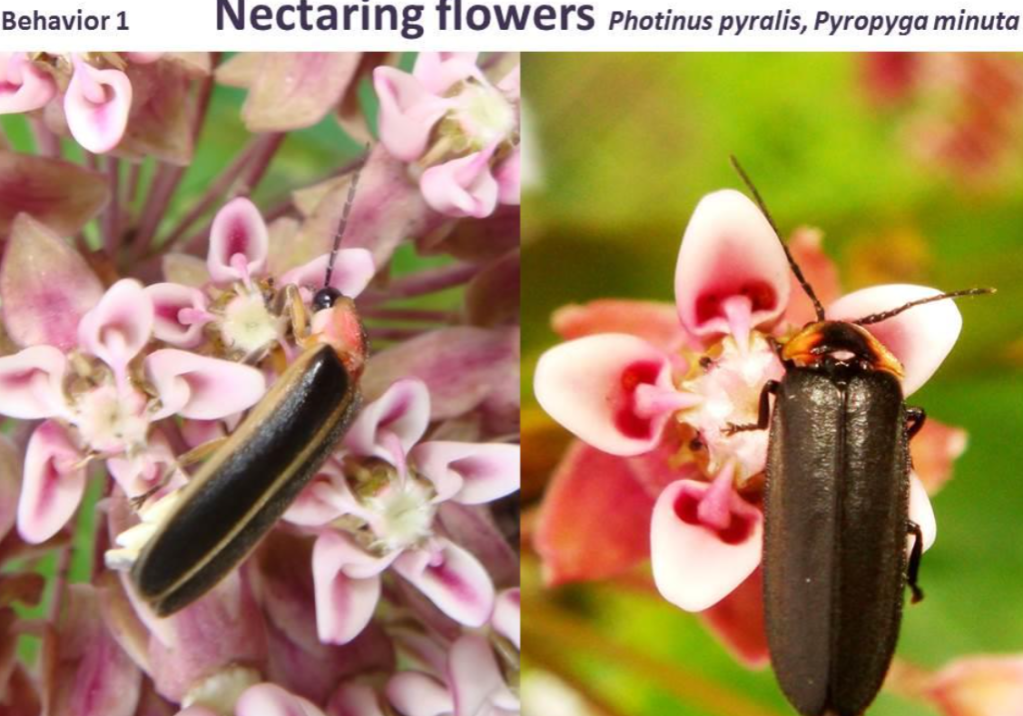
1. Fireflies seemed to nectar or mouth flowers by sticking their heads into the hoods of the flowers.
2. Fireflies seemed to sip nectar or mouth the stigmatic slits between the flower hoods
3. Fireflies actively mouthed at the top 1/3 of leaves or uppermost
4. Fireflies avoided wilted or immature flowers as well as avoided over mature
5. Fireflies preferred to stay out of sight or hidden when foraging
6. Pollina which is milkweed pollen packets were found attached to the leg and tarsi of 3 firefly species
7. These behaviours were not seen on other plants
8. Individuals of a specific firefly species and other milkweed insect visitors would be observed in a coma or death like state on their backs under the milkweed umbel. Some recovered over time while others did not.
Fireflies were not seen from August 30th-Sept 7th when the latter portions of observations were conducted. During the experiment they found that firefly larvae did not like milkweed leaves but preferred the milkweed rhizome (a continuously growing horizontal underground stem which puts out lateral shoots and adventitious roots at intervals). They would even move them to cover and continue feeding. After 1 week the larvae did not prefer the milkweed or the rhizomes of milkweed but ate the cat food, however after eating they returned to the milkweed to sleep and curl up. Caught fireflies that were released conducted the same behaviour as natural fireflies, rarely leaving milkweed.
Discussion:
8 observed firefly species in north America (L. atra, P. pyralis, P. indictus, P. cooki, P. decipiens (and/or P. nigricans), P. minuta, Photuris sp. (possibly representing >1–3 species), and a Pyractomena sp.). But it seems that adult fireflies do engage in nectaring especially during the peak time of milkweed. The reason that this was not known before was because the times of peak activity normally was outside of the survey time range. The predatory femme fatale firefly was noted to have eaten most firefly species but rarely accepted a specific one (P. pyralis). This may mean that different species have different methods of accumulating the chemicals into their body making some species more preferable than others as prey.
 Al3xandria