Development of simple standard assay procedures for the characterization of snake venoms – Theakston & Reid, 1983
Introduction:
A WHO Coordination Meeting on Venoms and Antivenoms was held to examine the progress made so far in researching these substances. The standardization of assay methods used to identify the biological activity of venom and neutralizing capacity of antivenom still requires further investigation. Characteristics such as lethality, defibrinogenating, procoagulant, haemorrhagic, and necrotizing activity need to be standardized so that labs globally can assess venom identically.
Methods:
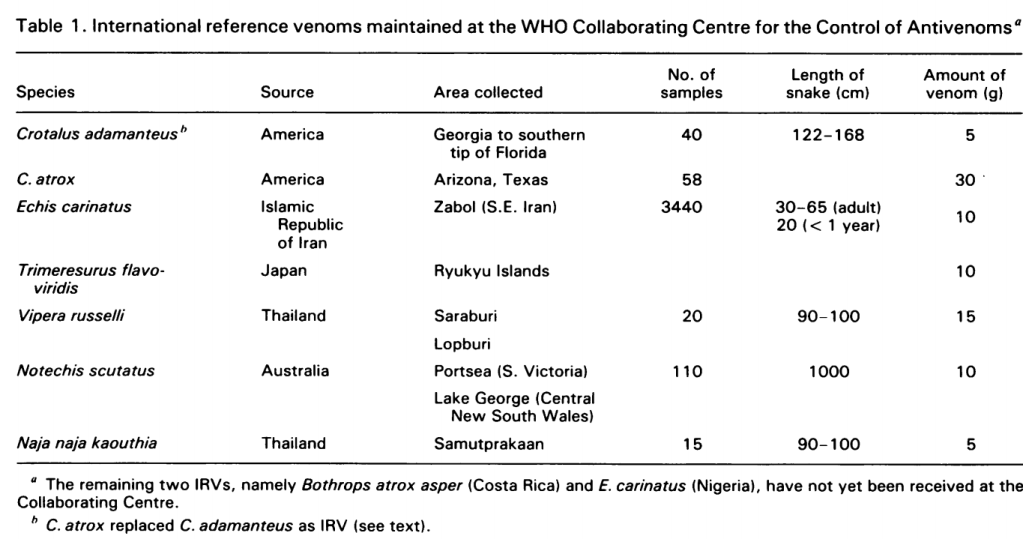
– Venoms – n = 53 venoms total from 30 different species of snakes, 6 venoms were international reference venoms
– Median Lethal Dose (LD50) – injected venom into 0.2mL of physiological saline into the tail vein of 18-20g male CFW strain mice, 6 mice were used at each venom dose. LD50 was determined by a probit analysis of deaths occurring within 24hrs.
– Minimum Coagulant Dose (MCD) – this is defined as the least amount of venom (in mg dry weight per litre of test solution) that clots either a bovine fibrinogen (2g/L) in 60 seconds at 37 degrees Celsius, or citrated solution of human plasma (fibrinogen content = 2.8g/L) in 60 seconds at 37 degrees Celsius. 50 microlitres of physiological saline with final venom concentrations ranging from 240-0.5 mg/L were mixed to 0.2mL of bovine fibrinogen solution.
– Minimum Hemorrhagic Dose (MHD) – least amount of venom (micrograms dry weight) which when injected intradermally into rats results in a hemorrhagic lesion of 10mm diameter 24hrs later. 0.1 mL of physiological saline containing 120-5 micrograms of venom were injected into 250g male Sprague dawley rats under light anesthesia. After 24hrs the rats were euthanized and dissected to calculate size of lesion.
– Minimum Necrotizing dose (MND) – least amount of venom (micrograms dry weight) which when injected intradermally results in a necrotic lesion of 5mm diameter 3 days later. Dorsal skin was removed after 3 days to calculate lesion.
– Minimum Defibrinogenating Dose (MDD) – for this a wide range of doses was selected for each venom and injected intravenously into 4 mice. An hour after injection the mice were euthanized and their blood was pooled, which was later divided into 2 halves for further analysis. This analysis includes whole blood clotting method while the other was mixed with citrate containing 50g/L aminocaproic acid to prevent fibrinolysis and tested using the fibrin polymerization time test. ; Whole blood clotting method – blood was placed in a clotting tube and left at room temp for 1-2hrs and graded using a 1-5 system. MDD-WBC is defined as the minimum dose needed to produce non-clotting blood within 60min of injection.
– Fibrin Polymerization Time (FPT) test – Check paper for specifics
Results:
Out of 45 viper venoms, 35 of them which is 78% had defibrinogenating activity while none of the elapid venoms had significant activity. Almost all elapid venoms except for one species showed no measure hemorrhagic activity while all the vipers except for one species showed some activity. Venom from an immature Bitis arietans was twice as potent as a matured individual, but also the compared venoms are from different geographical regions -> we already know that geography and diet in the area is a strong influencer of venom composition. Of the 53 venoms tested, 48 had necrotizing potential with different species ranging in potency. 3 species of snakes had double the necrotic ability as compared with their juvenile counter parts. There were also considerable differences amongst individuals. -> Check paper for specifics
Discussion:
There is a reasonable amount of variation in clotting activity of venom within the same species that differs based both on age and geography. There are mixed reports of a species known as E. carinatus that was initially said to have no clotting ability after a certain age but some evidence has been shown that this is not true. Advantage of whole blood clotting method is that it is simpler and cheaper in terms of materials. Advantage of FPT method is that it is quicker and more specific since it gives the direct estimation of fibrinogen levels. MDD-WBC test is the method of preference. When MDD is near to or greater than LD50, then fibrinogenation in humans can have serious clinical implications (take with a grain of salt cause it is an extrapolation). Check paper for specific snakes that meet this criteria. Viper venom is known for causing hemorrhages via powerful proteases on the vascular endothelium, this is not a characteristic of elapid envenomation. A coagulation defect does not necessarily mean that there will be a hemorrhage or that they should be linked.
 Al3xandria