Collective rule-breaking – Krause et al. 2021
Abstract: This paper looks at how cognitive mechanisms involved with rule breaking at an individual level can be scaled upwards to understand how rule breaking then appears in social groups. Social Contagion (The spread of ideas, attitudes, or behaviour patterns in a group through imitation and conformity.) plays an important role in this.
An interdisciplinary study of collective rule-breaking:
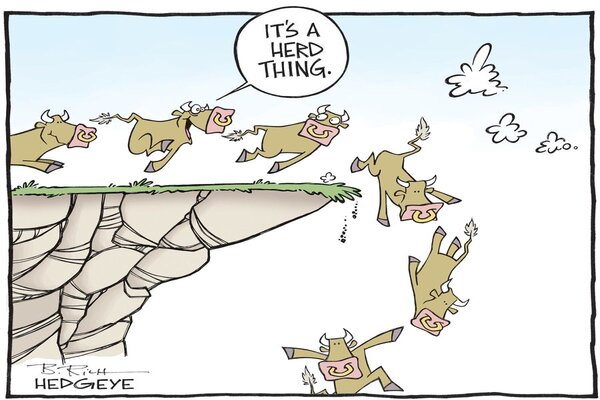
Collective rule breaking encompasses numerous behaviours such as jay-walking and riots caused by mob mentality. This is currently seen during protest events and at the end of major sports events for both winning and losing teams. When teams have won they have also incited riots that lead to police cars being flipped and large accounts of vandalism. This specific paper looks at breaking societally fixed rules which means all members of the group understand the rule but a strong social influence can cause them to break it. They also pay attention to if the rule has been instilled for a longer timeline than the social processes that takes to break it.
Cognitive Mechanisms Underlying Collective Rule-Breaking
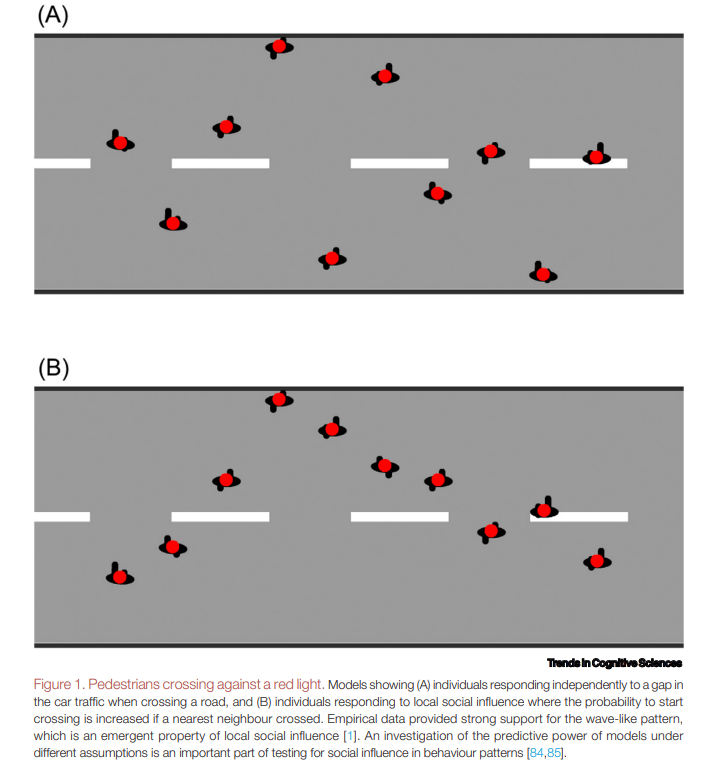
Group conformity is based on 2 types of influences: 1. normative influence (where people follow the group to feel included, 2. informative influence (people base their actions on social cues and information). This paper specifically looks at informative b/c of its importance in collective rule breaking. In this type of rule breaking the group and rule exert opposing influences, for example with jay-walking the signal says that it is unsafe to walk, but when an individual sees others cross the street, a variety of information is gathered. Perceptual & attentional processes, motor processes, and evaluative processes contribute to conformity. The individual’s attention is drawn to the jaywalkers away from the traffic light, and they show that it is safe to cross.
- How groups influence perceptual and attentional processes
Groups influence individuals by drawing their attention to certain events perceived by the group that may only be a small part of what is actually occurring in the environment. This is further strengthened by gaze following which is the incessant needed to follow the gaze of your peers to see what they are viewing, thus limiting your attention to that specific area. An example of this is walking through a mall and seeing a group of people look up which may cause you to look up, or during a protest where a violent group encourages you to join in b/c they focus on the aggressive police action rather than deescalating police action. - How groups influence motor cognition
This is called the drawing power of crowds in which groups that increase in size cause individuals to spontaneously mimic their motor responses thus giving a motor cognitive mechanism for social contagion. This is seen with jay walking and can also be seen with a lack of movement in by stander situations where motor activity is suppressed.
- The evaluative side of group conformity
Groups can also cause individuals to evaluate situations differently, for example they may have a negative opinion about looting and vandalism but in times of aggressive protesting or civil unrest the negative repercussions seem smaller and benefits seem larger. Also conforming itself provides a positive effect and is seen as rewarding to be included which also plays a role in collective rule breaking. - The dynamics of social decision making
Decisions are not made instantaneously but rather through interactions b/t group members or interactions with other groups.
Collective Rule-breaking in public
Jay walking is a good example of this b/c individuals opt to save a few minutes of time in risk of a fine or injury. This can be initially caused by the drawing power of leaders who move first, a study had shown that someone was 1.5-2 times more likely to cross the street if their closest neighbour moved. However none of these studies have observed the attentional/ perceptual processes that occur in this scenario b/c some individuals may not even recognize that it is illegal to walk since their attention is purely focused on people walking across the street. The evaluative aspect is also critical b/c it may provide insight into the size of the group necessary to alleviate negative repercussions.
- Opportunities for the study of rule-breaking
With the world as it is there is a higher presence of video surveillance allowing researchers the opportunity to study public events as well as normal day to day events through body cams and surveillance cameras. COVID 19 has also given a unique situation since lockdowns and mask requirements were active. - Quorum thresholds in collective rule-breaking
Quorum means the minimum number needed to be present to make something valid. Decision dynamics in animals is usually non-linear and a certain threshold of individuals need to present a behaviour for it to be adopted by the rest of the group. The reason for this is that if a number of individuals perpetrate the same behaviour it reduces the uncertainty given that they agree on the same option. However this is also dependent on the type of behaviour since something small like jay walking has a smaller quorum than that of violent behaviour. - Predispositional versus situational influences
This is a large debate in which public violence is said to be a result of people who have predispositions towards violence, such as hooligans. However more often than not people can have these dispositions but choose not to act on them and more often than not there are no violent outbreaks. However there is a systematic pattern in situational interaction dynamics where if a group is predisposed to violence and a public event concurs with this behaviour that it would present itself. For example in the UK soccer hooligans is a big issue where the crowd is already looking for a fight and has a violent streak, thus when an event presents itself where that behaviour could be triggered or “understood” then it is engaged in even though it is known to be wrong.
Mathematical models for study of collective rule-breaking behaviour
Agent based models are important for the study of emergent collective behaviours. Examples are behavioural contagion, opinion dynamics and collective decision making. Social contagion models tend to be based on susceptible-infected-recovered (SIR) type models. Rule breaking is most likely an example of complex contagion rather than simple (like simple diffusion of information of infectious disease). 3 universal classes of contagion behaviour – 1. epidemic threshold, 2. vanishing critical mass models, 3. pure critical mass models. The first is similar to SIR models for disease spread, so simple contagion, the other 2 are more complex and need more than just a couple individuals engaging in a behaviour for it to propagate through the population, AKA it needs to reach a quorum. For vanishing critical mass models, the critical fraction decreases continuously with increased social interaction until it vanishes above a critical coupling strength-> what does this mean??? The critical coupling is also known as a tipping point, thus even a small spark could cascade through the population but for pure critical mass models no tipping point exists thus it needs a finite number to be infected before it can propagate. Tipping points have been observed in ecosystems and animal models, and being able to notice the early signs of a tipping point could be advantageous to avoiding violent outbreaks, for example observing rapid changes in noise level of a group.
Future research should focus on agent based models and virtual reality is now a possibility to test social influence.
Concluding Remarks
More empirical studies that look at the problems in different contexts is needed. Observing the interactions b/t groups is also necessary since violent outbreaks are usually a result of opposing groups for example protestors and police.
 Al3xandria