Initial evidence for eliciting contrafreeloading in grey parrots (Psittacus erithacus) via the opportunity for playful foraging – Smith et al., 2021
Abstract: Contrafreeloading is the choice to work for food rather than it be freely available. This study examines this aspect in parrots (n=4-5) and found that during the first experiment the subjects preferred contrafreeloading. In the second more naturalistic experiment 2 chose contrafreeloading, 2 did not and 1 chose at random.
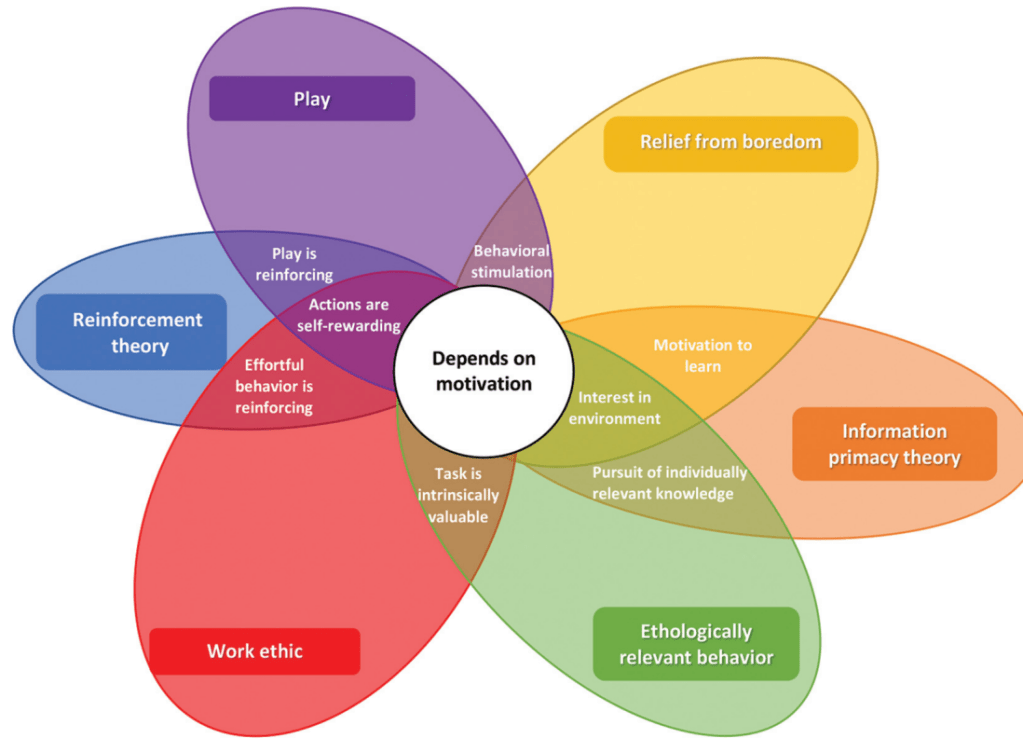
Introduction: Several theories try to explain this aspect: 1. conditioned reinforcement 2. work ethic, or value associated with work 3. information acquisition 4. response to boredom (would this be considered play?-> nvm they note the overlap in theories) 5. predispositions for ethologically relevant behaviour. The paper then proposes that play be included as a sixth possibility. Play definition: Play is repeated, seemingly nonfunctional behaviour differing from more adaptive versions structurally, contextually or developmentally and initiated when the animal is in a relaxed, unstimulating or low stress setting. This study observes parrots given their nature for innovative behaviour and the past literature evidence of contrafreeloading with focus on the effects of food presences and ethological relevance.
- 1. Conditioned reinforcement: some argue that the action itself becomes a reinforcement in turn engaging in the action is seen as beneficial and conducted even in the presence of free food -> I wonder if given enough time if the behaviour would be eliminated since it would become deleterious. Increased food deprivation does affect this behaviour as seen in rats that when starved and fed for only an hour did not show contrafreeloading compared to satiated rats. Contrafreeloading happens most when the stimuli associated with the food is neither very familiar or novel.
- 2. Work Ethic: The concept that working for something increases its value or justifies the effort. An explanation is also that any aversive event that occurs before a reward like work would be seen as increased value b/c of the contrast b/t the events.
- 3. Information acquisition: When animals normally live in high variance environments they adapt by constantly updating themselves on possible food sources. This may translate to contrafreeloading seen in captivity since it gives the subjects a sense of control over their environment. In rats contrafreeloading was observed by giving drugs that affected the dopamine system to favour information gathering implying a rewarding nature.
- 4. Boredom theory: When subjects live in complex environments and then kept in minimalistic enclosures with no stimulation they may be motivated to partake in any action to kill the time. Once the basic needs are met organisms try to fill other needs like cognitive. When rats were satiated with food, subjects living in minimalistic enclosures showed contrafreeloading significantly more than enriched rats but this was not apparent when starvation occurred.
- 5. Ethologically relevant: This theory connects contrafreeloading to context, when pigs were taught to press a lever for food, they opted for freely available food. However when foraging was used as the working method compared to freely available the pigs chose to contrafreeload. This was also seen to be the case with other species as well, and even when freely available food was consumed more, feeding behaviour initially began with foraging showing that there may be an innate component.
- 6. Play Behaviour: Play has been observed in a large number of species other than humans, and is used as an indicator of physical and mental health. When animals are satiated in the basic needs and have physical enrichments may contrafreeload just because it is rewarding to do -> makes it sound like the other theories. But they stress that the difference is that contrafreeloading in this instance is seen as positive.
Method:
– Subjects & Housing: Grey Parrots, experiment 1 used n=4 and experiment 2 used n= 5. Not experimentally naive, housed in enriched enclosures with daily human contact. Birds were never starved but waited an hour after feeding before trials began.
– Apparatus: Birds stood on a T stand made decisions out of 2 cups that were placed on a stool. cups were transparent allowing view of items inside.
– Procedure: Preference for food was first confirmed, then the mix of food treats were presented with lids and open in random fashion with other treats as well as empty containers to understand the degrees of contrafreeloading. Throughout this process they continually checked food preference to make sure it was consistent -> smart cause this is key to contrafreeloading. Ranked the subjects on whether they displayed 1. Calculated contrafreeloading = removing lid for preferred food item; 2. Classic contrafreeloading = removing lid for food item even though it is the same as the available 3. Super contrafreeloading = removing lid for less preferred food item.
Results:
– Overall food item contrafreeloading = for just contrafreeloading one bird showed significant preference for it, 2 birds did not and 1 showed significant avoidance of contrafreeloading.
– Empty cup controls = 3/4 birds showed significant preference for opening lids when containers were empty.
– Types of Contrafreeloading = 1 parrot showed significant evidence of calculated contrafreeloading and classic contrafreeloading, the lid significantly affected the choice made. 1 parrot showed a high preference for calculated contrafreeloading usually only opening the lid if it was a highly preferred food item. 1 parrot showed no signs of super contrafreeloading and showed preference for calculated contrafreeloading only when its most favoured treat was lidded.1 parrot showed no signs of super contrafreeloading and showed significant preference for calculated contrafreeloading.
– Food items paired with empty cups and lid conditions = All the birds very rarely chose to open the empty containers when a treat was freely available however when they did it was usually with their least preferred treat. This might show that they find opening the lid more rewarding than the food item, or it might be a curiousity thing since the cups are not completely transparent and opening it might reveal something better than the other treat.
Discussion:
1 parrot mainly engaged in calculated contrafreeloading but did not shy away from opening lidded cups compared to empty open cups thus did not find the action aversive. She just mainly chose to engage in the activity when a highly preferred food was present. 1 parrot found the action to be positive, the one that showed signs of classic and calculated contrafreeloading. This parrot also chose empty lidded cups over its least favourite food when it was freely available -> could this be that it is fun or is it satiating curiousity. 2 parrot significantly preferred calculated contrafreeloading and found the action of popping lids to be slightly tiresome.
Experiment 2:
This was basically the same experiment design except with nuts that had shells and didn’t.
– Results:
2 birds significantly chose not to contrafreeload, 1 chose at random, and 2 chose to contrafreeload.
Discussion:
Given that the birds sometimes showed contrafreeloading in the first experiment and not in the second, and vice versa, might show that the different actions are sometimes seen as play or positive. This strengthens the case for including play as a factor that needs considering when observing contrafreeloading. One bird preferred to engage in the action of removing lids even when food was available or an empty cup was available showing that the action was not aversive and not just a secondary reinforcer. This was also seen with the nuts (shell vs no shell) where if it was a secondary reinforcer then they would have contrafreeloaded but did not significantly. In terms of work ethic they would have super and classic contrafreeloaded more as well since the act of working would increase the value of lesser preferred treats but this was not the case. Information Gathering did not play a factor in this case b/c of transparent containers. They discount the Boredom hypothesis b/c the subjects live in enriched conditions thus popping a lid would not be interesting and the nuts are given with shells regularly as treats thus is not novel or interesting either. However during test trials the subjects are placed upon a T stand and left to do choices, if animals come from an enriched environment where they have learned to interact with the environment continuously they probably have a lower threshold for boredom. Maybe having them partake in these trials of choosing b/t 2 stimuli is boring and is the reason for the differences b/t individuals. The study addresses the numerous individualistic differences and states that it may be centered around whether the action in question is viewed as play in certain situations in turn making it more appealing. This is seen when one parrot clearly enjoyed popping lids by choosing it over taking free food but then the same parrot found shelling nuts to be an aversive action or perceived it as work opting to take the nut with no shell.
 Al3xandria