Motor timing learned without motor training – Meegan et al. 2000
Brief Communications Paper
Normally when perceptual training is involved in learning, there is no generalization to similar tasks. Which means that the training is only beneficial when implemented with that specific task. However this study has found evidence that training in one form of learning (perceptual) can impact the learning rate of another form of learning (motor). The common bridge was that both tasks relied on perceiving time. The perception task focused on auditory information and was completed first as training prior to the motor task that included pressing a button with a finger successively.
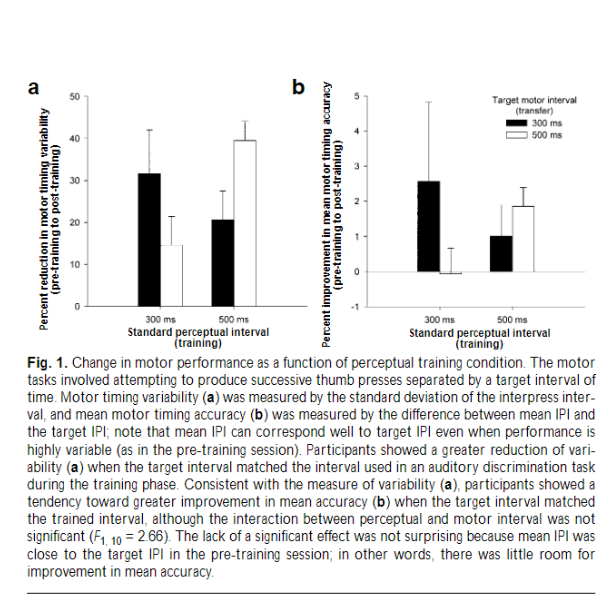
Method: n= 12, right handed male adults participated in 7 experimental sessions, no more than 2 days between sessions, made 2500 auditory discrimination judgments, subjects indicated which of the 2 successive temporal intervals was longer. They used 300ms and 500ms as short auditory stimuli. The purpose of this task was to act as training, it basically instilled the temporal duration prior to the motor task. For the motor task they observed the reduction in timing variability, so how long it takes for them to become consistently correct with the task.
Results: There was a significant interaction of the auditory training on motor control, specifically participants trained with the 300ms tone did better at the 300ms motor task. Same occurred with the 500ms tone, thus showing that there is a connection between the areas responsible for perceptual learning and motor learning. They did better when the temporal requirements of the previous task matched the latter.
Discussion: They propose that motor learning was achieved by an enhanced representation of the temporal interval through a plastic network shared by sensory and motor systems. There is a possibility that the motor task gave auditory cues via the clicking of the button which would be more inline with the training thus resulting in a perceived motor learning. However this was controlled for by using white noise during the tasks to limit auditory cues. The subjects also did not know the two tasks had similar temporal durations, and were shocked to hear about it after the experiment. There is also the possibility that the learning seen was not b/c of a connected network but b/c both perceptual and motor areas perceive time in a similar fashion. This would mean that sensory timers would be located in sensory cortices, same with motor timers and motor cortices. Another possibility is that while being anatomically distinct, that they are connected through the cerebellum and the temporal portions of these regions are adjacent to the cerebellum. There is also increasing evidence that the cerebellum is critical to learning where time is involved.
Significance: Since learning can occur without having to engage in that particular activity it means that it would be extremely beneficial when someone is physically limited and in rehabilitation. For example, in speech development speech perception could train neural control of actually talking before the vocal chords have reached maturity. Also shows how watching footage for sports is beneficial.
 Al3xandria