Ontogeny and personality affect inhibitory control in guppies, Poecilia reticulata – Savasci et al. 2021
Introduction:
The ability to control behaviour and adapting it to current situations is a well researched area. This paper specifically looks at inhibitory control which is present across vertebrates. An example of this behaviour is placing a transparent barrier in front of a food source, in response the subject must inhibit the tendency to move directly towards the reward. It must learn to move around the barrier to get the food, which is a skill that progressively gets better with age. Juveniles and neonates perform this task worse than when they are older, as seen with humans, crows, fish and monkeys. The maximum use of this ability also usually tops out when fairly young, 10 weeks old for crows. Personality can affect cognition thus this study used guppies of various ages 10-90 days to test performance as well as personality to see whether personality had an effect.
Methods:
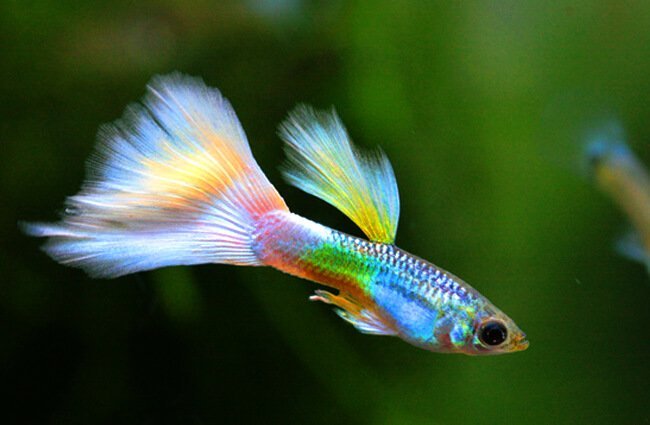
Subjects – 49 guppies of a domestic strain called snakeskin cobra green were used.
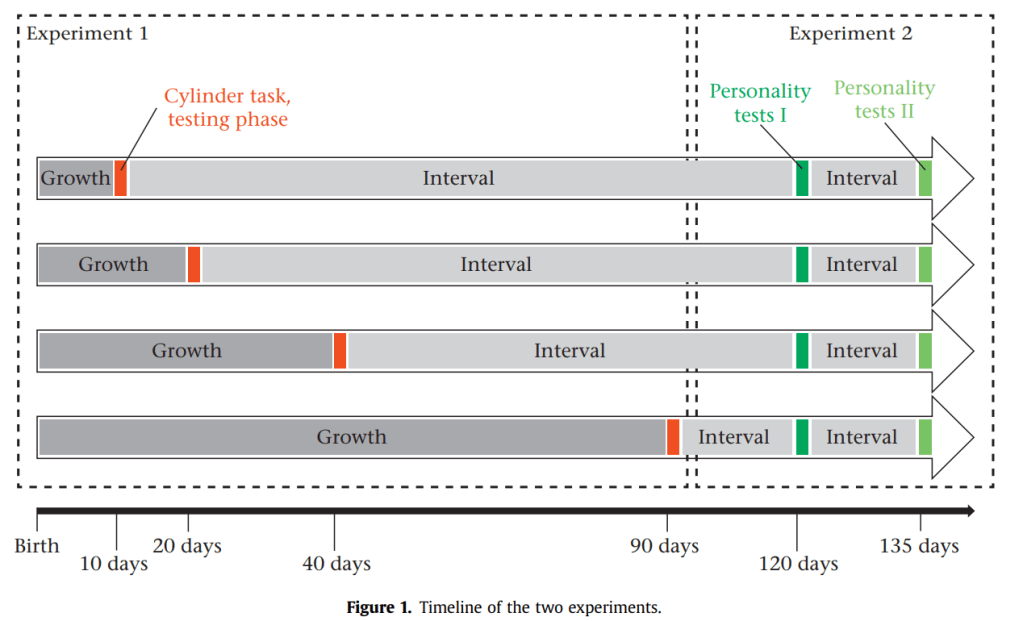
Experimental Design – 4 age groups consisting of 10 days, 20, 40 and 90 with Ns of 12, 12, 12, 13 respectively. Guppies were trained to retrieve food from a cylinder which then became transparent. For the second part of the experiment dealing with personality the guppies were housed individually until 3 months when personality fully emerges. Since the fish is social they took 10 tanks and immersed them in a bigger tank that allowed them to see each other with holes so that olfactory cues could also be transmitted. Scototaxis test, open field test and the mirror test was used to determine personality. Scototaxis tests anxiety with a dark and white environment, open field tests exploration and mirror tests whether they approach their mirrored image for self recognition. Check paper for more in depth methods.
Results:
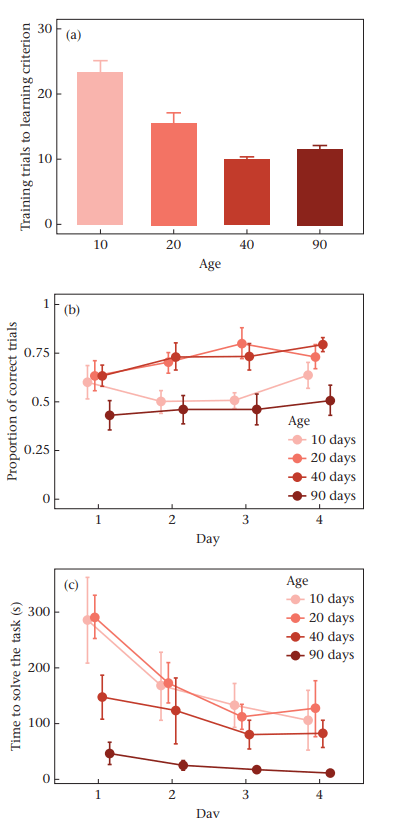
Guppies of different ages needed different training period durations to reach criterion. 10 day old guppies were significantly slower than other groups, and remaining groups were not significantly different from each other. For proportion of correct trials 10 day and 90 day guppies were not sign different from each other and were lower than 20 and 40 day guppies. For time to solve the task 10, 20 and 40 day old guppies were similar while 90 day guppies were significantly quicker. For the personality tests the guppies preferred to spend slightly more time in the white side and spent a significant amount of time near the mirror and spent a third of the duration in the centre of the open field test. Found a correlation that guppies that spent more time in the white side also spent less time with their reflection.
Discussion:
There was a U-shaped effect where the 10 & 90 day guppies performed similarly while 20 & 40 performed similarly for the motor test. The increase in skill until age 40 days makes sense given other evidence but the decline at 90 is odd. An explanation might be that there is less of a predatory pressure when youre older thus have no need for a higher inhibitory control. High inhibtory control is needed if you’re a forager that needs to stop foraging immediately at the presence of a predator. The only correlated trend found b/t the personality and inhibitory tests was that subjects that spent more time in the centre of open exploration also showed higher inhibitory control.
Notes:
90 day old guppies are not old and are just reaching sexual maturity, thus the U-shaped effect cannot be explained b/c of age. Using mirrors for social stimuli isn’t a good idea b/c it can’t be controlled so why not use real conspecifics behind glass? The training they gave before testing may have played towards certain personality types since the training itself relies on boldness. Also when using mirrors usually subjects are habituated to the mirrors for a week first before testing.
 Al3xandria