Cleaner fish are sensitive to what their partners can and cannot see- McAuliffe et al. 2021
Abstract: Much of human experience is informed by our ability to attribute mental states to others, a capacity known as theory of mind. While evidence for theory of mind in animals to date has largely been restricted to primates and other large-brained species, the use of ecologically-valid competitive contexts hints that ecological pressures for strategic deception may give rise to components of theory of mind abilities in distantly-related taxonomic groups. In line with this hypothesis, we show that cleaner wrasse (Labroides dimidiatus) exhibit theory of mind capacities akin to those observed in primates in the context of their cooperative cleaning mutualism. These results suggest that ecological pressures for strategic deception can drive human-like cognitive abilities even in very distantly related species. – taken word for word
Introduction:
The ability to imagine one in another’s shoes and gain their perspective is a core component of humans as well as non human primate theory of mind abilities. Theory of mind = ToM. This is nicely shown with primates using food compeition, rhesus monkeys are more likely to steal food when their competitors face is hidden versus their body. This hints that they are able to understand what another individual can and cannot see, this also leads to deceptive behaviour where individuals can conceal visual and auditory stimuli from rivals. This is normally seen in big brained animals but was tested in cleaner fish that use a unique feeding strategy. Cleaner fish eat ectoparasites off client fish but prefer to eat the mucus of clients, however eating mucus causes clients to leave. Cleaner fish also work in male-female pairs thus producing a prisoners dilemma b/c males normally bully females into cooperating and not eating the preferred food item. The prisoner dilemma is basically do you eat the mucus before your partner tries to, cooperate and only eat ectoparasites thus eating for longer and both fish eat, or do you eat ectoparasites but then get cheated on by the partner who eats the mucus thus leaving you hungry? Research into this topic has already shown that females have a higher motivation to cheat and eat mucus as well as are known to be more loyal if watched by a bystander client fish. This study looked at whether females would cheat more if their partners were behind an opaque wall or transparent wall. After a cheating event occurs they lift the partition and observe the punishment behaviour for 30s. They hypothesized that females should cheat more when they are not seen.
Methods:
n= 12 pairs of cleaner fish were used. Training took the form of 2 waves, first that if the fish ate the highly preferred food item it would be removed to emulate a client leaving and second that punishment may occur if the plate is removed. Fish were allowed to eat as many low-preferred food item but high preference was removed immediately if eating began.
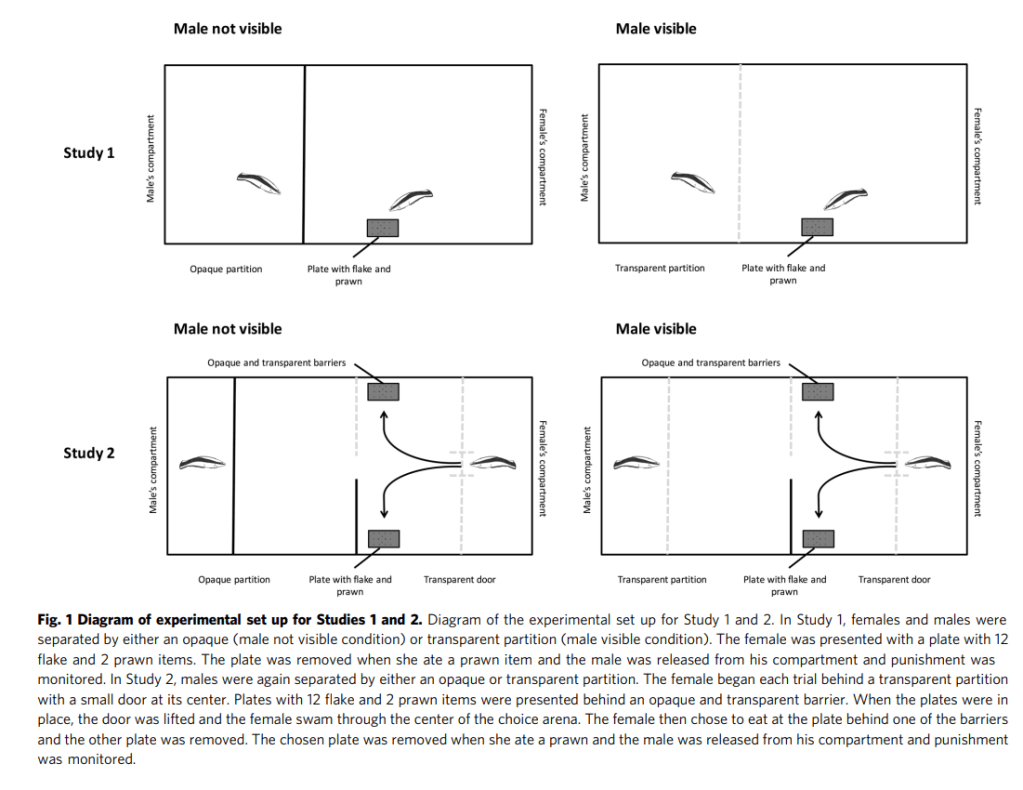
Study 1: females were presented with a plate of 12 flakes and a plate of 2 prawns, if female cheated then prawn was taken away and partition separating male was removed. Males were also getting less food during this study thus would be more inclined to punish if cheating occurred. Fish had 24 trials, 12 where males were visible and 12 where not, I wonder if b/c the males were not being fed as much if their own hunger would indicate that cheating had occurred even if it had not been visible?
Study 2: Building on the previous experiment, this time they would separate the males either with a transparent or opaque barrier and females with a transparent barrier on either sides of the arena. In the middle there would be both a small opaque barrier and transparent one with food behind both (the food was 4 flakes and 2 prawns on each plate). From the male’s perspective it could see behind the small transparent barrier but not the small opaque and could see the female in her compartment. Once the female was released and chose a barrier to eat from, the other plate was removed, if the female ate prawn from that barrier it was immediately removed and the male was released to observe punishment behaviour. This was done for 24 trials, 12 of males behind transparent and 12 behind opaque with barrier sides pseudorandomized.
Check paper for analysis
Results & Discussion:
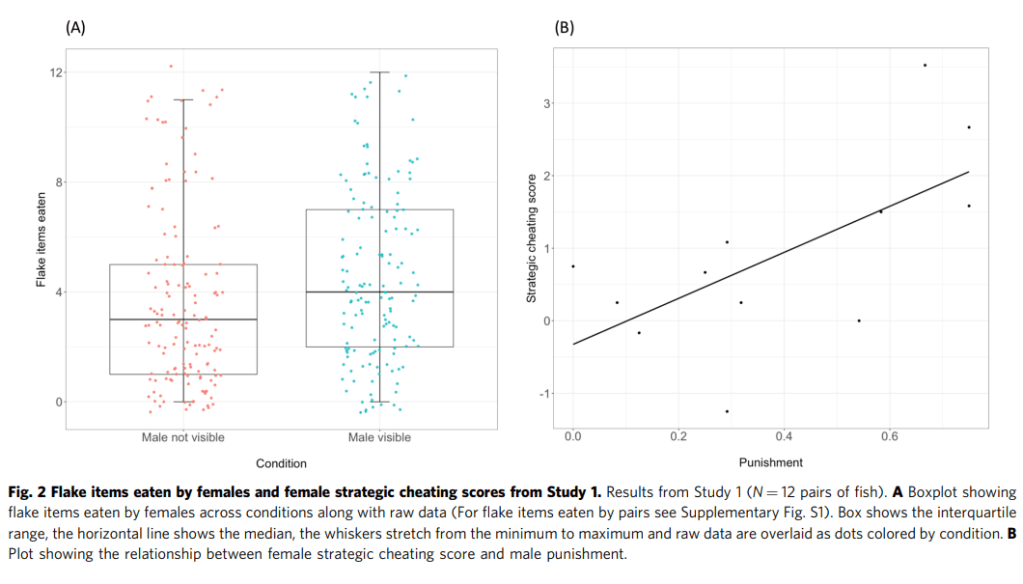
Main measure was whether females ate more flake items (meaning cheated less quickly) when the males were able to see them. Indeed females did eat fewer flakes when the males were not visible, therefore cleaner fish cheat more often when not seen just like humans and non primates. In terms of punishment males were less likely to punish females that ate more flakes whether they could see them or not. This might mean that males are not only using visual cues to sense cheating but may observe female behaviour to inspect hints of cheating -> once again could this be a hunger thing? When looking individually they found that this trend of eating more flakes when visible was also present. Since males vary in punishing severity from individual to individual, some females would actually benefit from cheating since the punishment would be worth it. This was shown in this study as well with females that experienced more punishment were more sensitive to being observed compared to females that did not experience as much punishment. In Study 2 they found that in the first block (1st trial) the females preferred to eat behind the opaque barrier when males were visible, but in the second block (2nd trial) preferred to eat from the transparent barrier when males were visible. This is b/c males punished females more when they ate behind the opaque barrier, thus shifted to feeding from the transparent barrier in the second trial. This shows that these behaviours are a lot more complicated than first assumed since males are also influencing the behaviour depending on what they observe. The punishment findings are really cool in this study because in the Study 1 the males punished the females regardless of whether they could see them and in Study 2 males punished more when they ate in private behind an opaque barrier. The reason for the shift in behaviour not representing what occurs naturally may be because in natural conditions males would not get access to monitoring the females that closely and administering punishment immediately. Therefore cleaner fish responses are extremely flexible and are dependent upon more than just visual cues.
 Al3xandria