Evaluating Environmental Enrichment Methods in Three Zoo-Housed Varanidae Lizard Species – Waterman et al. 2021
Abstract:
Little is known about reptile enrichment therefore this study observed the effects of including only scent-based enrichment and food enrichment (hanging feeders). Both types of enrichment significantly increased exploration and prolonged for 330 min post provision. There were no significant differences b/t scent and food based enrichment showing that scent may be just as effective.
Introduction:
Proper environmental enrichment broadens an individuals behavioural repertoire. 2 main issues with reptile enrichment are evaluating welfare is challenging given we don’t know the totality of their behaviours and their cognitive abilities are normally underestimated thus enrichment was seen as unnecessary. When given proper enrichment there have been cases of problem solving, enhanced plasticity, reduced stereotypies, greater longevity, increased breeding success and improved body condition. Multiple ways to include enrichment, but main 5 ways are creating a dynamic habitat, encouraging social interactions, encouraging foraging, introducing novel objects and training. They observed exploration rates and interactions with given enrichment. Prediction: predicted that exploration would increase with provision of enrichment, magnitude would change depending on enrichment, engagement with the actual enrichment would differ based on type of enrichment and that enrichment would lose its novelty thus less attention from the individuals.
Materials and Methods:
Individuals: 5 individuals total, = 1 male and female for komodo dragons as well as for emerald tree monitors, and 1 female crocodile monitor. -> their housing was all different and some were housed with other species, this might make comparing the effects of enrichment a little difficult even across the same species since the pre-existing housing wasn’t controlled. The individual ages were also not controlled thus ontogeny may have an effect as well.

Testing Protocol: subjects were presented with randomized series of 6 enrichment conditions over 16 weeks. Each enrichment was only presented once to the subjects and not all subjects got all 6 enrichment. Observations took place in 4 sections for a total of 80min in a day -> pre enrichment, during enrichment, post enrichment 1 and post enrichment 2. Block 1 and 2 were continuous and blocks 3 and 4 happened randomly at 30-150min and 151-330min respectively. Check paper for statistical analysis.
Results:
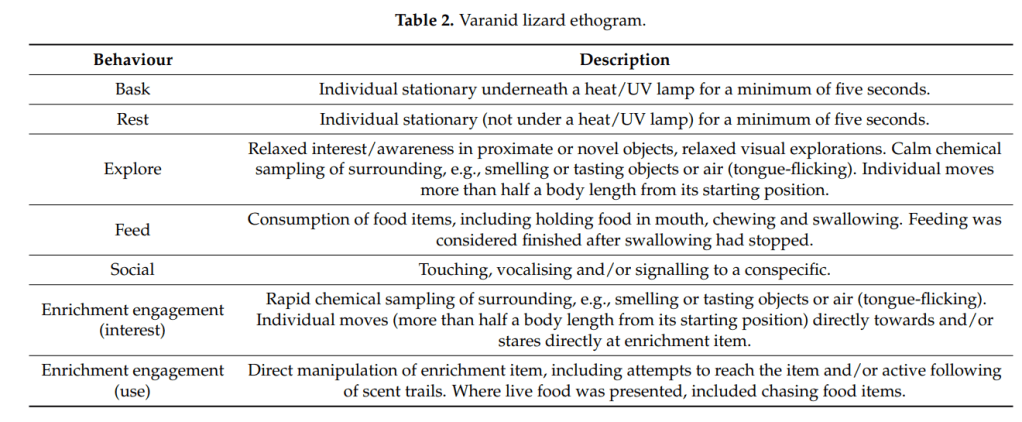
-> Effect of enrichment on exploration: provision of enrichment increased exploration and exploration significantly differed based on enrichment type. Hanging food, scent piles, and scent trails were all associated with significant increases in exploratory behaviour. There were no significant differences in exploration for pre enrichment and during enrichment for scent furnishing, food(ground), or scent (trail-food).
-> Effect of enrichment type on engagement time and longevity: engagement with enrichment decreased over time, significantly lower in post obs 2 than 1. No significant effect of enrichment type on diminishing time.
-> Effect of Food vs. Scent
No significant difference in longevity of engagement with food vs. scent based enrichment.

Discussion:
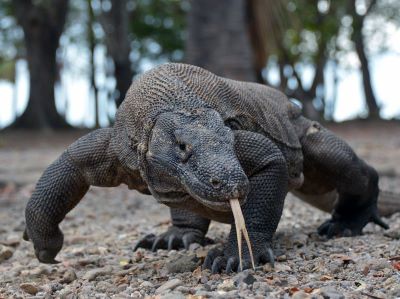
Found that the inclusion of this type of enrichment significantly increases exploration in captive lizard species and can hold novelty for upto 2.5hrs. Found that not all enrichment types elicit the same responses and scent based enrichment seems to be the most effective. These findings confirm what has been proposed by few previous studies that show turtles and other reptiles being receptive to enrichment. The findings of this study also confirm that the most effective enrichment types are those that play into the subjects natural behaviours. For example makes sense that scent is so enriching for these species since komodo dragons rely on their sense of smell to forage and can detect scents from upto 8km away.
biggest limitations of this study is the small sample size for each species and the varied ages, and the varied housing of individuals even within the same species. For example one individual was housed with other species thus habituation rates b/t individuals couldn’t be compared accurately.
 Al3xandria