From fish out of water to new insights on navigation mechanisms in animals – Givon et al. 2022
Abstract: To understand navigation systems and whether its universal, they trained fish to navigate a terrestrial environment. They call this method a domain transfer methodology and placed a fish in a tank that was set upon a robot which moved whenever the fish was close to the tank wall and facing outwards. The found that the fish could successfully navigate a terrestrial environment with minimal mistakes.
Introduction:
Fish have been shown to orient themselves using allocentric and egocentric maps which means that they can orient themselves using external cues (allocentric) like landmarks as well as themselves (geocentric) for example like this thing is to the left of me. The neural basis of fish are also similar to mammals and birds when observing the large amount of evidence in various forms of navigation. For example salmon can navigate on micro and macro scales and rabbit fish could find their homes even after being displaced. This poses the question of whether all species navigate in the same manner, is space represented the same, does environment affect representation and how is it used? By using the method of domain transfer they hope to understand this question better since the fish will be navigating an environment that it would never be in. To do this the fish needed to first learn the motor skills related to the task and needs to understand the information received from the terrestrial environment. Especially because of the diffraction issues from air to water and through glass.
Animals:
One female, three males and two undetermined fish were used for this study.
Fish Operated Vehicle:
Basically a tank on a robot in which each of the walls of the tank can propel the robot in the direction required based on orientation of the fish as well. Check the paper for the specifics of the python coding used and the methodology. Dimensions of the vehicle was 40cm x 40cm x 19cm
Behavioural Arena:
3m x 4m arena.
Behavioural experiment
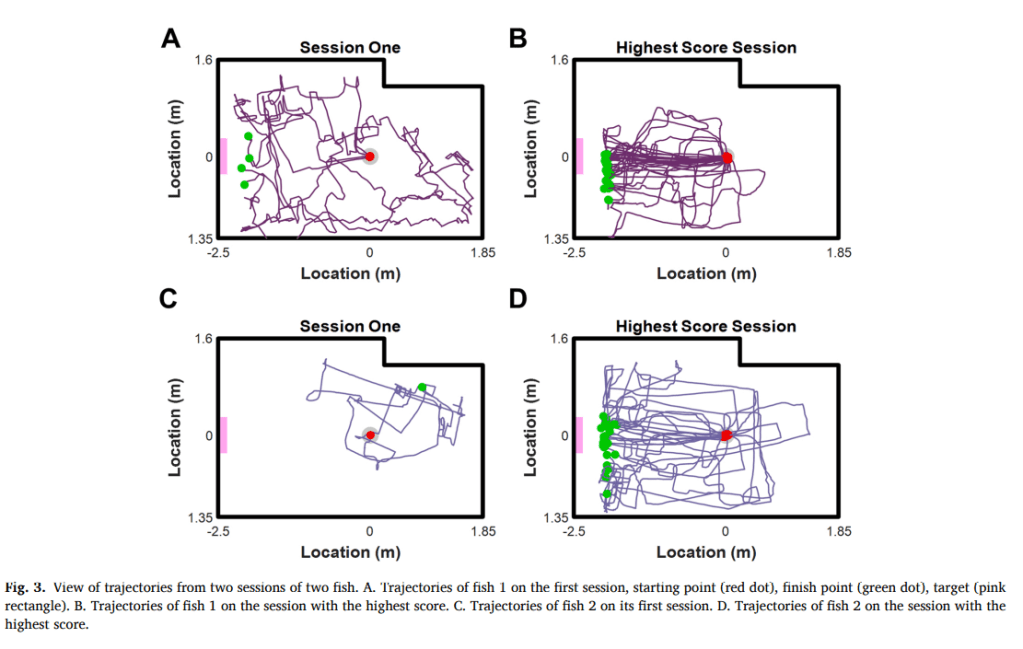
Each session lasted 30min, and to limit overfeeding there was a maximum of 20 trials, sessions were conducted 3 times a week every two days and unless more than a day passed between sessions the fish were not fed between sessions. The experiments started by letting the fish use the vehicle for 15min (was this done in the arena?). The experiment specifically looked at whether the fish could drive to a target within the arena for a food reward. First test was to place fish in the center of the arena with a wall marked with a pink board
Statistical analysis:
One tailed t-tests were used.
Fish can overcome environmental manipulation:
They manipulated different things with the experiment to make sure they were learning the task.
– First changed location of starting across trials this was to make sure that it wasnt just muscle memory.
– Decoy target control -> placed targets of the same size and shape on all 4 walls but had different colours and did this for 15 trials. The fish started from the central location for all trials and the fish never went for decoys.
– Target location control -> Changed the location of the target to the opposite wall which could leave 3 outcomes, 1. heads to OG reward spot and stays, 2. heads to OG then heads to new target spot after not being rewarded, 3. heads straight to new target spot. The fish did the second method showing that the fish take in more of the environment than just the target, they rely on the target cue after some main attribute first fails.
– Conjunction Control -> Same task but now with decoy targets as well.

Discussion:
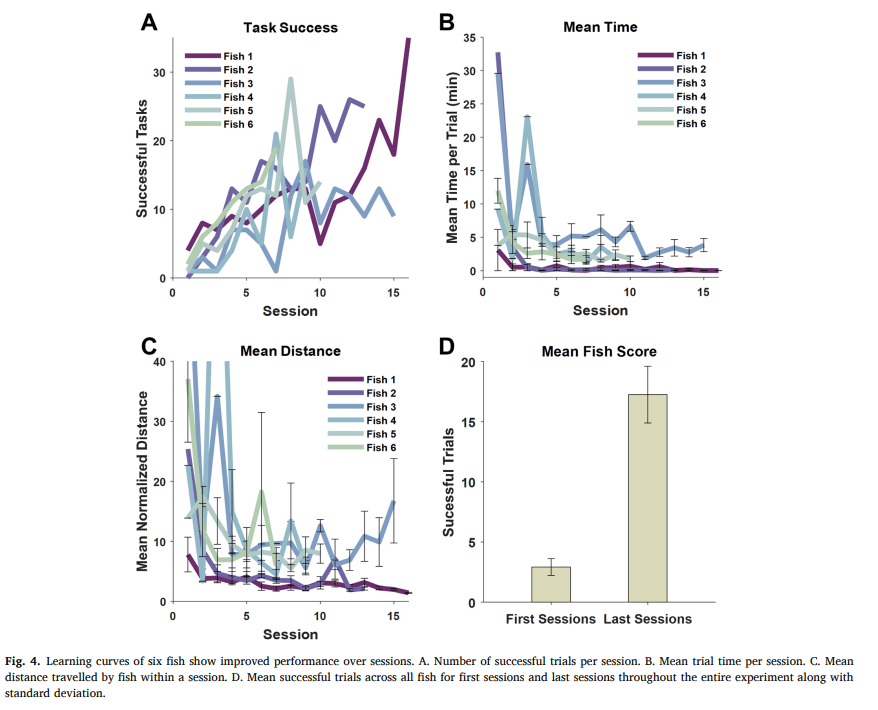
Showed that fish can learn to use an automated vehicle and that they can use it to traverse an arena for a reward even when the arena is manipulated with change of location and use of decoys. Shows that the navigation systems used by fish in an aquatic environment is successful in a terrestrial environment. They also connect the definition of domain transfer methodology into the use with space travel since when animals are placed in alien environmental conditions their behaviour tends to change as well. This study is a little difficult though because I wonder if this study could be replicated without the complexity. Like what if you strapped goggles that distort the vision of the fish in the same way as water to air, because I think this experiment dwindles down to the fish learning to wait close to a wall that has the specific target. I think what we know for sure from this study is that fish can differentiate between colours outside of the tank, and can learn to wait next to wall in relation to the target colour in which positive feedback maybe the target getting bigger as it waits there. However their figure 5b is cool because the fish goes to what spot it should normally and then seems to manuver back out and back to the spot multiple times before heading straight to the targets new position. I wonder if we would get the same effects if the arena moved and the fish tank stayed stationary. Like 4 different tv screens that create a virtual environment?
 Al3xandria