Aggregation and social interaction in garter snakes (Thamnophis sirtalis sirtalis) – Morgan & Miller, 2020
Introduction:
Reptiles in general tend to rely on a method or variety of interactions called cryptic sociality, in which they use chemical cues to interact with conspecifics. However this is very hard to study given its invisible in most situations. The least social of this cryptic group are the snakes however few studies have shown otherwise with evidence of communal shedding grounds, kin recognition by timber rattle snakes, and social networks by Arizona black rattlesnakes. There is also evidence of accidental aggregations in which individuals are mutually attracted to a resource abundant location, pr large numbers serves a benefit like thermoregulation in a group, decrease water loss, protection from predation. On the other hand the costs of this are snakes cannot share food and with juveniles present it can become deadly when fighting over food or juveniles can become a food source. This experiment observed whether garter snakes would seek social interaction even when conditions were kept constant and water/food was plentiful. This was done by placing groups of 10 snakes into an arena with four shelters and tracked movements and social interactions. They also used a personality assay for individual snakes which includes a boldness and sociability score.
Methods:
– Subjects: 40 juvenile snake were used, 30 from 3 wild caught females and 10 additional snakes purchased from a local breeder. The majority of the study was run using siblings kept in groups therefore, 4 batches. Snakes were split into other groups as their size.
– Apparatus: 73.7 cm squared tabletop enclosure made of 35.6cm high walls. 4 black shelters of 14cm x 10.2cm x 5cm were placed in the center of each wall. Boldness and sociability were conducted in 2 separate arenas different from the apparatus.
– Procedure: Aggregation experiment – 4 batches of 10 individuals each, batch 1 had 10 siblings of identified parentage, check paper for more indepth about each batch’s individuals. Each snake prior to the experiment was individually marked with nail polish for ID and remarked with each shed. Snakes were habituated to the arena first by placing them in the experiment the day before and then running for 8 days. All snakes were kept on the same diet starting a week in advance to limit dietary effects on aggregation, for example some food may take longer to digest thus thermoregulation may cloud the effects of sociability. Twice each full day the researcher would record placement of snakes via a handheld camera, after each recording the snakes would be removed, cleaned the apparatus completely and then released the snakes back in via a predetermined fashion. The personality assays were conducted after the experiment, check paper for indepth.
– Statistics: check the paper
Results:
– Individual personality assay: heavier snakes were more bold and snakes were similar in boldness across their own trials showing repeatability. Boldness was determined using latency to leave shelter and time out of shelter. In the social test snakes spent significantly more time in the social shelter than the control, the social shelter had conspecific scents while control had nothing. Sociability scores correlated negatively with boldness but not with weight.
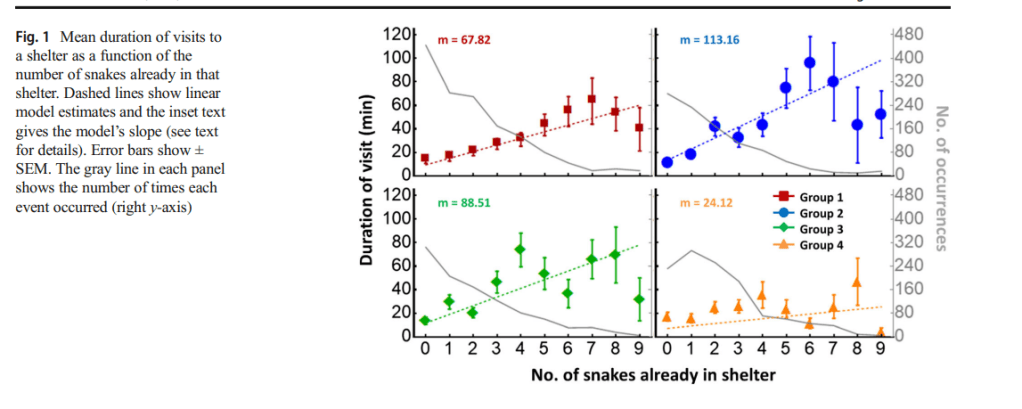
– Aggregation experiment: snakes spent 94% of their time in shelters, males spent more time sheltering than females, time sheltering did not correlate with boldness, sociability or weight. Snakes spent less time out of the shelter when in a group than when alone with a larger effect in males than females. Snakes were more likely to stay in shelters that had more individuals. Batch 4 acted significantly different than batches 1-3. Batch 4 was the oldest group and they showed that the number of individuals was less critical when sheltering.
– Time of day effects: Snakes explored significantly more in the afternoon than in the morning or midday, snakes tended to stay longer in the shelters when they were placed in them versus released from the center. When snakes did explore, they tended to explore in groups rather than alone.
– Social Network: The snakes tended to group in cliques but the severity of the clique changed with the time of day. Snakes showed a stronger preference for cliques in the morning than at the other times and this was not driven by sex. Check paper for more in-depth analysis.
Discussion:
Offer evidence that juvenile garter snakes actively seek to join and be apart of groups especially large ones both when sheltering and exploring. They display a variety in individual personalities which influence aggregation groups. They form nonrandom networks where they prefer some conspecifics over others and these aggregation patterns are repeatable over time even after repeated perturbation to the groups. Previous studies show that snakes aggregate because of different factors like thermo regulation or water loss, however this study shows that even when conditions are kept constant that snakes still prefer social interactions. Also this was mainly seen with the juvenile snakes showing that this effect may disappear as they age and predation becomes less of a risk. The snakes also sheltered a lot but came out periodically when others would go out, they may use others going outside as a cue for it being safe. Since snakes cannot share food then finding food can be very competitive, this provides a certain social dynamic, for example butler garter snakes aggregate with individuals on a different diet than themselves.
 Al3xandria