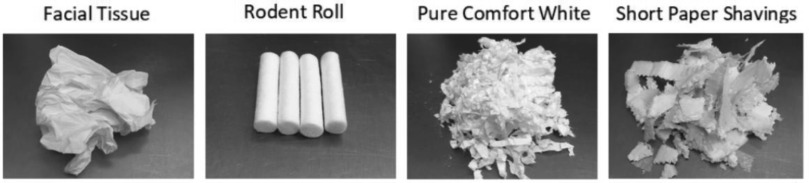
Preferences for nesting material as environmental enrichment for laboratory mice – Van de Weerd et al. 1996
Abstract:
Behavioural and psychological needs of laboratory animals generally cannot adequately be met in standard laboratory cages. Environmental enrichment, which provides a more structured environment can enhance the well-being of laboratory animals. They may perform more of their species-specific behaviour and may control their environment in a better way. An easily applicable form of enrichment for laboratory mice is nesting material. Six different types of nesting materials were evaluated in a preference test with male and female animals of two strains (C57BL/6Tor BALB/c, n=48). No significant differences in preference were found between the strains or between the sexes. All mice showed a clear preference for cages with tissues or towels as compared to paper strips or no nesting material, and for cages with cotton string or wood-wool as compared to wood shavings or no nesting material. Paper-derived materials were preferred over woodderived materials, although the results also suggest that the nature (paper or wood) of the
nesting material is less important than its structure, which determines the nestability of the material. Nesting material may be a relatively simple method to contribute to the well-being of laboratory mice. – word for word
Introduction:
Most lab enclosures only include the bare mininum needed for subject survival, like food, water and substrate to avoid contact with feces. However their behavioural and psychological needs are inadequately met since they are limited by enclosure space and lack of stimuli to engage in natural behaviours. Animals in these enclosures with the added stress would be poor models to extrapolate results for human use. Therefore enrichment would be useful to alleviate said stress. Nesting material is easy to implement and used by various rodents for various means like pregnancy and thermoregulation. This study aimed to observe whether mice preferred certain types of nesting material as enrichment among normal environmental conditions. Preference testing prior to implementing enrichment is critical because different breeds of the same species can respond differently to the same enrichment.
Materials
– Animals: n= 48, experiment started at 8-10 weeks of age, males went first and lasted 7 weeks, females lasted 4 weeks. Animals were housed in groups of 6 in 2 or 4 enclosures with tubes that connected them.
– Procedure nesting materials: mice were introduced to the preference system between 15:00 and 17:00 and tested individually. The behaviour of each mouse was observed for 12hrs during the day and 12hrs at night. Three test series to test 6 different types of nesting material, 1st test series – paper, 2nd test series – wood, 3rd series – highest choice of each series compared together.
– Behaviours : sleeping, manipulation of nesting material, grooming in nest, grooming outside of nest, ingestive behaviour, locomotion, climbing, rearing, and digging.
Results:
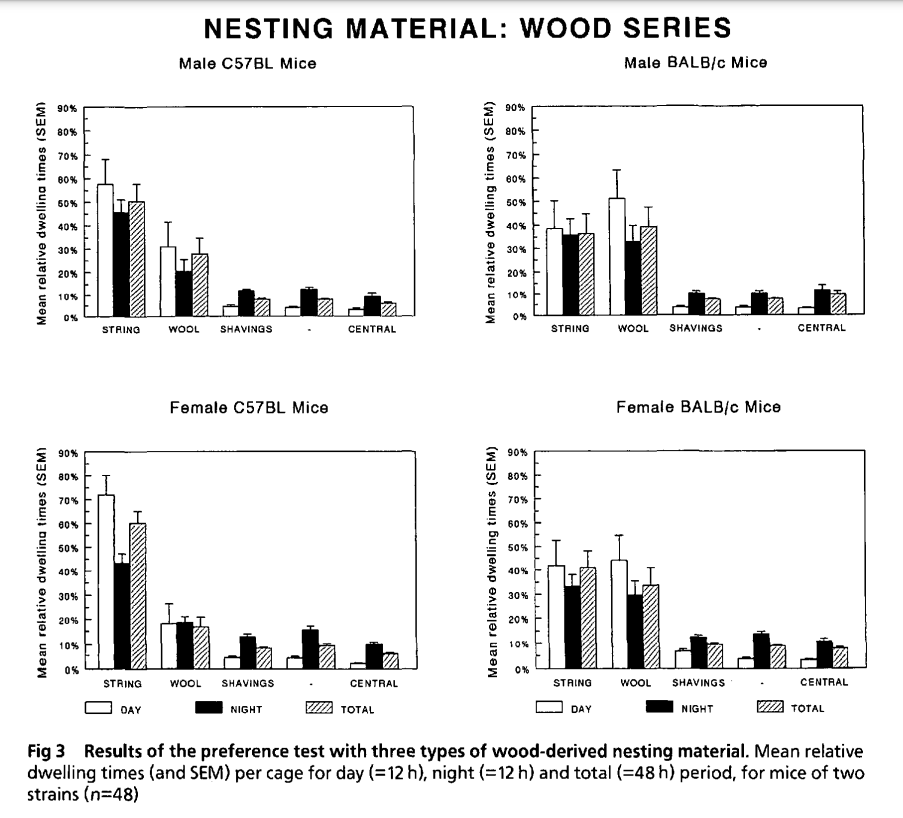
No significant differences in cage preference was found between strains. In the paper series they preferred tissues and paper towel, while in the wood series they preferred cages with cotton string and wool-wool were preferred. The females significantly preferred tissues and cotton string regardless of strain and In the 3rd series comparing the highest of each type, they preferred the paper nesting materials in the total and during the day. For food and water intake, one strain drank more water when with tissues and no nesting material, while the other strain drank more with tissues and towels. One strain of mice ate significantly different levels of food when in the wood series, specifically when there was wood shavings and no nesting material. Check paper for specific results. The mice also had a habit of dragging and mixing different nesting material instead of just using one.

Discussion:
Results show that mice can differentiate between nesting material and that they do have a preference. Cages with tissues or towels are liked more than those with paper strips while cotton string or wool-wool is preferred over just wood shavings during the wood series. One strain of mice significantly preferered the paper materials over the wood while the other strain did not prefer one but rather preferred to combine materials. Given that some of them mixed material shows that other features in nesting material are critical to choice like structural integrity. The structure of nesting material is crucial because it determines nestability, which is the manipulation to making a nest. Each of the preferred nesting materials could be shredded or formed into any desired shape. Permeability to light may also be a critical aspect to think about because mice are mainly nocturnal thus need a solid cover around them to block the light during the day.
 Al3xandria