Environmental Enrichment Alters the Behavioral Profile of Ratsnakes (Elaphe) – Almli and Burghardt, 2006
Abstract: 16 sub adult rat snakes (Elaphe obsoleta), 8 in enriched conditions and 8 in standard for 8 months. Enrichment came in the form of additions to enclosures with elevated hide, and loose substrate to burrow in as well as live feeding. Enriched snakes showed shorter latencies to goal sites in a problem solving task, habituated faster in an open field task, a feeding task did not show any differences. A discriminant function analysis observed a number of parameters taken from the cognitive tests and correctly placed all individuals into their residing treatments. This showed that the treatment created a unique but consistent behavioural profile.
Intro:
Enrichment being critical to normal growth or reaching the full potential of an organism is a common theory and it is generally tackled in 2 ways. The first method is to include environmental enrichment to study changes in physiology and the other is to improve welfare in captivity. Enriched environments allow inhabitants to engage in more natural behaviours, however these environments will never replace their actual natural habitats. Environmental enrichment has been thoroughly studied in mammals, and part of this is social enrichment since they are typically social animals. However social contact during enrichment could be a confounding variable thus snakes provide a unique opportunity to asses the effects of enrichment when sociality is removed. Also given a snakes morphology of being limbless and ectothermic, they may be more responsive to changes in their environment. This study chose to use rat snakes because they are precocial which means they are independent from birth, and tend to avoid conspecifics. The specific tests used to assess the effects of enrichment are based around task-driven behaviour (problem solving), spontaneous behaviour (exploration), and functionally relevant behaviour (feeding).
Methods:
– Subjects: Originally 18 but 16 surviving captively hatched rat snakes from 4 males & 2 female yellow rat snakes, and 6 males & 4 female black rat snakes. Kept in treatment conditions for 8 months.
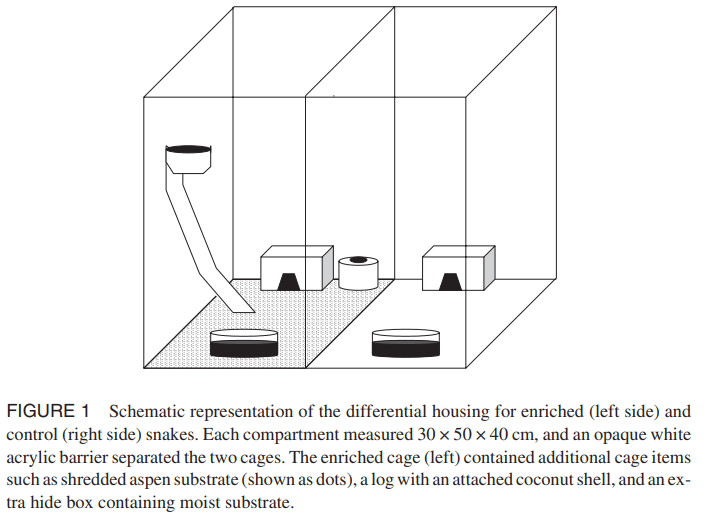
– Standard Condition: 5 male and 4 females were kept in cages with paper substrate, no climbing enrichment, and given dead prey for feeding.
– Enriched condition: 5 males and 4 females were housed in cages with shredded aspen bedding, elevated coconut hide, hydration chamber in the form of wet moss in a plastic container and were fed live prey.
– Behavioural experiments:
1. Problem solving task , 10min trials or till goal was located, involves a circular wooden platform with 12 holes that act as goal sites. They used sand to give the snakes traction and during trials 1/12 holes were open with a hide underneath. The arena was fitted with bulbs overtop to create extreme heat and bright light that would motivate an escape response.
2. Open field task: these tests an animals natural responses, observed locomotion, rearing, and tongue flicks. Trial lasted 10min.
3. Feeding task: this was to test whether the enrichment had an immediate biological relevance, like in feeding behaviour. Enriched snakes ate live prey and standard ate dead prey, during testing they were given 4 presentations with 1 presentation/10days in a A-B-A-B sequence. The A was familiar prey (either live or dead) and B was unfamiliar which was the opposite. Based observations on prey capture position, prey handling method, type of coil, prey position at ingestion, feeding proficiency, and total feeding duration.
Results:
– General: enriched snakes grew significantly larger than standard
– Behavioural:
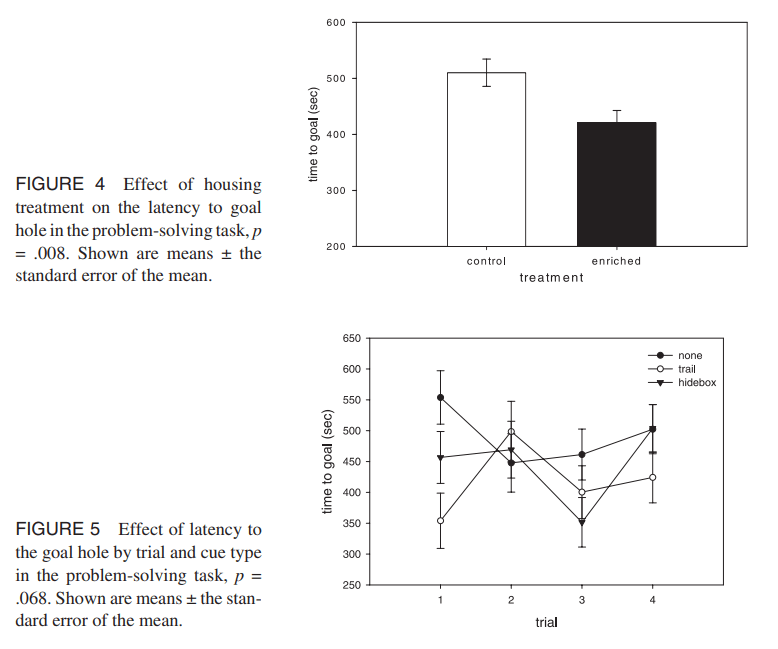
1. Problem solving: enriched snakes found goal sites significantly quicker than standard and there was a trend that snakes in general found goal sites quicker when there was a prey odour trail.
2. Open field Task: Enriched snakes habituated to the open field while standard snakes increased in their response within a trial. Over all the trials all snakes showed habituation however enriched snakes habituated faster.
3. Feeding task: no change was seen between the treatments. Live feeding took significantly longer than dead prey for all snakes.
4. Discriminant function analysis: observed variables of total consumption time with live prey and dead prey, tongue flicks in OpenField, grids crossed in OpenField, rearing time in OpenField, rearing bouts in OpenField, latency to goal in problem solving, time in goal quadrant in problem solving and number of errors in the same task. Found that the treatments created a unique behavioural profile.
Discussion:
Enriched snakes were better at problem solving and less reactive during the open field, showing a beneficial effect from the treatment. The DFA shows that the enriched snakes may be better adapted than standard snakes which performed not as efficiently. Enriched snakes had shorter feeding latencies suggesting that they had better motor control, had higher initial rates of exploration and habituated quicker than standard counterparts to novel environments, which might indicate that they have reduced emotional reactivity. This signifies that the animals are calmer and not as emotionally volatile when presented with novel stimuli. They also had shorter latencies to goal sites indicating improved problem solving ability.
 Al3xandria