
Only child syndrome in snakes: eggs incubated alone produce asocial individuals – Aubret et al. 2016
Abstract:
Egg clustering behaviour has many advantages like anti-predatory, moisture maintenance, temp control, prevention of eggs rolling and hatching synchrony through embryo communication. In this experiment water snakes were housed either in clutches or individually to see if the effects in social behaviour. Individually housed snakes were less social and more active during open field trials when placed in a group of 5 snakes.
Introduction:
Eggs from both birds and reptiles were thought to communicate using egg vibrations, heart rates, odours and carbon dioxide levels. This is key for hatching synchrony because when individuals hatch together it decreases chances of predation, recently it is hypothesized that the eggs may also be sharing information on natal environment and future competition. This experiment split water snake eggs into either individual or group housing then recorded embryo development rates, hatchling body sizes and post natal social behaviour.
Methods:
Used water snakes (Natrix maura) .Had 4 different clutches in which each clutch was separated in half into clustered and individually housed eggs. They measured heart rate and egg mass every 10 days until hatching. They placed the eggs into jewelry bags just a few days prior to hatching to ensure the snakes stayed separate and close to their eggs for identification. -> Great idea btw
Results:
– Incubation and hatching traits: egg mass did not significantly vary, there was a significant effect on heart rate, as days progressed the single eggs increased greatly in heart rate compared to group housed eggs. Hatchling body size and incubation time were non-significant.

– Aggregation and activity: This was done in the open field, snakes that were incubated alone moved on average 695.48± 31.67 cm2 versus 433.31± 122.65 cm2. Snakes incubated alone also contacted each other a lot less than the clustered eggs.
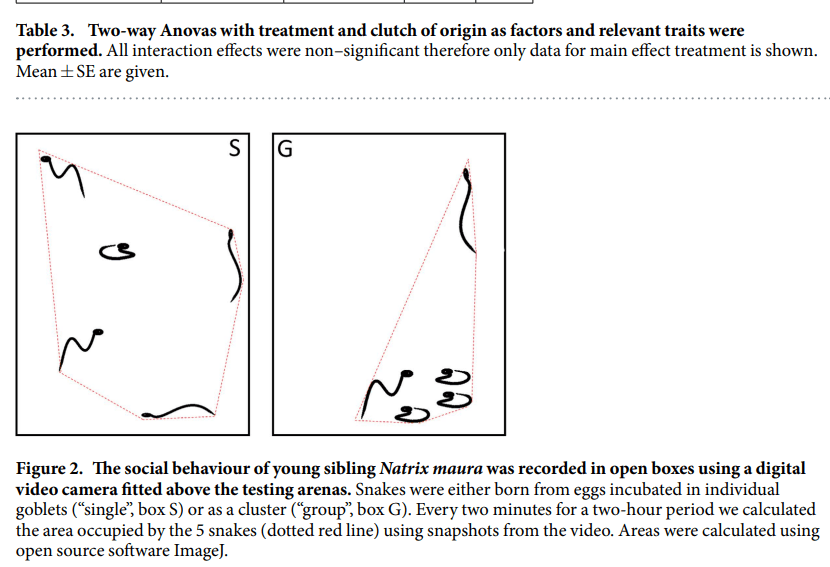
Discussion:
The hatchling size of snakes affected by treatment almost made significance, thus with higher sample sizes this may be seen at a larger scale with other reptiles. For other species, clustered eggs normally hatch larger than those alone. The fact that social behaviour was altered by this condition shows that clustering eggs may be critical to fostering social bonds prior to egg release. Other reptiles like anoles show social behaviours as soon they are released from their eggs and also engage in hatching synchrony, and iguana eggs were clustered they found that grouped eggs found the shortest distance to the mainland compared to single eggs. It seems this kind of trait is also present in water snakes and may have been facilitated by heart beat and hormonal odours. From the results of the open field they try to show that the snakes from the singly housed maybe exploring more and trying to escape b/c in their isolated egg form they had no communication from neighbours which may have signaled that the current environment is not hospitable. This leads to questions about egg welfare since most reptile hobbyists and breeders separate eggs to minimize risk of egg rot. However if there is communication occurring between eggs, this might be critical to social development, even in a typically asocial animal.
Future research could take the eggs and conduct the cognitive tests afterward better by running a personality assay and assessing multiple aspects of cognition.
 Al3xandria