Variation in Yield and Toxicity of venom from a rattlesnake – Minton Jr, 1957
Introduction:
– Different studies have looked into the variations in milking frequency on yield and toxicity of venom in various species. Check paper for specifics, one study showed that milking every month caused the second milking event to produce on average less than the first. However more studies have shown that there is a large variation and it seems to be random given that the snakes are healthy, for example one species had the highest venom yield on its 7th extraction while another species had the highest yield in its 1st extraction but its final extraction was only 1.4mg less. Therefore it seems quite random how much the snake produces venom at any given time and is different amongst individuals of the same species as well as different species. Another study using agkistrodon piscivorous over a 2 year period found that venom yield fluctated randomly between 80 and 237mg with the minimum LD varying between 0.05mg-0.16mg. In general they showed that shorter rest periods produced lower yields. Another study with crotalus ruber lucasensis recovered 59% of venom after 27 days and 90% after 54 days. This same study shpwed that rattlesnakes in captivity tended to decline in venom yield over time.
Method:
– This study looked at one wildcaught rattlesnake kept in a lab condition for the duration of the experiment. It was roughly a year old, rarely rejected food and would engage in defensive behaviours at the slightest provocation. It was fed every 5-7 days, venom extractions were done monthly and feeding was absent 7 days prior and 2 days after milking. They placed the snake in a chest freezer to calm it down and then milked the snake with little restraint. Venom was collected in a watch glass then weighed and placed in a small desiccator overnight. Afterwhich it was weighed again and the process was repeated until the weighings were within 2mg of each other. However they placed samples in the fridge while other studies say -80 is best.
– Toxicity tests required dissolving the venom in saline for 2mg concentration and venom dilutions were spaced 0.05mg apart and injected into groups of mice. This was done until the lowest dose produced no more than one death and the highest with no more than one survivor.
Results:
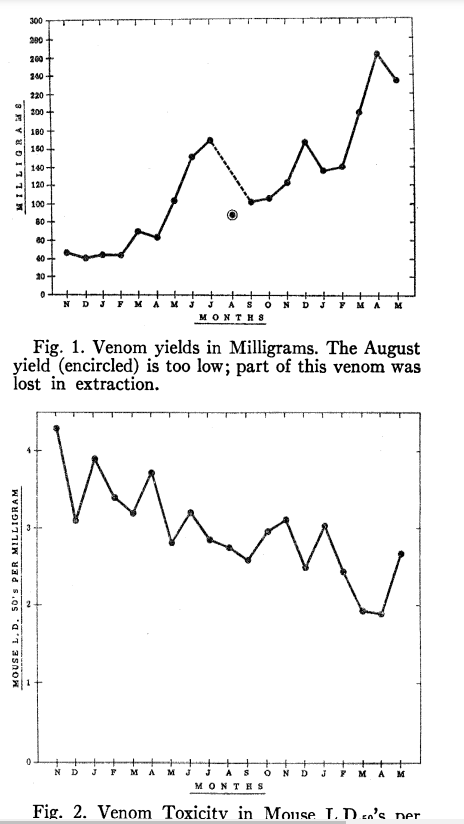
– The last 3 venom yields were not below the average of 277mg which is the value given by another study using same species of adult rattlesnake. The first 4 months of collection were basically the same, a slow increase during Feb. and March but a rapid increase in April-June. Late september produced 60% of the usual yield with increases from october to the following Feb, and then another steep increase from March to April. Variation in toxicity was large among the 19 samples collected with LD50 being 17.35mg and standard deviation being 3.608. There was a general trend for decreasing potency in captivity over time, and the samples were low in toxicity compared to 10 wildcaught rattlesnakes that were milked immediately after capture. The fluctuations in toxicity may be because weaker components of the venom are produced faster than powerful components and the powerful components increase in production as the snake matures. They also tested wildcaught venom samples qualitatively against the captive specimen and found only a slight difference in positions of the bands that indicates some antigens are present at difference concentrations in the freshly caught snakes.
 Al3xandria