Always watch the videos and pretend to code a couple times before starting:
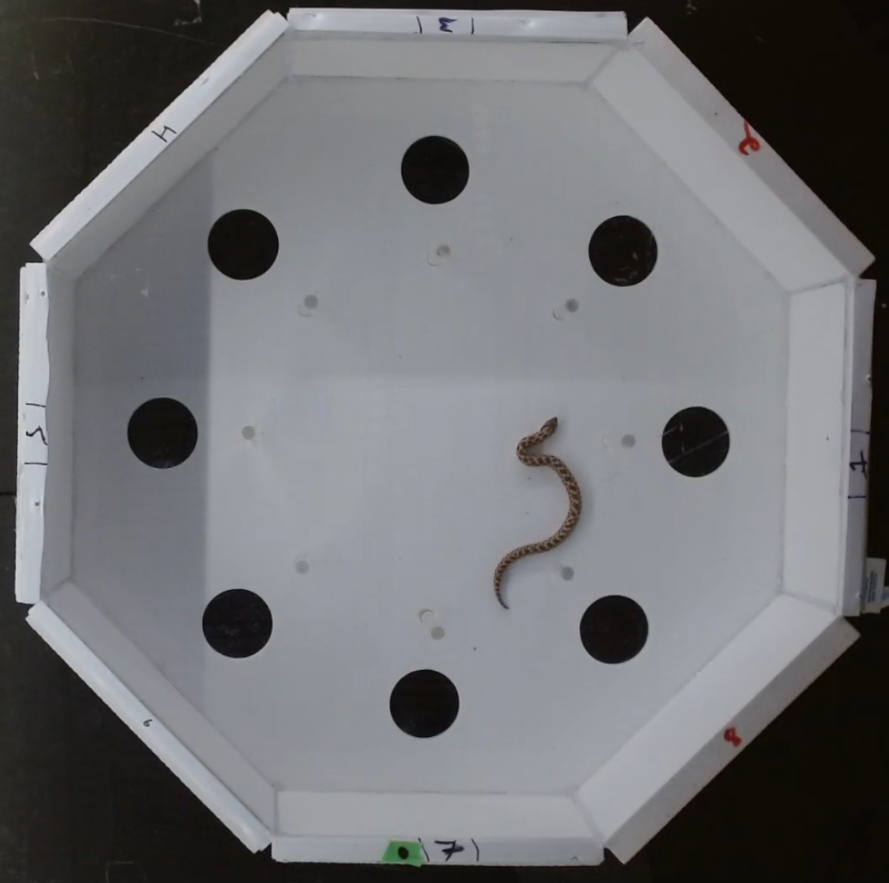
- The Barnes maze is used to observe spatial cognition and memory mainly in rice. From what I can tell the Holtzmann et al. (1999) study was the first to adapt this for snakes. They used a circular arena with 8 possible entrances for a reward shelter to be attached. Only 1 entrance is open during a trial and the trial finishes once the snake finds the hole or the trial duration finishes, in which case the snake is led to the goal site.
- I used the same test with hognose snakes and found they were capable of doing it. The snakes completed the maze most of the time, and I added an extra component using scent markers. I placed artificial odour cues around the arena in a compass rose fashion to help the snakes orient themselves. Personally I think the snakes don’t use them as much as just freely moving around and stumbling onto the reward because of the cue placement. In the diagram you can see the scented pegs are placed in front of the circle entrances but given thigmotaxis, I wonder if the pegs should be attached to the wall. This would definitely increase the possibility of encountering the holes prior to reaching the entrance.
- Barnes Methodology: 20min is good, if the snakes don’t complete the task then gently guide them to the goal site. The reward for hognose snakes was a shelter filled with soil attached to the bottom of the entrance, this is species specific since the snakes love to dig. For other snake species you may want to use other rewards, maybe for arboreal snakes the “shelter entrances” are actually placed on a stand to give height with only one allowing entry. I used artificial odour cues consisting of natural fruit juices since they are non-toxic to snakes, I used pineapple, orange, apple and lemon. I purposely did not use the lemon as the reward cue b/c some online stuff says that snakes avoid the scent of lemon.
- Behavioural variables to code for:
1. Multiple trials: It will take multiple trials for the snakes to learn this task, I used 5 b/c of time constraints but I recommend more. Track completion times as they progress through trials.
2. Movement Path: Code every 2nd frame noting head, middle of body and end of tail position in the maze to track which path it takes throughout the trial. This will help you figure out whether the snakes are being more efficient with movement.
3. Thigmotaxis: This is good to use b/c it will tell us about the personality of the snake, bolder snakes will move away from the safety of the walls to explore.
4. Tongue Flick rate: Check tongue flick rate if you are using odour cues, best to record anyway cause even if scents are present the snakes do rely on it for investigation.
5. Probe Trial: This is the most important thing to look at, block the entrance to the reward and run the trial for the full duration. Observe how often it reaches the goal site and how long it spends there. This will tell you if the snake actually knows where its going.
 Al3xandria