Evidence of mild toxicity in the saliva of the hognose snake (Heterodon) – McAlister, 1963
Introduction:
This paper focuses on whether the saliva of H. platyrhinos is venomous to small animals. Previous studies looking at different snakes that are deemed as non-venomous showing swelling/toxic effects after bites are mentioned in this study.
Methods:
n=3 adult females and 1 adult male, salivary glands were collected from all specimens. -> 2 specimens were collected from Porter County, Indiana and the other 2 were from a dealer in Florida, so half the samples can’t be verified for history or diet. The assay animals were adult white mice and a group of amphibians, check the paper for specifics.
The experiments were conducted by pithing the snakes and then extracting different organs/tissues and macerating it in 5ccs of 0.1 Holtfreters solution. The first solution was four glands of both superior labial and both inferior labial salivary glands, removed with forceps and scissors. This was deemed the salivary preparation. Next the postorbital portions of both harderian glands were prepped in the same manner and called the harderian preparation. Finally 2gs of axial muscle tissue removed from the midbody and prepped in the same way and deemed as control preparation.
All assay animals were injected within 30min of snakes being pithed and were injected in left thigh.
Results:
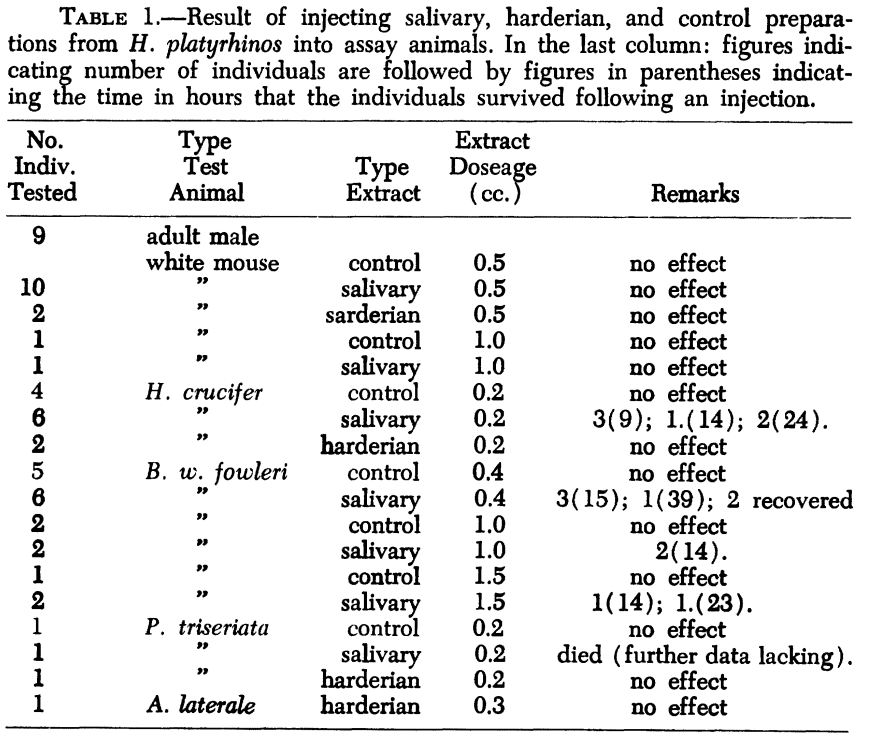
There was no change between control and harderian preparation for both mice and amphibians, and mice did not show any adverse effects for salivary preparation. In amphibians, 15/17 of them died after injections. No acute symptons were seen among the amphibians other than hemorrhages and inflammation at injection site. The two subjects that survived showed the visual signs but then the signs faded after 2 days.
Discussion:
There is evidence that shows labial salivary glands of the hognose snake is fatal to amphibians within the first 24hrs. -> In terms of my own project, after euthanizing the hognose snakes I can attempt to remove the venom from the glands as well as macerate the glands themselves to create a solution that hopefully can be analyzed via similar methods. The venom in the labial glands are hemotoxic as shown by the wounds around the injection site. They propose that the reason these snakes have fangs 3x the size of their regular teeth is not for envenomation but rather manipulation of the prey item. This is supported by the fact that the venom doesn’t cause any acute symptoms that would help in subduing the prey.
 Al3xandria