
Biochemistry and pharmacology of colubrid snake venoms – Mackessy, 2002
Extraction of venom from colubrid snakes
– these types of snakes (including western hognose snakes) have a weak delivery system because of low pressure which means using the normal forced milking process of pressing the venom glands physically results in low venom yields. Also given that the fangs that drip the venom into the prey are located in the back of the mouth, access to them is difficult.
– some methods are: washing of the oral regions, gland removal/maceration (this method means a subject cannot be sampled multiple times and seen as unethical). Maceration is hard b/c it includes organ materials and makes it harder to compare with other species, straight venom is the easiest.
– Direct venom collection: This is the best method to get pure venom that is minimally contaminated -> specifcally called the micropipette aspiration. This is slow and if used without anesthesia it can be difficult with the animal struggling and blood can enter the sample.
– anesthesia: They used ketamine-HCl followed by parasympathomimetic pilocarpine-HCl, at 20 micrograms of ketamine per gram of snake body weight in a volume of 50-750 microlitres of solution, minimal volume is best. The injection was made in the skin anterior to the heart and complete immobilization takes about 20-30min. On the opposite side (contralateral, so the first injection should also be somewhat lateral) a dose of 6 micrograms of pilocarpine per gram of snake body weight is injected with a similar volume and is done after immobilization. After 5min the oral gland starts to secrete and a glass container is placed under the rear fang to collect samples. An aspiration tube is also needed while the snake is anesthetized (this would be a lot of work, would need to contact the ACC about the procedures and get the compounds needed. I still think extracting would be the better method since we will need brain mass anyway. Maybe the fMRI would be a good solution).
Venom Yields:
This method of using ketamine and pilocarpine, greatly increases the yield of venom sampling. Garter snakes and night snakes increased yield by 30x and 3x respectively. Check the specific paper for more examples. Venom samples can be analyzed via electrophoresis and limited N-terminal protein sequencing. Also larger the snake the more venom can be collected.
– Clean venom samples with minimal saliva should have more than 75% protein content, if there is a lot of saliva it creates a mucus rich clot after resolubilization. This clot should be removed via aspiration or centrifugation before more analysis.
Electrophoretic Analysis:
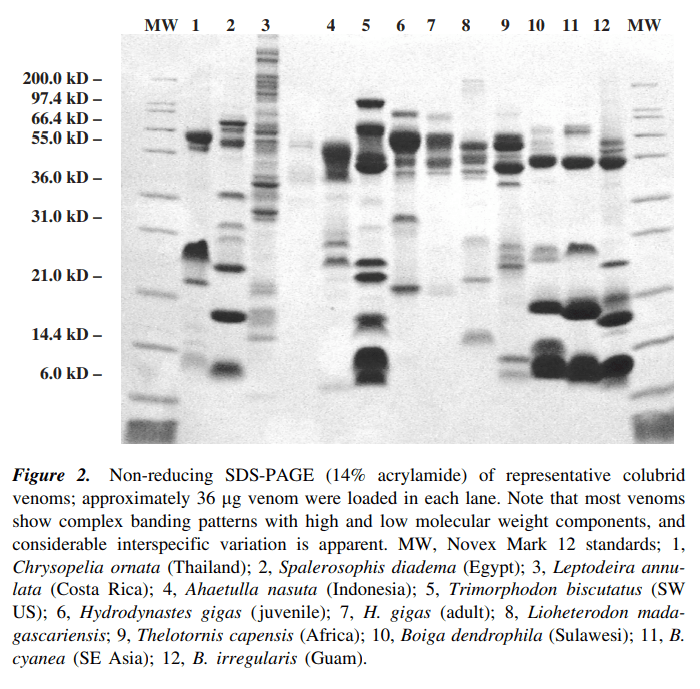
– with precast acrylamide gels available from Novex/Invitrogen you can analyze the complexity of venom from 35-40 micrograms of venom. Colubrid venoms show lesser components on a 1-D gel compared to viperid venoms, but when using 2-D electrophoretic analyses a lot more protein spots can be observed, approximately a 100 was observed from a single species.
 Al3xandria