Investigating personality in vipers: individual rattlesnakes exhibit consistent behavioral responses in defensive and exploratory contexts – Gibert et al. 2022
Abstract:
This paper looks at personality in 20 captive Western rattlesnakes using 5 repeated trials including a handling assay, an open field test and a threat assay. They found that certain behaviours related to exploration, activity level and boldness showed significant repeatability, but no evidence of behavioural syndromes.
Significance:
No studies have looked at personality in venomous snakes, and personality is becoming important in matters of conservation and management of these animals. This study could help in identifying more humane strategies to decrease the frequency of human-wildlife conflict.
Introduction:
Recent literature shows that multiple taxa of animals display individually repeatable suites of behaviour which is also termed as personalities. These suites of behaviour with individual differences should remain consistent over time and context to be defined as personality. Temperament on the other hand is used in lieu of personality but is seen as more restrictive than personality and is seen very early on in life and rarely changes throughout the lifespan. These temperaments can be associated to 5 specific traits: 1. shyness-boldness 2. exploration-avoidance 3. activity 4. aggression 5. sociability (it would be nice to incorporate this into some of my own work, assessing personality on all levels would make for a more persuasive paper). Now if the behaviours displayed during these types tasks are correlated, then this is deemed a behavioural syndrome, this would mean that there are underlying constraints imposed by plasticity or genetics on what kind of behaviours can be expressed in a given scenario.
Animals that are dangerous to humans and are also in close proximity to humans because of encroachment, are normally moved to a new location. However the personality of individuals can drastically affect the survival rate after this management action, for example tortoises have a proclivity to explore novel habitats during tests so they tend to do well after translocation. But animals like captive bred swift foxes that are less risk averse and explored more during personality tests were less likely to survive when released. Venomous snakes are a major concern for this type of situation since they are either translocated or euthanized when they are found, and they are found constantly in numerous areas around the world. This study hopes to shed more light on the personality of western rattle snakes using a handling test, open field test, and a threat test. Hypothesis: like other animals have been assayed in these types of tests, venomous snakes will also display repeatable behaviours in the mentioned tests, and that there will be a behavioural syndrome between boldness-shyness and exploration.
Methods:
– Study animals and housing:
N=20; 17 males and 3 females, caught as adults, 12 of the snakes were considered problem snakes that were going to be moved. They were kept in identical enclosures filled with paper substrate, hide box and water bowl. Fed once a month, after every behavioural assay they were returned to the housing unit and not tested for 14 days.
– Experimental Design:
Tests occurred in a 1.2m x 1.2m x 1.2m four walled arena with black tape used to mark quadrants. Each quadrant had a plastic hide box, each trial was made up of all three behavioural assays- handling, exploration and threat. Every individual received 5 trials total.
– Handling Assay:
Snakes were handled using metal tongs and held for 30s above the arena, after the initial 15s they were shaken twice and then lowered into the arena where latency to rattle, total time spent rattling, number of defensive strikes and latency to strike was recorded.
– Exploratory Assay:
Snake was released into the arena for 60min and allowed to explore undisturbed. latency to move after release, total time spent moving, total number of lines crossed, total number of hides entered, total time spent in hides, total time spent exposed, and time spent frozen. Check the paper for specifics.
– Threat Assay:
The snake was moved into a corner of the arena after the exploration phase and all the hide boxes were removed. Then to elicit a threat response, they used an inflated balloon moved towards the snake in a procedural fashion (check paper for specifics). Head hiding incidents, time spent moving away from the balloon, time spent frozen, individual defensive strikes and latency to strike was recorded.
– Statistical analyses:
Sex was not included in analyses since they were uneven and small numbers. All behaviours were recorded using BORIS and all stats were done using R. Check the paper for specifics.
Results:
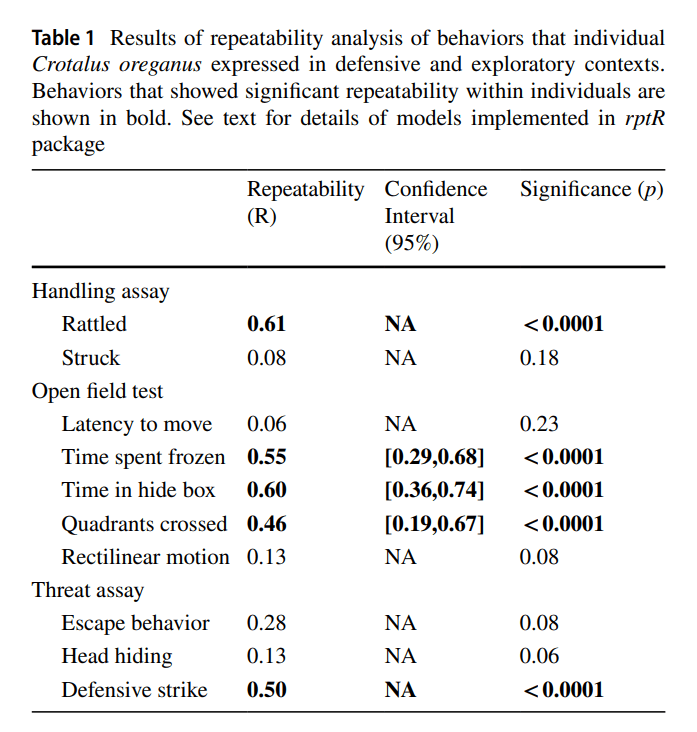
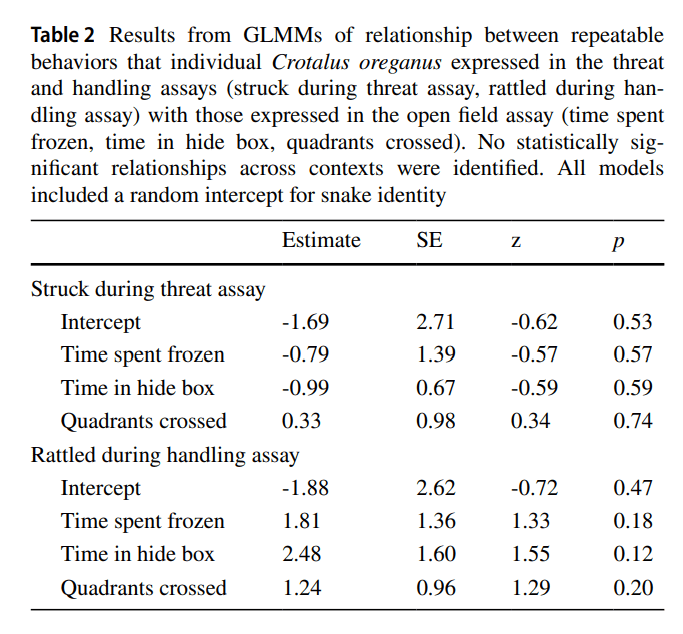
lateral undulation was highly correlated with quadrant crossing (r=0.87, p<0.001) and moderately correlated with total time spent in hide box (r=-0.63, p<0.001). Rattling, total time in hide box, time spent frozen, quadrants crossed, and defensive striking in the threat assay were significantly repeatable. Majority of snakes exhibited limited exploration behaviours (quadrants crossed), 6/20 exhibited high rates of exploration. Half of the snakes rattled during handling assay but 6/20 rarely rattled. Only 4/20 snakes struck defensively during majority of trials and 11/20 never struck. There were no statistically significant findings between traits of defense and increased exploration.
Discussion:
There was significant repeatability of traits with consistent individual differences, this means that these individuals can be considered to have distinct personalities. Individuals who rattled continuously and struck numerously were likely showing signs of boldness, since risk aversive individuals would not want to draw attention to themselves. Crossing quadrants in the open field displays exploration while hiding in the hides shows reduced tendency to explore novel environments. These differences in temperament traits would decide whether an individual was more or less successful in tasks like reproduction and colonizing new habitats. For example more risk averse individuals would survive better in high predation environments since they would be out less, but they would also have less access to food because of the same reason. They propose a plan of running personality assays on individuals that are a problem to identify the best course of action. They also propose that different regions with differing human presence would impact the personality of snakes by how often they would rattle. A study where rattlesnakes were found in a human dense area were found to rattle less because humans would be drawn to the rattling rather than avoid them like a normal predator. This study also makes a point of, a few individuals should not label a species given the individualistic differences, especially since more than half of the individuals in the study did not strike. There was no findings to show that behavioural syndrome is present in this species, this is similar to another snake study with garter snakes.
 Al3xandria