
Neural Consequences of environmental enrichment – Praag et al. 2000
Brief introduction:
There are a lot of studies that claim environmental stimulation has positive effects on the brain and brain function with neuronal plasticity. Basically when one cell excites another repeatedly over time, it or both gets better at this process with observable differences in other categories like behaviour. The first time this was introduced was in 1940 when Hebb said that the rats he took home as pets in enriched environments showed improvements in behaviour compared to the lab variety. With studies progressing in this field they found enriched environments to have a hand in dendritic arborization (which is when the dendrites branch out and create more complex pathways), gliogenesis (formation of new glial cells in the nervous system which help with neural protection and communication), neurogenesis (which is the formation of new neurons) and as a result improved learning.
What is enrichment?
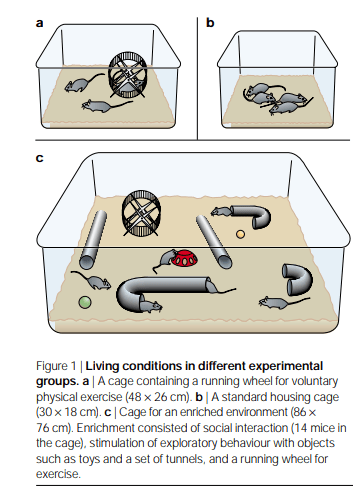
The standard definition is a combination of complex inanimate and social stimulation. Studies have tried to tease apart how individual variables can cause the changes we see but a single variable is rarely the cause, but rather needs the combination of stimuli to evoke the changes. The 2 main cognitive theories to explain the effect of enrichment on the brain are 1. the arousal hypothesis, which refers to the arousal that comes from experiencing novelty and environmental complexity, 2. the learning and memory hypothesis refers to the morphological changes that occur to the components involved with learning. Even though previously it was stated that rarely a single component evokes the changes observed, voluntary exercise has been known to cause increased cell proliferation and recruitment of new neurons to the dentate gyrus. Thus it is hard to dissociate whether the enrichment components are causing the changes we see, or if its because of voluntary motor behaviour/exercise that is always intertwined with an enriched environment. Also our idea of a lab environment for subjects is normally an impoverished version of their natural habitat, which was found when birds were captured from the wild and pulse labelled with H-thymidine, half were released and half were kept in the aviary for a certain duration. Afterwards some of the freed birds were caught and it was found that the neurons born during the labelling period survived for birds that were freed but not as much for those kept in captivity. This shows that the lab condition is actually poorer, and enriched environments just simulate more of their natural environment with constant changes that stimulate them more. Also different forms of enrichment, whether its voluntary exercise or complexity can have similar morphological changes showing either common final neural pathways or might mean we still don’t completely understand the full effects of these treatments.
Consequences of enrichment on the intact brain:
In an experiment where mice were exposed to either a learning task, voluntary exercise via wheel, environmental enrichment, or standard. It was found that enrichment and voluntary exercise promoted cell genesis but the other conditions did not.

- Improved Learning and memory: Enrichment enahnced memory in various learning tasks, they did better on the water maze testing spatial memory, voluntary wheel running also showed better spatial learning, also enriched rats with environmental complexity did better at the t-maze spatial task than rats with just the running wheel.
- Anatomical changes: Environmentally enriched animals were found to have enhanced gliogenesis when observing the brain cortex, found to be a result of increased oligodendrocytes and astrocytes. When looking at the dentate gyrus environmentally enriched animals had longer cell survival but not cell proliferation, while running alone caused increased cell division and net neuronal survival in mice. Thus cell proliferation and surivival are mediated by different forms of environmental variables. Outside of the dentate gyrus, EE (environmentally enriched) rodents show increased brain sizes and weight, enhanced perikaryonal (cell body of a neuron) and nuclear sizes in cortex. EE rats also showed more higher order dendritic branches. EE rodents showed reduced neorunal density but increase synapse to neuro ratios, synaptic disc diameter and sub-synaptic plate perforations. Exercise alone has enhanced capillary density in the cerebellum but not synaptogenesis, but in these studies the exercise was just a skill learning task and not voluntary running.
- Electrophysiological changes: In hippocampus slices, EE rats had greater excitatory postsynaptic potential slopes in the dentate gyrus, and enhanced hippocampal field potentials. In wheel running rats the discharge frequencies of hippocampal pyramidal cells and interneurons increase, and long term potentiation amplitudes were enhanced.
- Summary: exercise and enrichment have elements in common with both enhancing learning, neurogenesis, growth factors, neuro transmitters and synaptic plasticity.
Consequences for damaged or diseased brains:
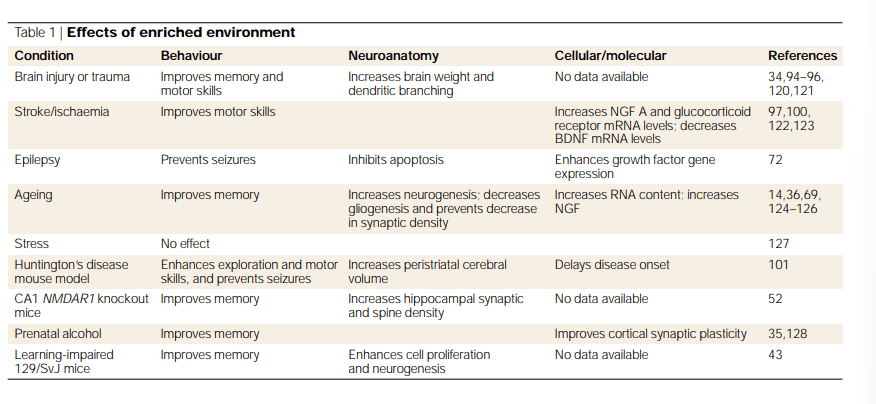
Enriched animals show reduced apoptotic cell death in the hippocampus by 45% and prevented motor seizures when dosed with a specific injection. Even small durations of EE are beneficial with animals and can produce similar results to animals that were continuously exposed to these conditions. EE also affects genetic conditions, for example deficits in nonspatial memory resulting from disruption of the hippocampal NMDA receptor could be alleviated with enrichment of 3hrs/day for 2 months.
 Al3xandria