Environmental enrichment, new neurons and the neurobiology of individuality – Kempermann, 2019
Introduction:
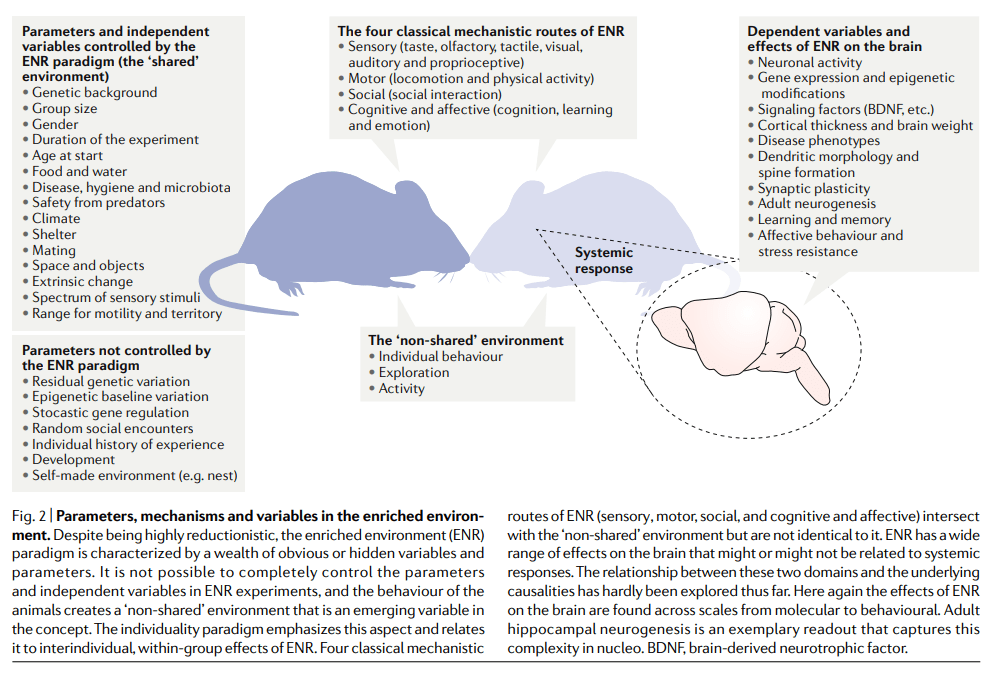
Environmental enrichment (EE or ENRs as stated in this paper) is basically known as a combination of inanimate and social stimulation. EE is hard to compare sometimes b/c so many studies used different set ups like keeping the cage size the same but changing the group size, or by only including toys or by using varying durations. However, even with all these variances in the procedure, we still get consistent results showing the effectiveness of enrichment in different contexts. Neurogenesis is a big component of EE and activity dependent regulation of neurogenesis means behaviours regulate growth of new neurons which can change aspects of future behaviours in turn regulating growth of neurons, hence closing the feedback loop.
General effects and mechanisms – Effects of EE on the brain
Early testing with EE showed that it had lasting effects on learning and generalizing in subjects which spilled into human work in the 1960s when the US tried to enrich the life of children living in low-income neighbourhoods as a way to improve their school readiness. These studies also showed drastic changes to brain structure and developed into a theory of how experience shapes the brain structure to in turn modify brain function. EE is specifically known to promote increased brain weight and size as well as the substructures within it. There are also significant effects of cell proliferation and cell genesis indicating that cell-based plasticity is possible with EE. EE also affects gene expression, alters protein production, modulates biochemical processes of components like neurotransmitters, neurotrophic factors, hormones and immune factors all on timescales that persist even after the EE is stopped.
Genetic background:
Normally EE studies keep the genetic background of a subject as a constant as they manipulate the environment they are in. When using subjects with a large genetic variation it’s harder to pin down that the changes we see are a result of the environmental manipulations. The startling observation that EE effects can be passed down through generations has increased interest in this field in combination with genetics to understand the underlying mechanisms.
Nested Mechanisms of enrichment:
4 main lines of EE involve motor, sensory, cognitive & emotional, and social stimuli as drivers for the EE effects resulting in arousal or learning which then leads to different forms of development. Identifying the mechanism of EE is a complex question because the effects of EE are a result of numerous direct and indirect factors that work across multiple levels, from cellular interactions to the end behaviours. Neuroscience has always been the main way to understand EE but with more studies focusing on outside the brain, will hopefully shed more light on how different organ systems interact with one another to produce the effects of EE. Adult hippocampal neurogenesis is a good model to gauge EE and its effects from genes to the end behaviours.
Adult neurogenesis: a key phenotype – EE effects on the hippocampus
The hippocampus is a key structure involved in learning, memory and emotions. EE produced more sparse place cell representations in the hippocampus which helps with learning in spatial tasks. Since EE stimulates neurogenesis even in adult stages, researchers have proposed that this might be a preventative or therapeutic measure against some neural diseases. This provides a mechanism as to why we see the changes we do see in terms of cognition and behaviour, but the actual reason as to why this occurs is still correlative or speculated. When this was tested in humans studies have come with opposing results when using proxy based markers, however it would make sense that human adult neurogenesis does not behave exactly as it would in rodents or with the same type of markers.
Neuronal development in adults
Adult neurogenesis is a complex process that includes lots of other steps and components, so the fact that EE stimulates this means it has a hand in the formation of multiple neural components. For example in mice and rats, EE is known to affect cell survival, precursor cell proliferation and maintenance (proliferation means when the cell grows and divides), dendrite and spine formation and maturation as well as functional integration. EE also increases the persistence of Cajal-Retzius neurons which in turn develops the dentate gyrus which shows that EE can stimulate and prolong this growth even in adulthood. When using a specific type of EE in isolation like voluntary running wheel we see only increases in precursor cell proliferation (precursor cells are unipotent stem cells that have committed to becoming a certain type of cell). EE might also cause learning of the stimuli just by exposure since it results in increased survival of neurons which is also a result of long term potentiation which is the frequent firing of neurons causing stronger synaptic connections and after specific learning of stimuli. Also when subjects are provided with the voluntary running wheel and EE, the results are additive rather than overlapping, and it was found that EE only benefits subjects when they are actively participating with the EE and not when they are passive with it, and this results in the pro-neurogenic and related functional effect. Even as subjects age we see an effect of EE, which is cool since normally neurogenesis decreases with age, but with extended exposure to EE there is a significant increase in maintenance of precursor cells, also seen a lot with physical activity, further showing that actually physically engaging with the stimuli maintains neurogenesis potential. These new neurons that are formed during EE are also more resistant to chronic stress by inhibiting the ventral dentate gyrus.
A more complete picture: Individuality
In most experiments the enriched environment is not really intervened with during the duration of the study except for husbandry needs, so the environment stays relatively constant. In these experiments researchers focus on comparing groups but don’t really assess whether EE causes variation within the group between individuals. A large experiment with mice observing numerous variables with both sexes found that simple enrichment like nesting material and shelters only produced small mean changes with little to no variability within individuals. When EE is given in some experiments, some individuals do not differ from controls while some individuals may have 5x as many new neurons as controls, this is partially explained by individualistic “roaming entropies”. Roaming entropies are the measure of how much you explore your environment and how much territory you cover, so animals that want to explore or actively participate with the EE more will show more changes.
Translational medical implications:
With all the findings of EE being positive in animals, translating this to humans seems like it would also have positive benefits, especially in the area of disease and aging. However the main issue with this is that humans cannot be kept in a lab with traceable histories on all their experiences, thus identifying a baseline for all subjects that is the same can’t be controlled in human studies. Also providing enrichment can’t be dosed as effectively since less factors can be controlled in human studies. This leads to enriched rehabilitation as a method to overcome these issues, for example with cerebral palsy where task-specific training and physiotherapy is better than the standard neurorehabilitation procedures.
The future of EE paradigm
EE is largely based on active experience, exposing subjects to a certain duration of EE causes altered brain structures that can lead to new behaviours which in turn affect the brain structure when elicited, continuing in a feedback loop. Teasing apart the interactions with genes and environment will be critical to applying EE effectively, but given the complexity of the factors it still remains a quite elusive. Individualistic differences should also be included in EE paradigms since active participation is critical to the changes observed, thus a subject that is less motivated to explore or “shyer” may not show changes as significant as a bolder subject.
 Al3xandria