Neurobehavioural effects of restricted and unpredictable environmental enrichment in rats – Rojas-Carvajal et al. 2020
Introduction:
Teasing apart how and why animals react the way they do to different environmental conditions would shed some light as to why EE works for some human subjects but not others. This is to do with the complex relationship between experience and neurobehavioural plasticity. In people especially, their own expectations on performance and motivation to interact with EE are critical to the benefits gained from the treatment. Not much research has been concerned with motivation and EE, thus this study aims to observe the role of motivation in the regulation of experience-dependent plasticity on the brain and behaviour. They designed an EE protocol with rats and observed its effects on different behaviours and the expression of genes related to neural plasticity. They deem physical exercise, social activity, and exposure to complex and constantly changing stimuli as the enriching components of EE that affect behaviour and brain function. Motivation for components can be addressed through unpredictable presentations of the stimuli, thus some subjects were exposed to restricted times of enrichment ranging from 2-48hrs randomly over 30 days. During non EE times, the subjects were kept in standard housing with 5 subjects total per cage.
– Experiment 1 was made up of 2 phases, one in cage and one in test situations. They assessed exploration, use of materials, eating-related behaviours, social interactions and vocalizations within the cage. Phase 2 was observing activity and vocalizations within an open field maze which is a standard testing procedure used for comparison between groups and this was done after the 30 days of treatment.
– Experiment 2 focused on EE’s effects on gene expression in relevance to neural plasticity, specifically focusing on genes related to the pathway involving brain-derived neurotrophic factor (BDNF) through its tropomyosin kinase B receptor (TrkB). Expression of transcription factor cAMP was also observed since it regulates expression of numerous genes, Rho GTPase activating protein 32 was analyzed since it is involved with structural plasticity by regulating cytoskeleton remodeling, and lastly they observed DNA methyltransferase 3A since it is important for maintaining proper DNA methylation which is relevant for neural plasticity.
Methods:
– 70 male winstar rats were used in this study, check paper for specifics on housing.
– Housing conditions = Naturalistic stimuli was used when possible, pilot studies were run to identify the use of enrichment and objects were rotated out and continuous objects in the cage were moved around.
– Once a week activity within the cages were scored for 10min via cameras.
– Vocalizations were observed in 2 categories of high and low frequency, high frequency was good and low frequency was alarm calls.
– For the gene expression analysis, subjects were sacrificed and brains were dissected, specifically the nucleus accumbens, dorsal striatum and hippocampus were collected. Check paper for specifics and on stats.
Results:
- experiment 1 = When subjects were exposed to EE, physical activity and cage exploration made up of sniffing, rearing and stretching increased. Both the random and continuous EE groups increased in these behaviours over minutes after exposure and continued to do so over weeks, but random EE did this significantly more. Random EE subjects also modified the EE they were given by making nests and such to a greater degree than continuous. For social interactions, Random EE rats increased in this aspect per minute over weeks while continuous EE rats showed irregular patterns. For vocalizations, Random EE rats displayed more positive vocalizations than Continuous. This is one of the first pieces of evidence to observe the vocalizations as a method of gauging enrichment. These findings also support previous work that showed unpredictable enrichment to increase the rewarding element of the enrichment. Basically the subjects were keen on using the time in EE as much as possible when it was unpredictable. There was also a decrease in eating behaviour in the Random EE subjects which might be because they were more motivated to indulge in naturalistic behaviours and because of the net effect of exercise on appetite which reduces food intake through the regulation of neural messengers like insulin, ghrelin and corticotropin release factor. Additionally the Random EE group were housed in groups of 5 but when in EE were housed with non cage mates, so the social interaction could also be a rewarding component.
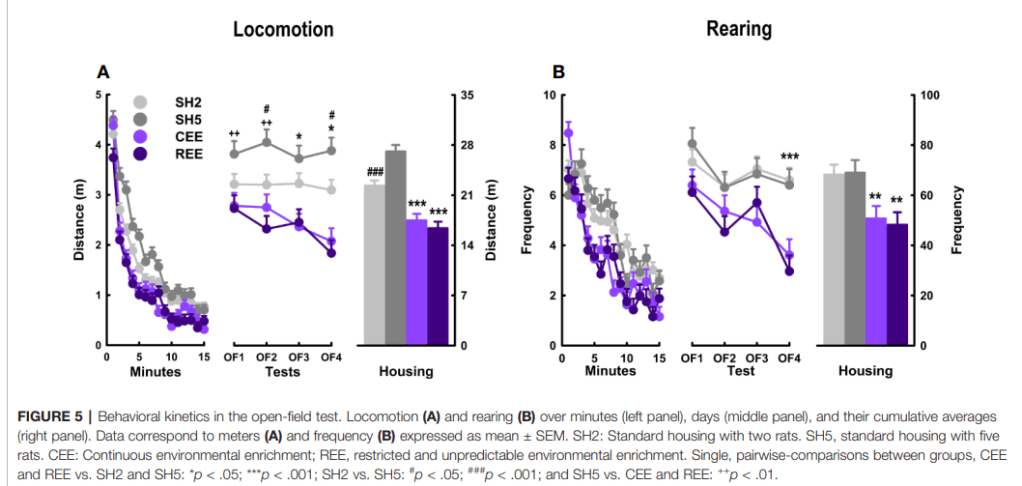
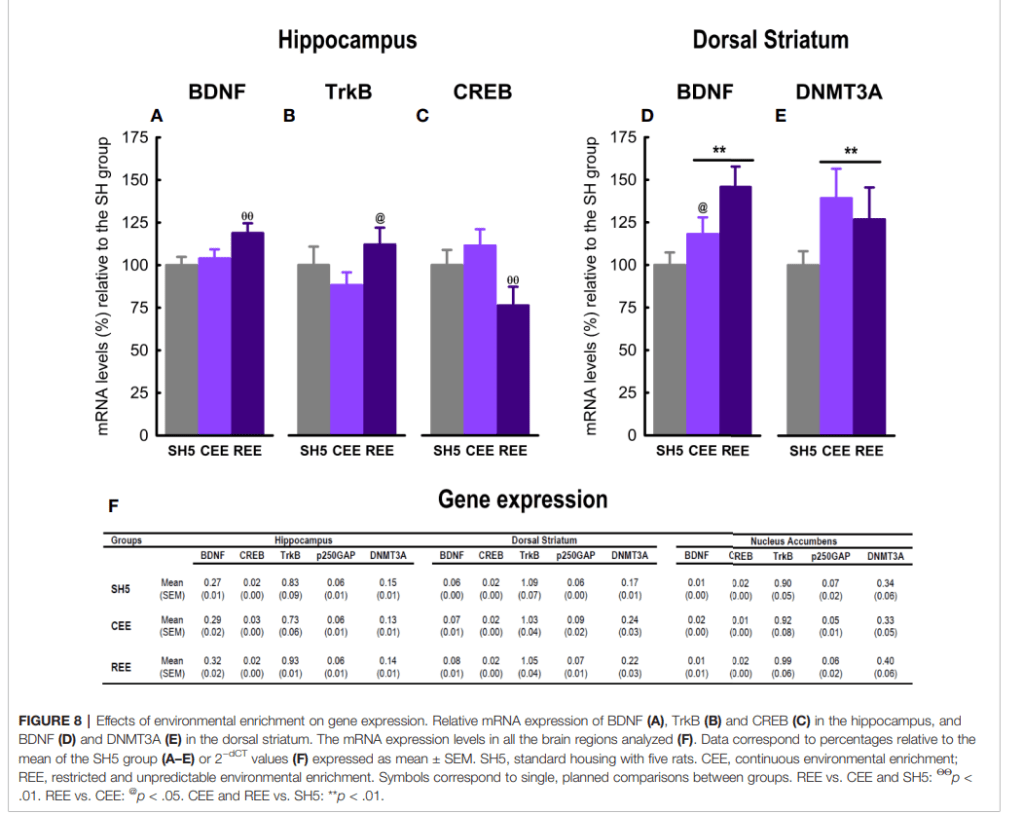
In terms of novelty habituation in the open field maze, only the enriched groups showed high rates of habituation with decreased locomotion. Oddly, Continuous EE and Random EE both performed similarly in Open field showing that even when exposed unpredictably at 50% of the duration as Continuous, the Random EE rats did not get detrimentally affected by the shortened duration. This was also the case with grooming behaviour in which both EE groups showed high rates of grooming that dissipated quickly between trials while standard housing showed less reduction. However, when comparing Random EE and Continuous EE, random EE subjects showed higher rates of grooming with less habituation than continuous indicating that the duration of enrichment has an affect in this specific defensive behaviour that restores emotional homeostasis. - Experiment 2 = This study measured the mRNA levels of BDNF, TrkB, CREB, DNMT3A and p250GAP since they are integrated in the signaling pathway for neural plasticity. In this experiment rats were housed either in standard housing with 5 individuals, or Continuous EE or Random EE with 10 animals per cage for 30 days. In the hippocampus BDNF was significantly upregulated in the most in the Random EE group to the continuous and standard group which showed similar levels. TrkB receptor was expressed significantly more in Random EE, and CREB expression was significantly downregulated. In the dorsal striatum both enriched groups showed significantly higher BDNF mRNA levels than standard and Random EE showed significantly higher than Continuous. DNMT3A was expressed significantly higher in both enriched groups.
– No significant differences were observed in the nucleus accumbens. It was odd that nucleus accumbens showed no differences since it plays a big role in the salience of incentives and reward predicting cues which would be the case here, but they think because of the tissue sampling time or because of the absence of behavioural challenges might have caused this. This shows how the engagement of behaviours really does control which mRNA components are expressed more, not all enrichment will cause the benefits that are normally seen. In terms of the hippocampus, there were significant changes seen.
– BDNF was significantly upregulated only in the Random EE group and not in continuous or standard, this supports one other Unpredictable EE study but usually Continuous EE also shows upregulating. However, normally these studies use a running wheel which encourages physical activity and this study did not use it for either enriched groups which may be why we dont see this change. However this does provide some insight into the unique benefit of Random EE, since BDNF is normally associated with physical activity, it seems providing unpredictable enrichment with durations of standard housing really motivate and encourage locomotion and exploration within the EE housing that mimics the provision of a voluntary running wheel. The Continuous EE group probably showed these same levels when initially provided with EE but as novelty wore off the expression of these genes returned to baseline, even with the enrichment being moved around. Additionally because we see heightened expressions of BDNF in the dorsal striatum it seems that the provided EE did have regional effects on neural plasticity. The Random EE group was significantly higher in this aspect than the Continuous EE but both groups were higher than standard. This shows that the dorsal striatum is a reactive region of the brain for activity-dependent changes.
– In terms of the reduced hippocampal CREB in only Random EE subjects, there are a couple of theories. Normally CREB is expressed more in relation to novelty and memory formation, and numerous studies have shown that behavioural tests after treatment tend to increase CREB. Given that this study only did the open field, this may be why. They also say that CREB may have increased when Continuous EE was first exposed but returned to baseline after familiarization to the environment, and their theory for the Random EE subjects is that because they only spent half the time in EE and it was unpredictable made familiarization harder, also CREB expression has many activation phases which might have also played a role.
– EE also increased the expression of DNMT3A in the dorsal striatum showing that regardless of whether EE is continuous or random, it causes modifications to the hypermethylation and transcriptional regulation of particular loci.
Discussion:
The Random EE group showed significant changes in multiple gene expressions, some even higher than the Continuous EE group. Even though this group was only allowed in the EE cage for 50% of the time as the Continuous group, they either equaled or surpassed expressions found in the Continuous group. This highlights that when rewarding stimuli are presented in short durations, it can still provide positive effects for the brain and expression of genes that are important for brain function. They do a final comparison of this work to humans, by stating that people who work indoors and in impoverished environments with low amounts of physical exercise can be representative of living in a standard housing condition. People can’t be continuously exposed to an enriching environment all the time, however if you can take the time to engage in some physical or enriching activities even in short durations would go a long way in positively affecting brain function.
 Al3xandria