Written with partial aid of chatgpt for summarization purposes
THE PHYSIOLOGICAL AND BEHAVIORAL EFFECTS OF HANDLING AND RESTRAINT ON THE BALL PYTHON (Python regius) AND THE BLUE-TONGUED SKINK (Tiliqua scincoides) – Kreger and Mench, 1993
Introduction:
This paper starts off by highlighting the use of handling reptiles for various settings like zoos, educational presentations, medical procedures for pets or zoo animals as well as just normal pet handling. As a result of this increasing frequency of handling with reptiles, the impact of this on welfare needs to be investigated. Previous research has shown that aversive handling and infrequent handling can result in elevated levels of stress hormones and decreased health outcomes in birds and mammals. However this type of research has been largely ignored in reptiles so this study aims to address this gap in the literature by observing 3 different handling techniques. These techniques include gentle handling, manual restraint and container restraint. The study measured stress hormones, changes in the heterophil/lymphocyte ratio (which has been used as an indicator of chronic stress), and changes in activity behaviors that may indicate stress-related pre-pathologies. They observed these in the popular pet the ball python and blue tongued skink.
Methods:
The experiment was conducted on animals (ball python and skink) from October to December 1991. The design was an incomplete randomized block with each animal serving as its own control and each animal was sampled twice per treatment. A control treatment was included for each sampling day. The experiment began at 1100 hours every 4 days to determine corticosterone elevations due to treatment rather than time of day. The animals were assigned to one of four treatments (gentle handling, manual restraint, container restraint, and non-handle) with all treatments except non-handle lasting 10 minutes. Corticosterone elevation from handling shows a rapid increase at 10 minutes and begins to plateau at 1 hour in the tree lizard. Sampling was done 15 minutes post-treatment and cloacal temperature, room temperature, and relative humidity were also monitored. Each treatment was conducted twice per individual.
The four treatment types in more detail:
- Gentle handling (G): The animal was placed on the experimenter’s upright palm, free to move along the hand and arm unrestrained.
- Manual restraint (M): The experimenter placed hands on the animal dorsally, with one hand anterior to the vent, minimizing the animal’s ability to move freely.
- Container restraint (C): The animal was placed inside a PVC tube, which was sealed on the side the animal faced, allowing some lateral movement but not the ability to turn around.
- Non-handle treatment (N): The animal was removed from its enclosure for immediate sampling and served as the control.
All treatments except N lasted 10 minutes, after which the animal was placed back in its enclosure for 15 minutes prior to sampling. Personal interviews indicated that 10 minutes is a typical handling period. The corticosterone elevation from handling shows a rapid increase at 10 minutes and begins to plateau at 1 hour in the tree lizard, so it was decided that 15 minutes post-treatment for sampling would reflect elevations due to handling.
In terms of behaviour the individuals were recorded for 6 days before the experiment began and 24hrs before and after the treatment. Activity was observed by recording active vs. inactive time, active was deemed as feeding, drinking, and locomotion for more than 10s while inactive was deemed as basking or staying in the provided shelter. Blood samples were collected by cardiac puncture of 0.5cc once every 4 days. Check paper for more specific details.
Results:
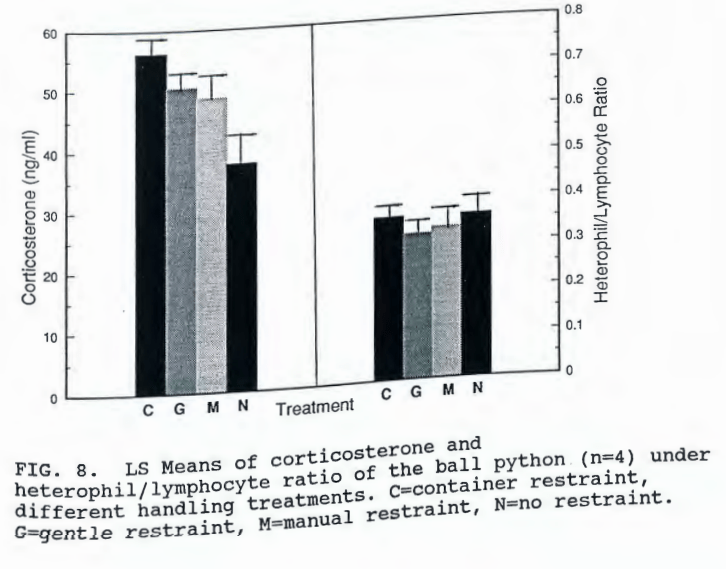
All animals either maintained or increased their body weight during this experiment. For the skinks there were no significant differences in corticosterone levels, heterophil/lymphocyte ratio or behaviours as a result of the handling treatments. For the pythons there was a significant effect of the handling treatment on corticosterone levels, specifically the container restrained handling was found to release significantly more than control. There were no differences in the other measures.
Discussion:
The study found that the different types of handling and restraint had no effect on the skinks but the container based restraint technique produced significantly higher secretions of corticosterone in pythons. It seems that even this type of restraint is not a chronic stressor. However a long term study has not been done to look at the effects of long term forced restraint as conducted in venom facilities.
 Al3xandria