Social competence: an evolutionary approach – Taborsky and Oliveira, 2012
Behavioural Flexibility as phenotypic plasticity
Classic evolutionary theory states that adaptation by natural selection is dependent on phenotypic variation which is heritable and produced by genetic variation. But when the genetic variation is outpaced by the environmental changes, then adapting to the environment without genetic changes is required, hence the reliance on phenotypic plasticity. This means when a genotype can produce different phenotypic characteristics depending on the current environmental conditions. Within this, behavioural flexibility is an excellent tool at an animal’s disposal because behavioural traits are more malleable than morphology and physiology and are also capable of being reversed within a subject’s lifetime. This study hopes to shed light on creating a single framework that bridges the gap between phenotypic plasticity and behavioural flexibility.
Adaptive behavioural flexibility in the social domain
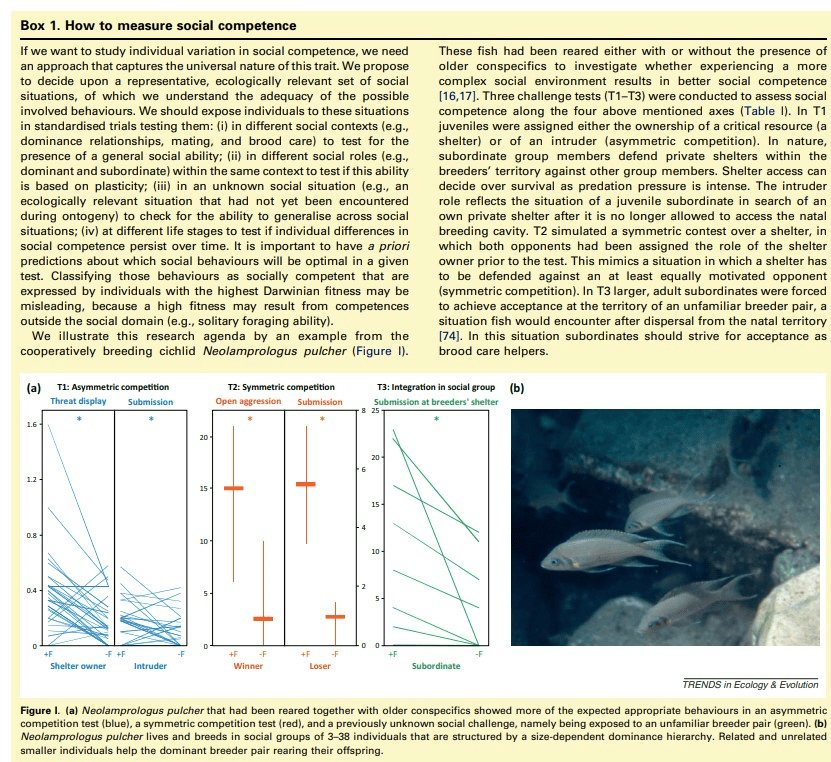
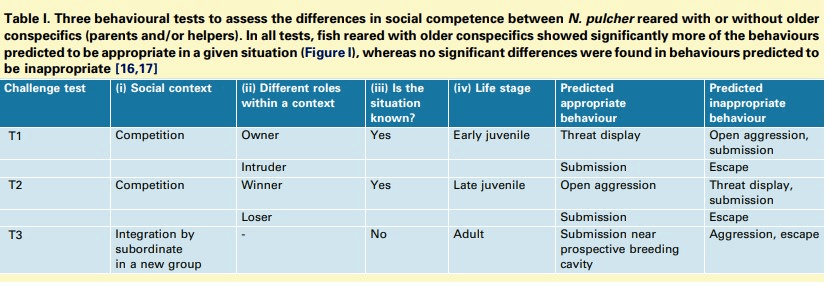
Social interactions are by far the most complex and fluctuating component within an environment because it involves interacting with other behavioural agents that are also capable of high levels of unpredictability. Even when an animal interacts with a non-social abiotic or biotic component of its environment, it creates a feedback loop in which it changes its behaviour depending on the output of its last action and the changes made to the environment based on the last action. For example, when foraging the animal will constantly adjust its behaviour with the changing resource density. However when interacting with a social component there is an infinite degrees of freedom since social context can be affected by the number, identity and external/internal states of the the conspecific they are interacting with. Additionally subjects require the cognitive mechanisms to detect the emotional state of conspecifics and to integrate this into their future behaviour so as to assess the correct behaviour to elicit in that specific context. Thus social experiential knowledge is valuable to individuals and it can be expected that social behaviour will exhibit high forms of plasticity. When individuals can optimize their behaviours in a social context, this is known as social competence and it should increase their fitness by allowing them to avoid costly social interactions and to avoid being rejected from the social group which can decrease survival and reproductive output. Social competence has been found to affect the performance of different social behaviours across contexts and there are 2 theories as to why this occurs. 1. social competence is made up of a bunch of social skills that were evolved independently or 2. social competence is the ability that underlies all social behaviours which causes a positive within individual correlation of performance across difference social contexts.
Animal Social Competence
Many animals show examples of social competence, animals have been shown to alter signals based on their audience and bystanders have been known to eavesdrop on information between conspecifics. Another example is that winners in bouts are found to continue in winning against different opponents and losers are found to lose against different successive opponents. Animals like rats are also more willing to help a conspecific if they have previous social experience of receiving help themselves even if from a different conspecific.
Social Competence Vs General Cognition
The argument of whether social competence is a form of general cognition or is lumped in with it has been of debate. An example of general cognition is when humans show positive correlations across various cognitive tasks if they perform well in one task, meaning they will most likely perform well in the other tasks as well. Some studies that reject this idea are the ones that show animals in social experiments are affected by the social treatment in a social context but are unaffected in other cognitive facets. For example lab rats that are exposed to maternal deprivation perform poorly in social tasks compared to control but both groups perform equally well in a spatial learning task. This is similarly seen in zebrafish as well. These studies indicate that social competence may not be connected to general intelligence/cognition.
An evolutionary framework for the study of social competence
If social competence is an ability that affects an individual’s performance then it should have key properties that show the inter-individual variation in performance from high to low and this should be positively correlated with fitness.
– Variation in performance: Consistent individual variation in social performance can be a result of a genetic disposition or can be induced during development. In humans we have found evidence of a genetic disposition, specifically in twins. In terms of during development, mice that are exposed to conspecifics during development do better with conspecifics compared to mice that only had access to their mother. Similar thing occurs in cichlid fish.
-Correlation with fitness: When social performance is affected by treatments via manipulated social cues during development, they found associated differences in fitness correlations. For example, rodents exposed to complex social environments showed better maternal care and higher reproductive outputs.
– Benefits of social competence: Having social competence will be very valuable for animals that live in social groups since it relates to predator awareness and rearing offspring.
-Costs of social competence: dealing with large amounts of social cues and processing this information has selected for larger brain sizes as a result of the extra cognitive demand. Also engaging in socially appropriate behaviour can be costly depending on the scenario, for example displaying submissive or aggressive behaviours can be more costly than the standard metabolic rate.
-Possible trade-offs: Recognizing social behaviours of conspecifics and integrating it into your own behaviours can be time consuming and can increase sampling times which can compromise the speed needed for accurate decision making especially in a complex/noisy environment. Also a lot of the social behaviour recognition is instilled during development which is also a time where other survival skills must be learned, thus there is a competition between learning social cues and others like predator detection and foraging techniques.
Final Remarks:
Social competence is a plastic trait meaning it relies on multiple social phenotypes to arise from the same genotype decided by interactions between genetic, environmental and epigenetic processes which lead to neural and behavioural plasticity. Even though social interactions between conspecifics can be limitless in the results, they would still be constrained by epigenetic, pleiotropic and epistatic effects of the genes involved in neural plasticity which limits their social competence/behavioural flexibility. Thus the reason social competence isn’t completely optimal is because it is still constrained by behavioural consistency at the individual level also known as personality.
Part 1 Article Audio
Part 2 Article Audio
Part 3 Article Audio
Part 4 Article Audio
 Al3xandria