Conditioned Discrimination of Airborne Odorants by Garter Snakes – Begun et al. (1988)
- Abstract- Garter snakes were trained via food rewards to discriminate between two biologically irrelevant scents. The first experiment was a 2 sided compartment and the second was a 2 sided maze, in both the snakes showed the ability to discriminate correctly. 4 of the snakes were also taught to reverse the conditioning and move towards the other airborne scent.
- Introduction: Snakes are normally focused on as subjects when observing their vomeronasal system which is different from their olfactory system, however there is less tissue dedicated towards the olfactory system compared to vomeronasal. Furthermore, when testing these systems scents of ecological significance are chosen which includes prey and predator scents, to ensure an observable response and are normally non-volatile in nature which means non-airborne. Most assumed that snakes amongst other reptiles lacked flexibility in different sense modalities thus this paper specifically tackled: 1. Can snakes detect airborne odorants? 2. What types of behaviours are mediated through the olfactory system? 3. Can snakes be trained to make flexible responses to odorants? This was done by training snakes with rewards in the form of treats to move towards a particular scent of low ecological significance, if any.
- Methods:
Subjects – Adult and juvenile garter snakes (Thamnophis radix) n=7 (2 males, 5 females).
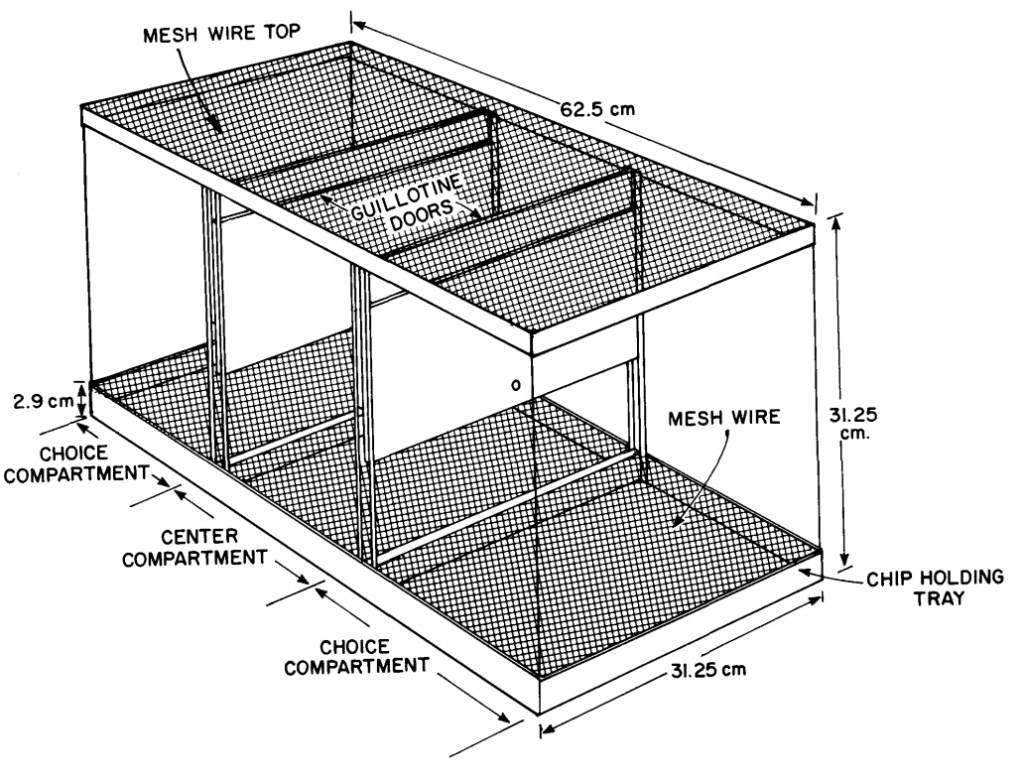
Apparatus & Method – wooden box with 3 equal compartments with mesh flooring that ensured no direct lingual contact with scented chips. Snake placed in the middle and left to decide which compartment to enter via its head, 100 trials total. 4 snakes were given reversal training with 50 trials as well.
- Results:
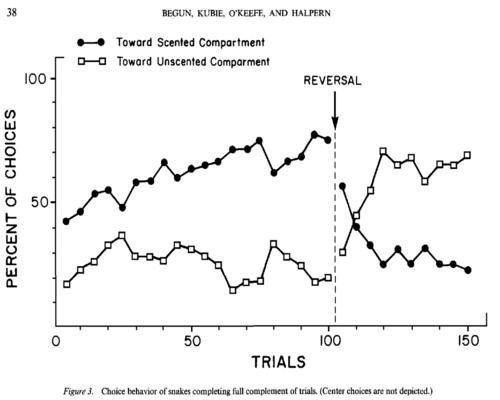
After 20 trials all snakes chose a chamber more than 75% of the time thus learned to move away from the center chamber. All 7 snakes that completed the 100 trials also showed a significant improvement in choosing the designated chamber where they went from 55% to 74.3%. Furthermore when reversal was used the snakes showed a significant increase from 37.5% in first 10 trials to 70% by last 10 and this was done in half the time.
- Discussion:
These results show that for one snakes are susceptible to a training paradigm, capable of learning an ecologically irrelevant scent under a reward paradigm and capable of reversing the learned connection in half the time. Also that airborne cues are picked up by snakes when the scent is pretty close by (almost lingual contact).
EXPERIMENT 2
Next step was to determine the role of the olfactory system in this by using a gas release system in a 2-choice maze.
- Method:
Subjects – n=10, adult male garter snakes (Thamnophis sirtalis sirtalis)
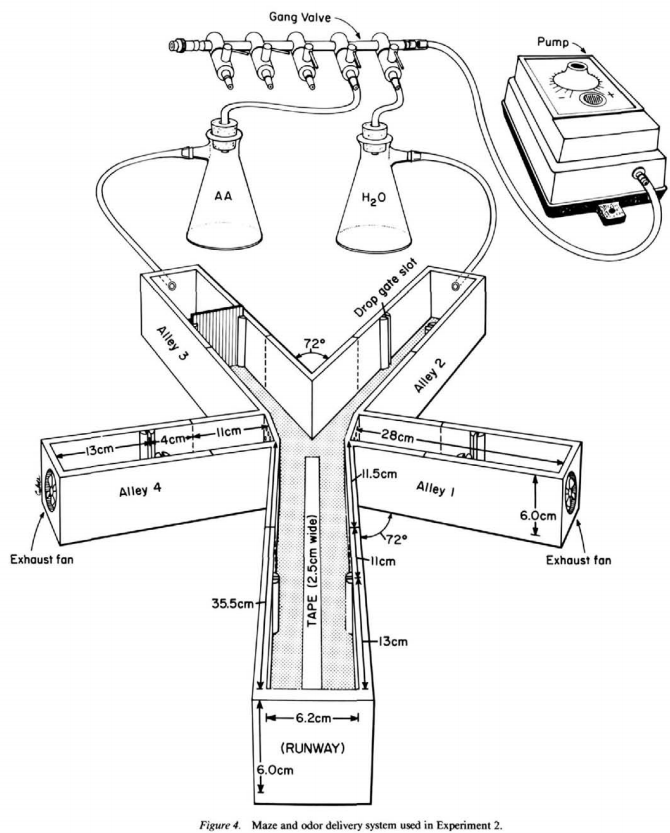
Apparatus & Training: a radial 5-arm maze was used as a 2-choice maze in tandem with a odor delivery system via gaseous scents. The training procedure consisted of the snake placed in the starting box with a piece of worm in the correct arm which alternated from side to side so as to limit locational cues. The baited arm would be flushed with amyl acetate scent to simulate a novel non-ecologically significant odour. The criterion for learning was that the snakes cumulative correct responses needed to exceed the expected chance on all trials of two consecutive training sessions (-> that’s a bit confusing).
- Results:
7 of 10 snakes completed training but the other 3 died of unknown causes. All snakes were successfully trained to choose the option they initially moved away form. The number of trials needed to meet learning criterion ranged from 25 to 70, the snakes trained to go towards amyl acetate needed more trials to meet the criterion thus were closer to 70.
- Discussion:
The main difference in criterion between the 2 experiments is that the first allowed the snakes to check both sides of the compartments before making a final decision at the 2min mark, in the second experiment only one choice was allowed to be made and if made incorrectly then a correction procedure was used to encourage the right choice. The first experiment also runs on emanating scents from the ground while the second focuses strongly on direction. In a natural setting both airborne and non-airborne cues would be important but airborne cues diffuse quickly thus in trailing actual prey they may be limited but maybe used for pointing in the direction of an odour and for orientation from a point source odour. However airborne cues can be detected from a greater distance thus maybe used to get close to prey but then switch to using non-airborne cues for a more precise understanding of its location.
Also, fact that the snakes were capable of learning novel biologically irrelevant scents seems to hint that they can adapt to varying food sources, with evidence from other papers that show they can learn to inhibit responses to potential toxic food sources. Another study by this lab also did lesions on vomeronasal and olfactory and found that lesions to olfactory caused complete loss of tongue flick elevation while vomeronasal was significant decrease but not complete loss.
This shows that snakes are capable of understanding novel odours when paired with a training paradigm. It also gives insight into the difference between airborne and non-airborne cues, airborne cues are for directional information and to get close while non-airborne are for more precise information with quick timing like actually chasing prey down. In my study snakes were able to passively recognize a novel odour and discriminate it against a similar novel odour at 30min, however most likely both airborne and non-airborne components were used for this. Shows that plasticity in odour responses don’t need to be reinforced but can be observed through natural curiousity.
 Al3xandria