Effects of Chemical and Visual stimuli upon chemosensory searching by garter snakes and rattlesnakes – Chiszar et al. 1981
Introduction:
There are 2 types of predatory strategies practiced by natricine snakes and crotalid snakes. The first case is that chemical cues increase tongue flick rate and the other is that visual and thermal cues release the envenoming strike which in turn activates a sustained higher tongue flick rate to track down the dying prey. To understand the mechanisms in which this occurs a factorial experiment was conducted with the presence and absence of visual stimuli in tandem with the presence and absence of chemical cues. This experiment also used both garter snakes and rattle snakes given that they fit both categories talked about earlier. Garter snakes generally tend not to attack just visual stimuli and rattle snakes normally do not increase tongue flick rate just because of prey odours.
Methods:
Exp 1: n=6, experimentally naïve adult western plains garter snakes (Thamnophis radix) were used for this experiment and experiments were conducted within home cages. Trials were done during the photoperiod cause these snakes are diurnal and 5 stimuli were used over a period of days with 1 per day for 5 consecutive days. The actual experiment was a trial duration of 10min in which the first 5min was to get a baseline of tongue flicks when snakes are undisturbed and latter half the stimuli were introduced. 1. Disturbance control (cage top lifted and a dowel lowered close to the snakes head and then removed, this is good because this is basically what bringing the stimuli in would do; limits effects based on action but tbh if all of the stimuli are presented in the same way would disturbance control really be necessary? Instead why not habituate the snakes to disturbance control prior to observation to get them used to the presentation of stimuli? 2 Water control, perforated cube with just room temp water. 3. Visual cues, fish in a small clear cube 4. Chemical cues, scent cues in a small clear cube with perforations 5. Visual and chemical cubes, perforated cube with live fish.
Results:
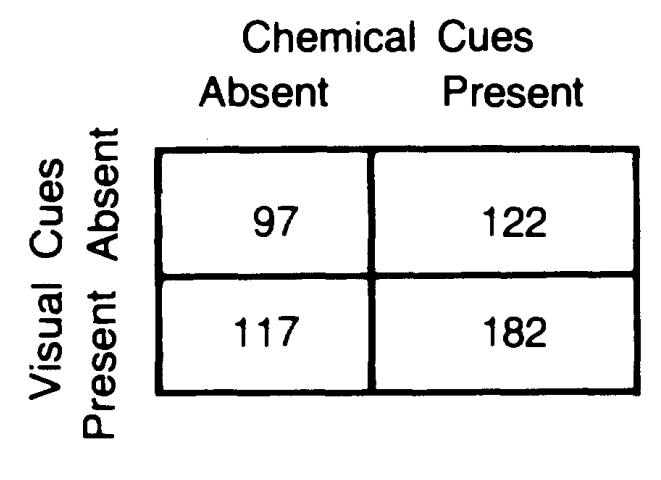
All 4 stimuli were higher than disturbance control, the visual & chemical cue were significantly higher than the others while visual and chemical cues individually were not different from one another.
Discussion:
First these findings suggest that the snakes did investigate all the stimuli. The tongue flick rate was also similar when presented with a cue even individually which means that each of these cues elicits generally the same response. However the effects of these cues are additive because when presented together they produce a significantly higher tongue flick rate. Also personal observation was that the snakes opened their mouths for attacks only when chemical cues were presented.
Experiment 2
Method:
6 rattle snake subjects of two species of Crotalus v. viridis (juveniles were also used). Same methodology was used, but given the physiology of rattle snakes the cues from 3-5 can be perceived as visual-thermal cues and visual-thermal cues plus chemical cues. Must take into account that the experiments were conducted during the photophase to replicate the garter snake portion, however rattle snakes are crepuscular or nocturnal.
Results:
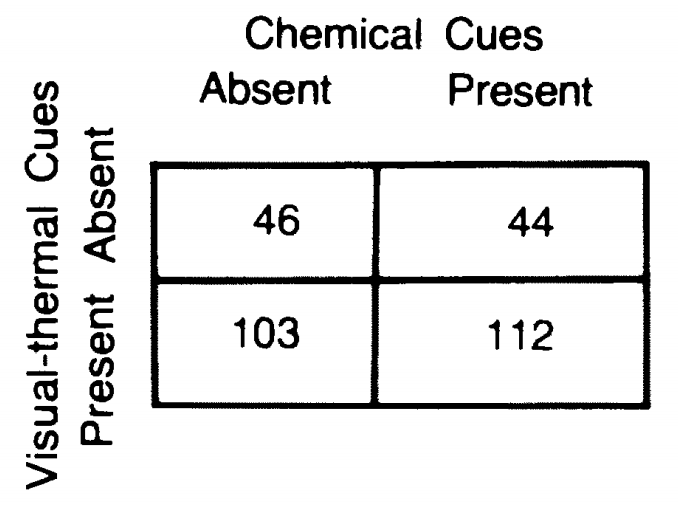
The main effect of having visual-thermal cues had a significant effect on the findings. On average when chemical cues were present (44) or absent (46) they were relatively the same when visual-thermal cues were not present, which is still significantly higher than the first 5min of the trial when no stimulus was added to the enclosure. The visual-thermal cues elicited a response of 103 when and 112 when chemical cues were absent and present respectively, which is significantly more than chemical cues.
Discussion:
These findings align with evidence found by other studies where rattle snakes did not respond much to just chemical cues in the absence of other stimuli. The exception is when the snakes are starved for a large amount of time like a month, in which lingual response increases for chemical stimuli. However, visual-thermal cues seem to be more preferred by rattle snakes given their proclivity for increased tongue flick rate. In experiment 3 they tested whether the snakes would respond better to chemical stimuli after being exposed longer to the visual-thermal cues, maybe habituating them to the visual cues would make them explore the chemical cues more.
Experiment 3
Methods:
N= 12, ingestively naïve 10 day old rattle snakes were used. The same methodology as experiment 2 was used except the trial duration was 15min total with the first 5min just observation to record baseline and then 10min of observing tongue flick after the stimuli was added.
Results:
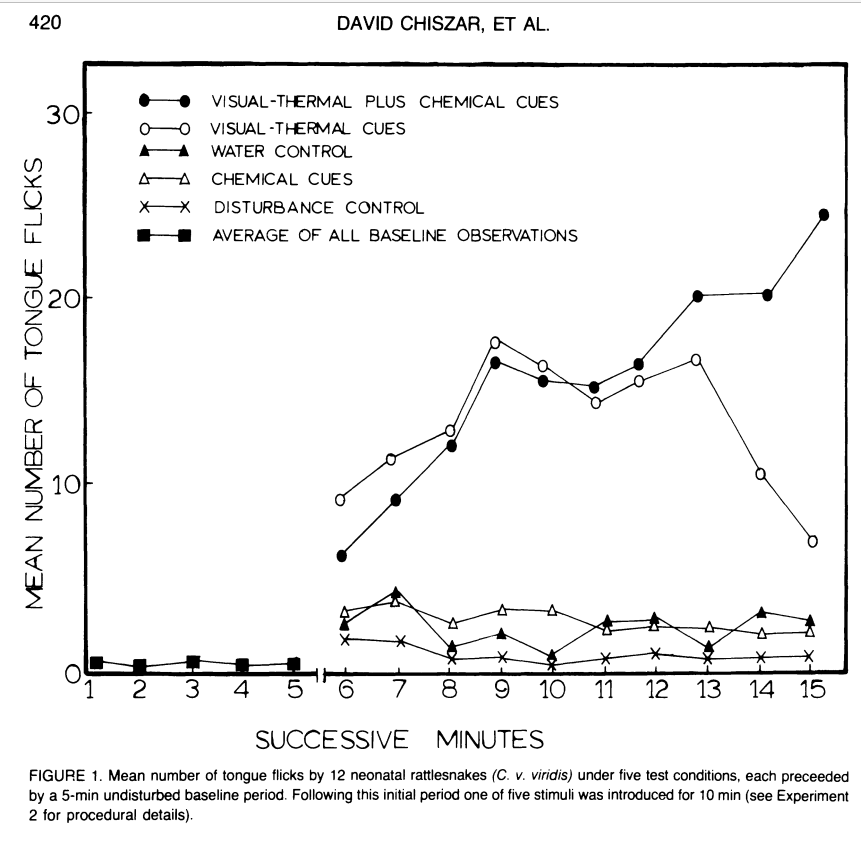
Baseline tongue flick was at 0.5, visual-thermal cues in tandem with the chemical cues were significantly higher than all other conditions, visual-thermal cues alone were higher than the other 3 conditions, and the other 3 conditions (water control, disturbance control, and chemical cues alone) did not differ from each other.
Discussion:
As assumed the visual-thermal cues are preferred to alert the snakes to prey and then tongue flick increases when chemical stimuli are available and visual-thermal cues have been habituated to. Key point is that rattle snakes, and some other snakes are ingrained to behave defensively which may disrupt chemoreception. Most snake chemoreception trials generally last a minute (I personally only used a 2 min duration for one of my olfaction experiment) which is not bad if the snake’s disposition is unlike vipers and pit vipers. Vipers and other venomous snakes may need more time to rely on chemoreception, thus several minutes may be a better trial duration to accurately observe olfaction. The chemical cues did not have an observable effect until 10minutes had passed suggesting that the behaviour observed at the initial 5 minutes (6-10min) was purely a result of visual-thermal cues. This makes sense given the rattle snake’s behaviour of striking a prey and then following it till it dies, thus when given visual cues even in the absence of a strike causes chemoreception to be activated after a set time period.
General Discussion:
These findings are fascinating and the explanation for the increased tongue flick rate after an extended trial duration as a response to chemical cues is good but there are a few arguments that oppose it. For example other studies have observed post strike chemoreception and those findings (70 flicks/min) are significantly higher than what this study observed (20 flicks/min), also rattle snakes would not be able to see a mouse this close without being able to strike, thus an unnatural scenario. As a result they note that post strike induced chemoreception and post visual cue chemoreception is regarded as different phenomena. Visual induced chemoreception might aid in stalking and may hint at the complicated predatory behaviour by rattle snakes. Rattlesnakes generally use ambush techniques, but stalking may be a secondary method of hunting. It was first thought that searching for prey was only intiated after a strike and it is a neural expression in the rattle snake nervous system as a result of chemosensory properties of a dead mouse, however this searching may be activated by other pathways and striking may not be necessary to activate prey trailing or ingestion. Alternatives may include foraging and carrion feeding.
The bigger point of this paper is that chemoreception and visual cue perception is not exclusive to specific snake types, but rather the order of use and degree of use is different b/t types. Natural selection has made it so that the snakes are best suited for their specific prey and environments thus rattle snakes reliant on ambush and natricine snakes reliant on searching have different predatory tactics. But each type also has the capability of using the others preferred method of predation, it just would be at a lesser effectiveness but further highlights the plasticity of these animals. Orthogonal combinations of cues are a good way to test this.
 Al3xandria