
THE EFFECT OF VARIED ENRICHMENT TYPES ON SNAKE BEHAVIOR – Krishnan et al., 2022
Abstract:
18 species of snakes from 2 families of colubridae and pythonidae were exposed to 4 types of enrichment consisting of humid hide, olfactory, climbing and suspended hide. Baseline observations and observations for 2hrs post introduction were conducted, there was no statistical difference b/t the stimuli but there was notable increases.
Introduction:
Snakes are hardwired for certain behaviours and the proper environment ensures they can engage in them. Therefore physical enrichment is really important for these organisms. Previous studies tend to lack the reptile welfare portion of study, however one study has shown that snakes greatly prefer larger enclosures than assumed. They make reference to the Almli paper about enrichment in rat snakes where environmental enrichment created unique behavioural profiles within subjects of a treatment. Some of the captivity related chronic stress behaviours in reptiles are increased abnormal behaviour, behavioural inhibition, vigilance behaviour, excessive hiding, fearfulness, frequency of startle and aggression. Examples of some of these are interacting with transparent behaviours, also seen as nose rubbing behaviour on flat surfaces, check the paper for more examples. This study specifically evaluates the effect of environmental enrichment on snake behaviour, not very specific.
Methods:
– Animals = 18 snakes total, 5 from pythonidae and 13 from colubridae. Specifically 7 kingsnakes, 1 cave snake, 2 reverse okeetee corn snakes, 1 bull snake, 1 milk snake, 1 rosy boa, 1 ball python, 1 mandarin rat snake, 1 hognose snake, and 2 kenyan sand boas. The main issue with this is that there are so many different snakes that occupy different environments, therefore they wouldn’t react the same to a single stimulus which would make drawing conclusions difficult. Also the snakes are a varied age and unequal male to female. Oddly all the snakes were kept at 10hrs of light and 14hrs of dark? Ball pythons and hognose snakes are on opposite activity cycles. They also did the experiment within the display enclosures b/c thats what they are habituated to which isn’t a bad idea if they emptied out the enclosure first so that they weren’t distracted by pre-existing stimuli.
– Design = lol so they didn’t remove existing stimuli, furthermore they conducted the experiment during operating hours at the zoo when people could come up to the glass. All observations happened at 9am to 12pm so the snakes weren’t given testing times based on when they are most active. Baseline recording was 3hrs conducted 6 times over a 2 week period, afterwards baseline recordings were followed by a presentation of a stimulus and then observed for another 3hrs. The snakes had 4 stimuli total and each stimuli was presented twice.
– Enrichment items = 2 categories of environmental and olfactory, the olfactory was plastic balls from a wallaby cage, no lie this seems kind of dumb just cause it could be confounding, when dealing with multiple species of snake from different geographical regions then using a an animal’s scent like a wallaby could invoke varied reactions. For environmental they were given a climbing board, suspended hide, and humid hide, where they were just introduced to the environment.
– Data collection : recordings were taken and an ethogram was used
Results:
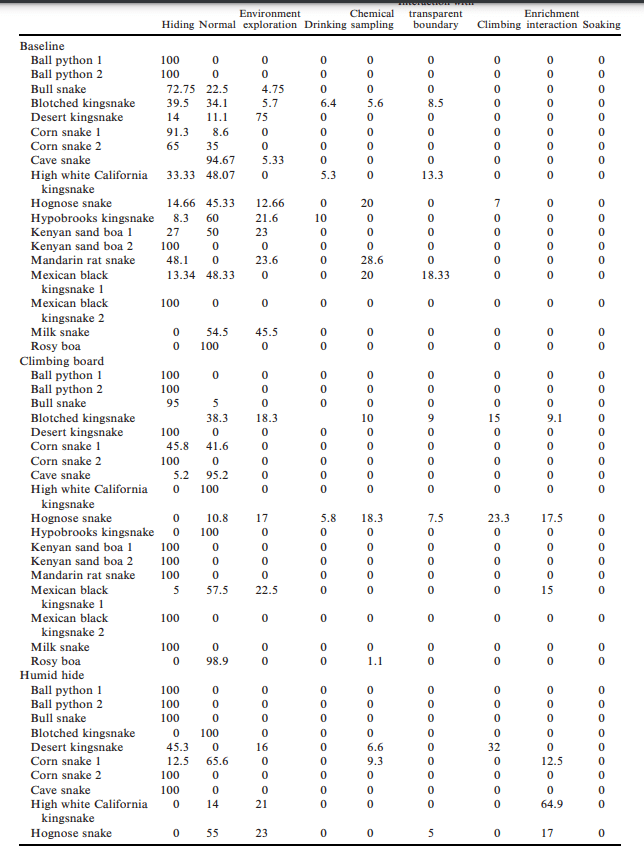
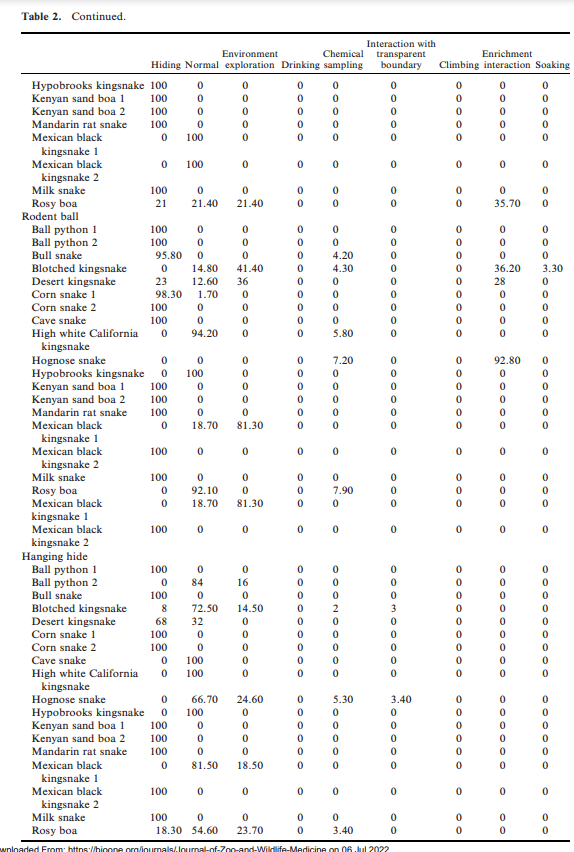
There was no statistical significant difference in behaviours from baseline to stimuli. 8/18 snakes displayed behaviours that weren’t present during baseline when stimuli was introduced, they basically break down what other snakes did but it doesn’t matter, the most useful thing is a table that they included of all the snakes so you can atleast paint a picture for each species from the small n’s.
Discussion/conclusion:
Theres just a lot in this paper that could have been controlled for and wasn’t, the discussion and conclusion is basically saying more invesgiation is needed in this topic based on overall observations of some of the snakes using the random stimuli. But we already have papers that say this and have done better work to break ground.

