
Short Communication: Rat’s Demand for Group Size – Patterson-Kane et al. 2004
Abstract:
Since social isolation can be detrimental to rat welfare, pair housing and group housing were explored. The study was conducted using the following group sizes 1, 2, 4, 6 and 12 rats. Pair housing was beneficial in reducing aggression and disease. In female rats with a stocking density of 20cm2/rat the optimal group size was 6 rats. Thus, this study suggests group housing was beneficial. Further studies are needed to evaluate the risk of disease and injury.
Introduction:
The benefits of rat social housing show decreased fearfulness and enhanced cognitive abilities. A paper from Brown, shows that a group size of 2-12 animals can be beneficial, however this needs to be replicated (Brown et.al, 1968). On the other hand, larger groups had increased disease, aggression and sometimes reduced weight gain.
This study assessed rat preference in groups of 0, 1, 3, 5, or 11 cagemeates. The stocking density was held constant and the animals used a lever to access cage options. Based on previous studies, the highest demand for 3 or 5 cagements and lowest demand for 0, 1 or 11 was anticipated (Mattheews & Laedwig, 1994; Patterson-Kane, Hunt & Harper, 2002; Sherwin & Nicol, 1995).
Method:
The two subject groups had the same equipment and housing, The subjects were all 1 year old female Hooded Norway rats that were kept in 20 x 20 x 40 cm Macrolon cages with plastic bottoms, with aspen-chips and wire mesh tops. Four subjects experienced all of the conditions whereas six subjects were placed in 0 and 3 rat conditions. The subjects were kept in a colony room on artificial 12 hours light/dark cycles, controlled temperature of about 22℃ and relative humidity of about 50%.
An apparatus was used to control a lever that operated using a Pascal software that scheduled experimental effects. There was a response chamber that had a lever and a light, which was lit when more lever presses were needed to open the door. Attached to the response chamber there was a 20 x 20 x 45 cm wooden tunnel that connected to a cage that had the resource evaluated. The tunnel was separated by a cantilevered door that opened when rats pressed the lever a designated number of times. There was a pressure plate at the end of the tunnel that turned on a timer and reclosed the door for 5 minutes.
The rats were trained to press the lever and travel through the tunnel and were rewarded with chocolate chips. The rats were assessed daily for 90-minutes and if they pressed the lever the designated amount of times they then had access to the resource in a standard cage. After each session, the designated amount of lever presses increased by 10 until the rats didn’t press it the required amount times within the allocated 90 minute time frame and couldn’t make it to the resource. The test was done three times per group size with a total of 15 times per subject.
The actual lever presses for each session were plotted versus the lever presses required using a Sigmaplot software to see the relationship of the response rate and price (the price being the amount of lever presses required).
Results:
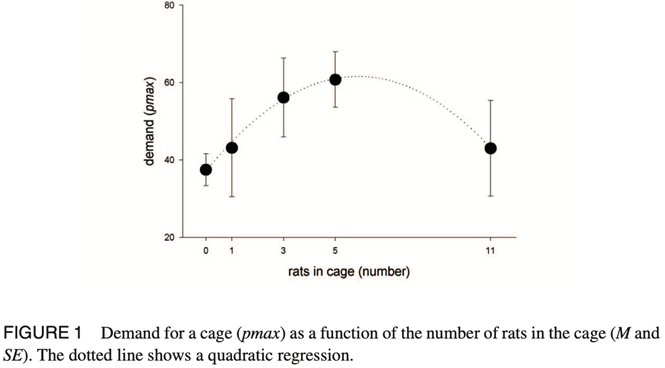
The greatest demand was a group size of 6 as shown in the figure below. Also there was an increase in demand for group size from 0 to 6.
Discussion:
According to the results, the rats preferred small groups and to narrow down the best group size, further tests using a wider group size range is needed. The rats in the larger group of 12, were less fearful and better maze runners than the other groups of 1, 2 or 4. On the contrary, smaller groups had better growth rates and lower mortality. The drawbacks of larger group sizes are linked to higher stocking densities, thus to really see the effects of group size on welfare a controlled study with consideration of sex and cage design is needed. To start, observing growth rates and health in lab rats and breeding facilities that use single, pair and group housing would be beneficial.
Since this study only used a small amount of female rats and only 90 minute sessions further studies need to be done. The advantages of group housing can depend on other factors like sex, strain, mixing frequency and housing/handling conditions. From other literature, small groups of 3-6 animals were recommended so aggression and disease can be monitored.
 Al3xandria