Developmental Social Isolation affects adult behavior, social interaction, and dopamine metabolite levels in zebrafish – Shams et al. 2017
Introduction
- Social isolation early in life can have numerous negative impacts in adulthood like altered behavioural, physiological and neural development
- It is hard to find a subject to use that will not confound the effects of maternal care as this would be a social influence. Snakes are great for this because there is no maternal care required. Zebrafish also do not need maternal care
- A typical characteristic of zebrafish is shoaling where the fish form a tight group, mainly used for predator avoidance. This behaviour occurs after 7 days old and gets stronger with age. This behaviour also increases brain dopamine levels. In zebrafish, early social contact can impact aggression towards shoal mates and frequency of leaving the shoal
- The presence of visual and odour cues of social stimuli in the environment early in life may be critical for appropriate ontogenesis of social behaviour. When zebrafish are raised with siblings for the first 7 days of life, they can recognize kin via odour cues while isolated fish could not. Early contact with shoaling fish with specific pigments creates a preference for that pigment later in life.
- Isolated fish may not associate conspecifics with reward because of changes to the reward pathways that work with dopaminergic system.
- In normal adult zebra fish, dopamine and DOPAC lvls rise rapidly in response to social stimuli, and that influencing these analytes with chemicals can affect shoaling response.
- Early social environment may also influence non-social behaviours. For example isolated zebrafish move less than zebrafish raised socially.
- This experiment focused on socially isolating zebrafish from hatching and had groups of short term isolation (Day 0-7), long term isolation and socially reared. They assessed changes in locomotion, and open field responses related to anxiety across development. They also observed shoaling behaviour and the whole brain for dopamine, serotonin and other metabolites.
Methods
- Subjects – 80 animals were used for this experiment but only 45 were recorded, does this mean that they randomly chose which social fish was going to be observed? n=15 for each group
- Developmental isolation and experimental groups – long isolation was 0-180days, short isolation was 0-7days and social experience from 8-180 days. Socially reared control fish were kept in groups of 5. Isolated fish were kept in 1.4l tanks while socially reared fish were kept in 2.8l tanks. Is there a problem with the fact that socially reared fish did not experience the same level of space as isolated fish were singly housed in 1.4l while social treatment was 5 fish in 2.8l? Isolated fish did not have visual, olfactory or tactile cues from other fish. They could not identify sexes of fish prior to placing in treatment but ended up being evenly distributed, incredibly lucky.
- Behavioural apparatus and testing – All experiments took place between 1000h and 1600h, and fish were tested on Day 10, 30, 60, 90, 120, 150, 180. A cool part was that they tested the fish in equivalent arenas along development so arenas got bigger as fish matured. The open field observations were done by using 50% of water from the home tanks and testing sessions lasted 30min. From open field, distance traveled, thigmotaxis and number of entries into center were taken.
- Behavioural apparatus and testing – Shoaling was tested at Day 185 in a large open field where groups of 5 fish which is similar to the social condition fish, are placed in the center of the testing tank. Social fish were tested with fish from other social tanks, and isolated fish were tested with other isolated fish. They used inter individual distances and nearest neighbor distance as measures of cohesion in shoaling. It might have been cool if they also observed locomotion and thigmotaxis.
- Neurochemical quantification – each brain was centrifuged after shoaling and assessed for dopamine, serotonin and other metabolites.
Results
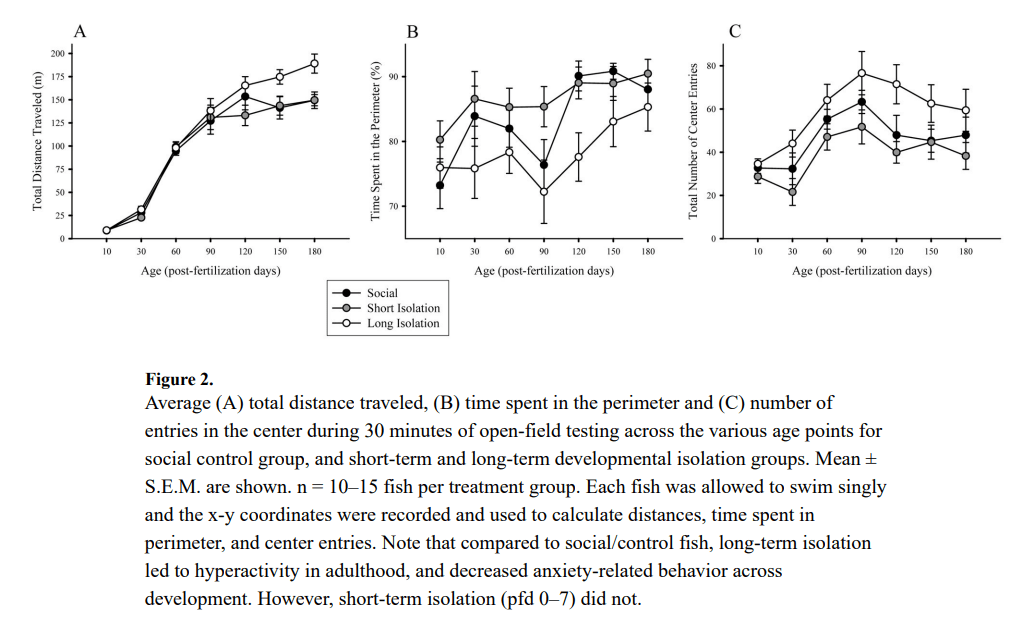
- Effects of isolation and age on open field – Fish travelled longer distances as they matured and the three conditions created fish that behaved differently at different ages. Long term iso fish traveled significantly more distance than fish from control or short term iso. At Day 120 the long term iso fish spent significantly less time with thigmotaxis compared to the other groups. At Day 120 the long term iso group made significantly more entries into the center compared to other groups. These effects were transient as they were not exhibited in days before or after.
- Effects of social isolation on temporal changes in locomotion – Isolation did not affect activity levels in the open field on all days except for Day 180.
- Social isolation on thigmotaxis and center entries – No effects of isolation on this except for Day 120.
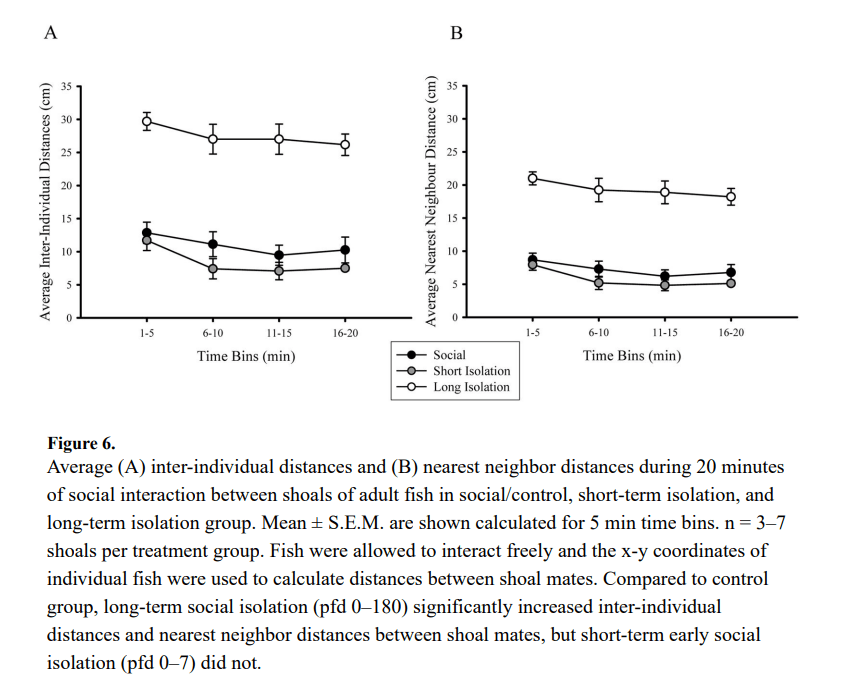
- Social isolation on shoaling – Shoal cohesion was significantly reduced in long isolated groups and they were very far from neighboring fish compared to other treatment groups
- Social isolation on physiological components – No effect of isolation on dopamine levels, however the dopamine metabolite DOPAC did. Both short and long term isolated fish had significantly reduced DOPAC levels.
Discussion
- The early social environment can have lasting impacts on brain function and behaviour. For example, animals deprived of early social contact show hyperactivity, increased impulsivity, altered reward processing and social deficits. Physiological changes include alterations to HPA, sensitization to drugs of abuse and altered neural plasticity
- First time to show that long term isolation in zebra fish can cause hyperactivity, reduction in anxiety responses, disruption of shoaling, behavioural changes, and reduced DOPAC levels. Behavioural changes seen in long term isolation fish were not seen in short term, but DOPAC levels were lower for this group as well. This indicates that even though behavioural differences were not seen, even a short 7 day duration during early development can lead to lasting functional changes in the brain. It also suggests that the behavioural changes seen in long term isolated fish are not solely because of DOPAC.
- Long term isolation on behaviour – This was found to cause hyperactivity which was seen with the more distance traveled. Similar findings were observed in rats, and early isolation with rats also induced behavioural impulsivity in adults. In rodents, social isolation also elevates anxiety, however in zebrafish they found that it actually reduced anxiety along different measures. I believe this is because of social environment matching, where the social isolation is actually very similar to the open field test which may have resulted in reduced anxiety. Another study showed that long term isolation in zebrafish did not affect cortisol levels, indicating it may not be stressful.
- Long term isolation on behaviour – Shoaling is mainly used as predator avoidance, and long term isolated fish showed decreased cohesion in shoaling and increased neighbour distances. This was perceived as reduced anxiety type behaviours, however I believe it may be the opposite. Given that these fish were isolated for a long period of time, they may be actively avoiding neighbour fish because of stress. I wonder if we would have seen a difference if they took into account thigmotaxis and locomotion during this parameter if we would have seen anxious changes. Their final point for this paragraph was that isolated fish are not stressed, I don’t think this is the case.
- Short term isolation on behaviour – There were mostly no significant differences between this group and control. They propose that resocialization after the 1 week of isolation could have reversed the isolation induced behavioural changes.
- Effects of isolation on neurochemicals – The level of DOPAC was significantly lower in both isolated groups and to the same degree. This occurred even though dopamine levels were similar, indicating that the metabolism of dopamine was significantly reduced in isolated groups, and this was taken as a sign of blunted dopaminigeric neurotransmission. This system is closely linked with motivation and motor function, therefore if this system is impaired as a result of social isolation, there would be alterations in motivation to shoal or explore amongst other behavioural changes.
 Al3xandria