Early social isolation disrupts adult personality expression in group-living mites – Schausberger and Nguyen, 2024
Introduction
- A critical social condition is whether or not newborns experience conspecifics during their early development
- If social isolation occurs very early in life, this can have dramatic adverse impacts on behavioural, physiological and other serious implications
- For example, social isolation affects energy homeostasis and causes oxidative stress that shortens the lifespan of certain ants, it destabilizes brain development in bumblebees and causes avoidance of social contact in mites and zebrafish.
- In humans, social isolation can have a critical influence on personality
- Personality in animals is assessed by seeing if they are repeatable in their behaviour and whether this repeatability is consistent within individual across time and context but variable between individuals.
- 5 major behavioural axes to describe personality, activity (movement in a familiar environments), aggressiveness (hostile towards conspecifics), boldness (risk-taking behaviour in familiar environments), exploration (tendency to explore novel environmental features), and sociability (tendency to associate with conspecifics)
- The early postnatal period is a highly critical and sensitive window in an individuals life
- This paper’s prediction was that early-life social isolation can impair behavioural repeatability when conspecifics are present, meaning it disrupts personality expression later in life. They tested this with predatory mites by group housing and socially isolating subjects from birth and then conducting personality assays.
Methods
- Early life treatments – they assayed the behaviour of P. persimilis females that were either reared in a group or socially isolated from birth, meaning as eggs they were placed in these conditions.
- Behavioural assays – Each female experienced 4 group assays in which group assays were divided into 2 types. They were either mixed groups of isolated and socially reared and pure groups where the group was solely made up of a single treatment type. Groups were made up of 6 mites at a time. The assays included placing the subjects into an arena and allowing acclimation for 5 min and then behaviour was taped for 5min. The first and third assay were mixed groups and second and fourth assays were pure groups. Interval between group assay was 1-2 days. Repeatability in activity was done by observing the subject in home enclosure 3 times over an hour span each on 5 different days both before and inbetween group assays.
Results
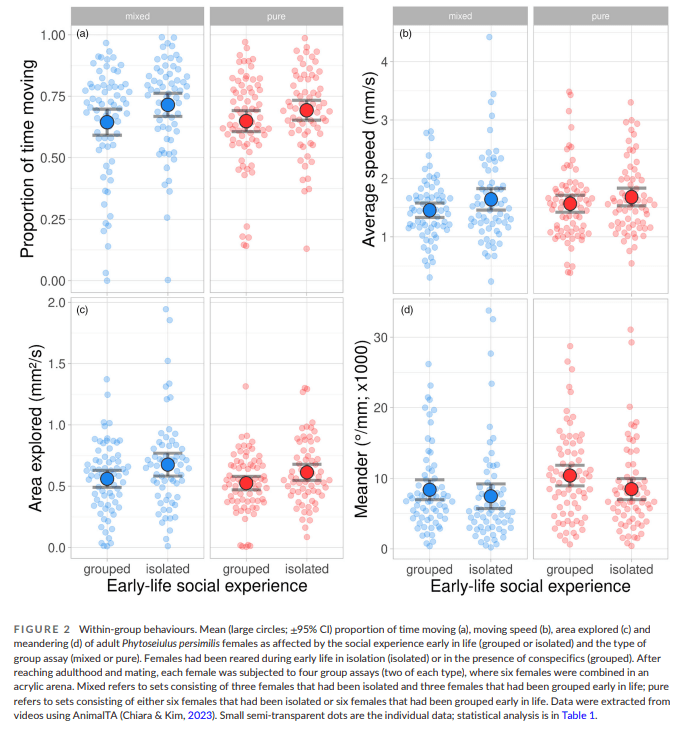
- Grouped females were less active, moved at slower speeds, explored a smaller area, meandered more and kept shorter distances between other group members compared to isolated females
- Mean moving activity did not significantly differ between treatment groups
- Grouped females showed repeatability in 5/7 behavioural traits measured while isolated females were only repeatable in the measure of “number of neighbors they are close to”
- Grouped females were repeatable in activity when measured in the group assay but not when alone, while isolated females were repeatable in activity when they were alone and not in a group
- The social environment of male mates influenced the personality expression of females. Specifically 4/7 traits measured in the group assays were repeatable in females that were mated to isolated males but none were repeatable in females mated to socially reared males.
- Moving activity measured when alone, was highly repeatable for females that mated to an isolated male, but was not repeatable in those mated to a socially reared male
Discussion
- Early social isolation has profound effects on personality expression of adult predatory mites. The results of this study indicate that early social isolation can be disruptive to how mites behave within groups
- On average, socially isolated females were more restless, ran more quickly, explored a larger area, meandered less, had fewer close neighbours, spent less time with close neighbours and kept larger inter-individual distances than socially experienced females. When assayed in groups, adult females showed repeatability in activity, moving speed, meandering, area explored and inter-individual distance. In contrast, when the mites had been deprived of any social contact early in life, adult personality expression was disrupted in the presence of conspecifics, and the above-listed traits were no longer repeatable
- Early social environment had a strong effect on female personality but not on mean trait expression.
- Mating with socially isolated males strongly increased behavioural repeatability of socially experienced females
- The lack of repeatability displayed by isolated females in group settings does not indicate detrimental when taken individually, but indicates that the presence of conspecifics is a stressful experience which affects social homeostasis
- The increased locomotion and speed are seen as hyperactivity and is also seen in socially deprived rats and angelfish
- Socially reared individuals were highly repeatable in group contexts while isolated individuals were repeatable in individual contexts.
- Early social experience increasing repeatability supports the idea that social interactions within groups are major drivers of individualized social niche formation. However the fact that isolated subjects were repeatable when alone seems to counter this point.
- Matching social environments from early life to adult personality assays is a possible reason for the high repeatability in specific contexts. Studies have shown that experiencing altered social environments promotes behavioural plasticity while consistent social environments promotes behavioural consistency.
- Personality can change with major life history events like developmental transitions and maturation
- Isolated male mites initiated mating quicker than socially reared male mites. They also induced high repeatability with socially reared female mites but not with isolated female mites. Females may have identified the isolated state of the mate as meaning there are no alternative males or healthy males are few in this environment. This could cause high repeatability as females want to reproduce and with no expectation to mate a again they become more consistent in their behaviour. Some mechanisms in which this could have been identified is with chemical signatures, body odours and behavioural traits of the isolated male mites.
- Having different personality types within a group is beneficial as it reduces inter-individual conflict as different personality types occupy different social niches.
 Al3xandria