Personality expression is shaped by the early experienced social context in predatory mites- A commentary on the Schausberger and Nguyen, 2024 paper by Chiara, 2025
As this paper is a commentary on a previous paper, there are no subheadings thus this post will mainly be bullet points
- The first researcher who may have studied personality was probably Pavlov as he identified temperaments among the dogs he studied
- The definition of personality is commonly known as individual differences in behaviour that are consistent both across time and context. Personality has been observed in numerous animal models, including invertebrates
- Factors such as environmental changes or experience/learning are known to later impact personality
- The consistency of personality traits between early life and later in life seem to be species-dependent and are potentially linked to the lifestyle
- Some older studies have shown that stress like predation risk or food limitation experienced early in life could favour the expression of personality by reducing within-individual variations in behaviour
- Social deprivation experienced by gregarious/social animals in early life can impact behavioural traits seen later in life
- The specific study the commentary is on focused on plant-inhabiting mites that were kept either isolated or in groups, this is a good model for this question because they are social but do not rely on social context for survival. This is great because then being in isolation or in a group are both biologically relevant
- The study found that early isolation in female mites created more active but less social individuals, which suggests that social isolation can significantly influence animal development in a species where social context is not required. This is good to include in my own charging paper from Year 2 as we found that socially housed western hognose snakes were more repeatable in personality in an isolated context even with physiological manipulations while isolated snakes were not. And these snakes were thought to be asocial, further reinforcing the fact that social isolation can have a tremendous impact on personality even in an asocial species.
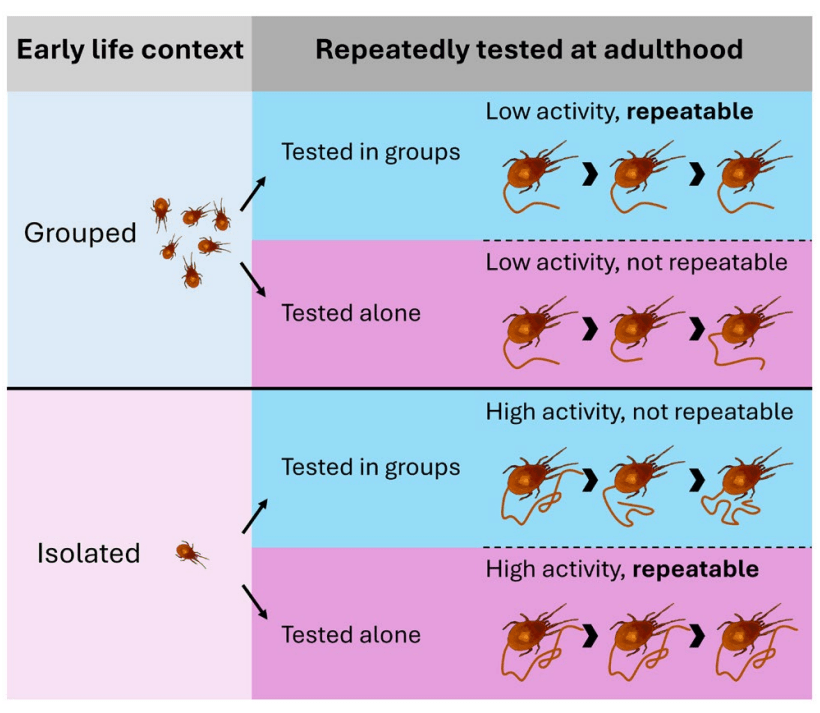
- The study also found that mites were more repeatable when environment matching occurred, meaning that the context in which they were tested, if it was similar to the context in which they grew up in, they showed high repeatability. This is exciting as it shows that earlier experience in life could reinforce/reduce the expression of personality depending on context
- Female mites that mated with isolated mites became more repeatable in personality, whether they were from social or an isolated context. A reason for this given in the original paper was that the isolated males may give signs that there are no other males in the area, making females more inclined to mate with isolated males and become repeatable in their behaviour.
- Statistical issues: This commentary says that the use of ICCs have raised criticism, however measuring repeatability is complex and they believe that the findings are probably robust even with other statistical methods
- The reason early life experience may affect later personality may be because it is adaptive, in the sense that early life experiences may predict what is expected to come later in life.
- Lastly this commentary highlights that more studies should look at testing animals in different contexts when observing personality as the expression of personality may be context dependent.
 Al3xandria