Personality and behavioural syndromes in two species of fruit bats (Chiroptera: Phyllostomidae) – Miguel et al., 2024
Introduction
- Evolution of behaviour works best when there is a wide variation in strategies used by individuals because this flexibility allows for populations to adapt better to environmental fluctuations
- Animal personality – defined as consistency of an individuals behaviour over time
- Different personality traits have different benefits, bolder and more active individuals are key for dispersion and establishing new populations which increases genetic diversity
- Behavioural syndrome – when two or more personality traits are correlated within a population
- Boldness to shyness personality trait – observes the propensity of an individual to face risky situations, sometimes measured by their reaction to proximity of predators
- Activity personality trait – this observes an individual’s propensity for locomotion in an environment
- Docility personality trait – refers to an animals tendency to remain calm and submissive when physically restrained, but can also be in respect to conspecifics and environmental stimuli. This is tested by sometimes making the animal immobile by placing it in a handling bag.
- Personality traits interacting with one another creates unique individuals, for example some individuals that are less docile may be better at securing food sources that are rare because they dominate in intraspecific competition. But this heightened energy spending from being more aggressive could cause for tradeoffs later in life.
- An example of a behavioural syndrome with personality traits interacting, is one of decreased docility that coincides with greater boldness results in a unique behavioural pattern that could affect the survival of individuals through acquisition of resources and territory
- Another example of behavioural syndrome is when reduced activity may reflect a cautious nature when exploring a new environment as seen in various species that adapt to avoid predation based on vegetation structure of a given habitat
- This study proposes multiple hypotheses – The first is that the traits of docility, activity and boldness are present in bats, A. lituratus and C. perspicillata. The other hypothesis is that these traits correlate in some form, one prediction was that there would be a positive correlation between boldness and activity as bolder individuals tend to explore more. They also predicted a negative correlation between activity and docility given that more active individuals would encounter conspecifics and predators more than inactive individuals.
Methods
- Capture – 6 mist nets were used to capture wild bats, in which 27 adult males of each species, A. lituratus and C. perspicillata, were captured. After the initial docility test, the animals were moved to a lab and were kept in individual tanks for 48hrs prior to the other tests.
- Docility test – Immediately after capture the animals were placed in a handling bag and a docility test was performed in which the animal was observed for 180s for how much it moved within the bag. After 48hrs in the lab after this test, another docility test was performed before starting the other tests. It would be surprising to see high repeatability between these cause the context seems so different, the first time is when the animal is freshly caught, the other time is when its been 48hrs in the lab.
- Activity test – Animals were placed in an open field test for 30min where movement was observed via video.
- Boldness test – Boldness test after the activity test, the animal was placed in the home cage and a food bowl was provided while a human observer was close by and boldness was measured as time to eat/approach the bowl in this context. The duration was 5min.
Results
- Docility was highly repeatable in both species, both above 0.6 (quite high, especially for docility given the difference in context)
- Activity was highly repeatable
- Boldness was highly repeatable
- The weird part is that 27 adult males were captured for each species yet the n for each test is not 27, why were some animals randomly excluded?
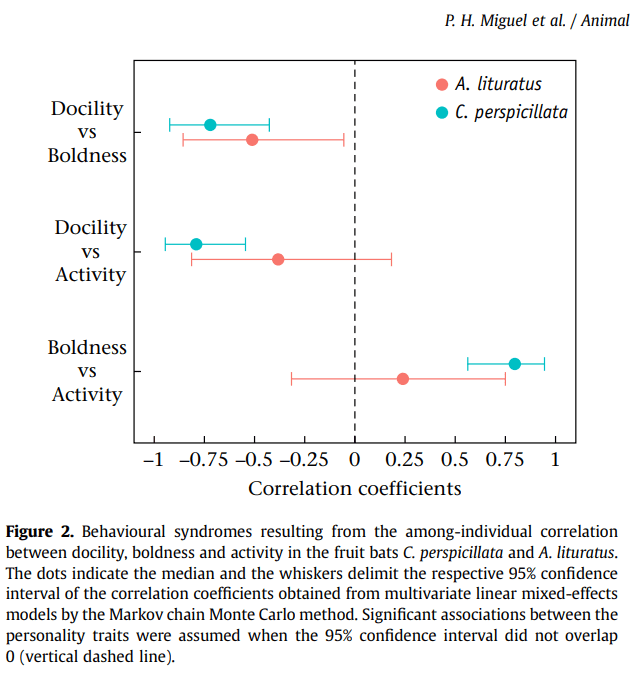
- Positive correlations – positive correlation for both species between boldness and docility. Activity was positively correlated with boldness for C. perspicillata and not the other.
- Negative correlations – Activity was negatively correlated with docility for C. perspicillata and not the other
Discussion
- All three personality traits showed high repeatability indicating that they are personality traits of these bats
- Some behavioural syndromes were found and they were unique to the species in some cases. Docility, activity and boldness were correlated for C. persp while boldness and docility were correlated for both species
- One reason for why boldness and docility were correlated is because of antipredator responses in which bolder animals needs to be less docile to thrive in the presence of predators and competitors, while less bold animals tend to use evasive behaviours instead to avoid risks. In these situations bolder individuals could have a competitive advantage leading to increased survival and reproduction.
- A reason for why there are differences in behavioural syndromes between the two species may be because of ecological and behavioural preferences. C. persp is dominant in fragmented areas which may have more selective pressures for dealing with increased predation risk. A. litur while capable of dominating fragmented areas, also dominates other environments meaning that behavioural flexibility may be preferred. Also higher activity levels would demand for greater docility because they may engage with more potential threats as is the case for C. persp, while A. litur is found in multiple types of environments and not just fragmented ones. As A. litur shows high plasticity and variation in activity levels independent of the other traits, may show behavioural flexibility which would be useful when occupying multiple types of environments
 Al3xandria